Overview
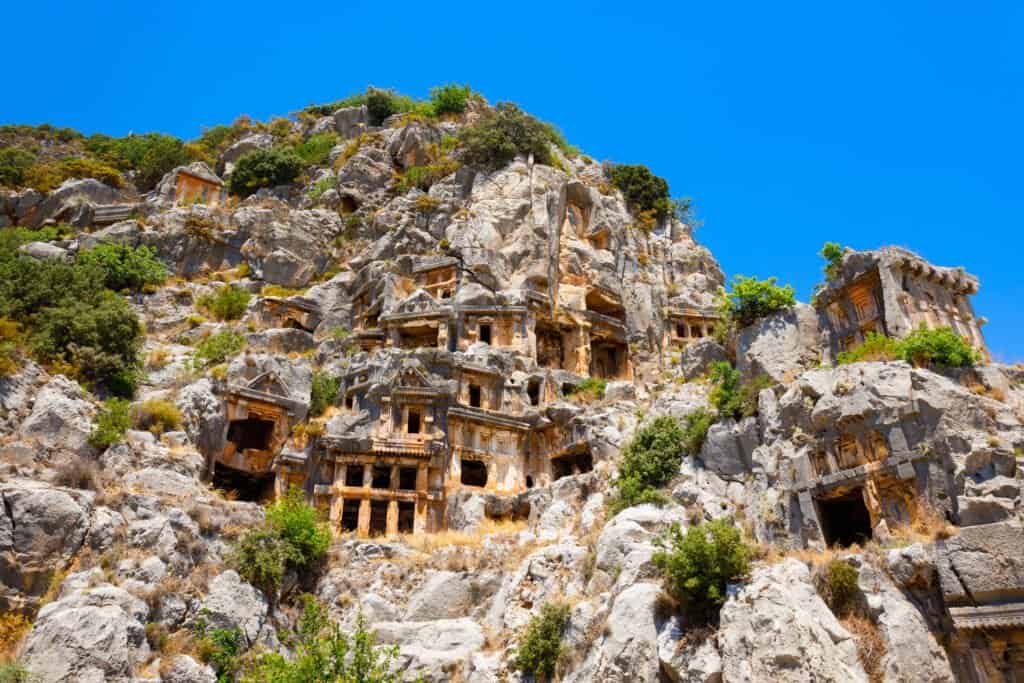
You climb the slope toward Myra and the rock tombs announce themselves first, carved directly into the cliff face like a vertical necropolis. The tombs are weathered but unmistakable, their facades still bearing the faint marks of doorways and decorative relief work. Below them stretches the remains of a Lycian city that rose to prominence around the 5th century BC and never quite left, even as empires changed hands and the harbor silted up. What you're standing in now is the accumulated stone of roughly 1,200 years of habitation, conquest, and gradual decline.
Why this place matters
Myra was one of the most important cities in ancient Lycia, a region that occupied the southwestern coast of what is now Turkey. The site mattered enough to warrant the attention of major powers: Romans, Byzantines, and later Arab raiders all took turns controlling or raiding it. The city became significant in early Christian history as the seat of a bishop and the legendary home of Saint Nicholas, the figure who inspired the modern Santa Claus tradition. When you walk the excavated streets and stand beneath the theater, you're moving through layers of Lycian, Greek, Roman, and Byzantine occupation.
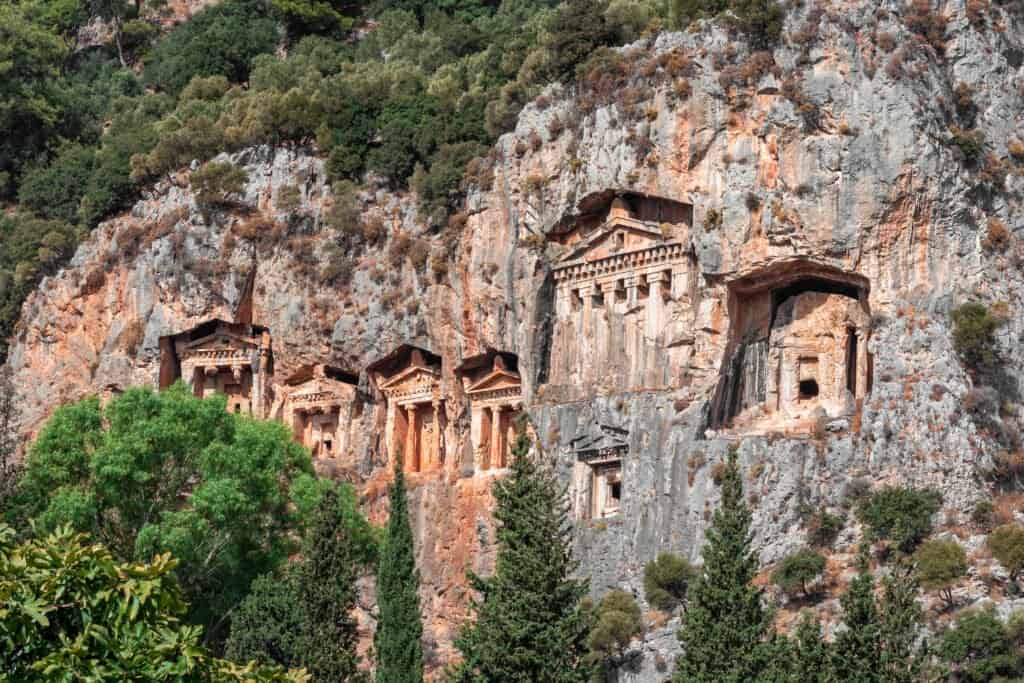
The rock tombs themselves represent a distinctive Lycian practice. These weren't modest burials; they were architectural statements carved into cliff faces, some with elaborate facades that mimicked the design of houses. The practice tells you something about how the Lycians understood the relationship between the living and the dead, and between permanence and the ephemeral city below.
Quick facts
- Located in Demre, Antalya Province, approximately 140 kilometers southwest of Antalya city center
- The site dates primarily to the 5th century BC through the Byzantine period
- Approximately 29 Lycian rock tombs are visible, carved into the cliff face above the lower city
- A theater with a capacity of around 11,000 spectators remains partially excavated
- The site received UNESCO World Heritage status as part of the Lycian Sites in 1988
- Open-air site with no fixed closing time; best visited during daylight hours
- The site encompasses both the lower city ruins and the upper necropolis
Getting there
Myra sits on the outskirts of Demre, a small town about 3 kilometers inland from the Mediterranean coast. If you're driving from Antalya, the journey takes roughly 2.5 to 3 hours heading southwest along the D400. The road is well-maintained and clearly marked. Dolmuş minibuses run from Antalya to Demre throughout the day, though schedules are less frequent in winter. From Demre town center, you can reach Myra by local taxi or dolmuş, a 10 to 15-minute ride depending on traffic.
The ruins are not within walking distance of Demre's central streets, though the approach road from town is straightforward. There is a small parking area near the entrance to the lower city excavations. If you're visiting multiple sites in the region, Myra pairs well with the sunken city of Kekova, which lies about 20 kilometers away, or the Church of Saint Nicholas in Demre town itself.
The layout and experience
The site divides into two distinct zones. The upper necropolis consists of the rock tombs carved into the cliff face, accessible via a path that climbs steeply from the lower level. The tombs face outward toward the sea, their facades weathered but still bearing traces of carved details. Some feature pediment designs that echo the architecture of temples or houses. Walking among them gives a sense of how Lycian elites wanted to be remembered, positioned above the living city and oriented toward the horizon.
The lower city contains the excavated remains of streets, structures, and the theater. The theater is the most visually striking feature, its stone tiers still largely intact despite centuries of neglect and earthquakes. From the upper rows you can see across the valley and understand how the city was positioned relative to its harbor (now far inland due to silting). Other structures are less dramatic but reveal the city's layout: you can trace what were once streets, and fragmentary walls indicate where houses and civic buildings once stood.
The scale of the site is manageable. Most visitors spend between 1.5 to 2.5 hours exploring the full area, including a climb to the upper tombs and time to sit in the theater. The terrain is rocky and uneven, with some steep sections on the path to the upper necropolis.
Main highlights
The rock tombs are the primary draw. The largest and most elaborate ones feature carved facades with Lycian inscriptions, though many are heavily weathered. The architectural variety among them is worth noting; some are simple rectangular chambers, while others feature decorative elements that hint at their occupants' status. If you have any interest in how ancient societies honored their dead, these tombs repay close observation.
The theater commands attention as soon as you enter the lower city. Its stone is a warm tan color, and the seating arrangement is still legible despite damage. Walking down to the orchestra and then up to the upper tiers gives you a visceral sense of its original function. The view from the top tier, looking back toward the cliff face and the necropolis above, is one of the most photogenic moments on the site.
The inscriptions scattered across various structures offer another layer of interest if you have a guide or reference material. Some are in Lycian script, a writing system that predates the Greek alphabet in the region. Others are in Greek or Latin, reflecting the later periods of occupation. These texts are often the only direct testimony to who lived here and what they valued.
History and background
Lycia was a distinct cultural region in antiquity, occupying a stretch of coastline that favored independent city-states over unified empire. Myra rose to prominence during the classical period and became one of the six most important Lycian cities by the Hellenistic era. The city maintained its significance through the Roman period, when it was incorporated into the Roman province of Lycia and Pamphylia. Coins and inscriptions from this period are common finds on the site.
The transition to Byzantine rule brought Christianity to Myra with particular intensity. In the 4th century AD, the city's bishop was Nicholas of Myra, a figure whose legend grew steadily over centuries. He became venerated across the Christian world, and his association with Myra contributed to the city's continued importance even as its economic and political power declined. When Arab raids intensified in the medieval period, Myra's vulnerability to attack (so close to the coast despite being inland) hastened its final abandonment.
The harbor that once connected Myra to maritime trade gradually silted up, a process that accelerated after the city stopped maintaining the channel. By the time of the Ottoman conquest in the 15th century, Myra was already a ruin. Systematic excavation began in the 19th century and has continued intermittently since, revealing the structures you see today.
Tickets and entry
Myra operates as a ticketed archaeological site. Entry fees are modest, with standard admission rates for adult visitors and reduced rates for students and children. A single ticket grants access to both the upper necropolis and the lower city excavations. There is no time limit on your visit. Guided tours are available through local operators in Demre, and hiring a guide for 2 to 3 hours will enhance your understanding of the site's layout and history significantly.
Best time to visit
The site is open year-round, but the experience differs with the seasons. Late autumn through early spring offers the coolest temperatures and lowest visitor numbers. Summers are hot and dry, with daytime temperatures regularly exceeding 30 degrees Celsius. The sun exposure on the site is intense, with minimal shade available. If you visit in summer, arriving early in the morning or later in the afternoon will make the experience more comfortable.
Spring and autumn are ideal. The light is softer, the heat is manageable, and the landscape around the ruins shows more variation. Winter months are generally mild in this region, though occasional rain can make some paths slippery. The wildflowers that bloom in spring add color to the rocky terrain surrounding the site.
Photography tips
The rock tombs photograph best in late afternoon light, when the sun rakes across the cliff face and accentuates the carved details. Early morning light is softer and less dramatic but still strong enough to reveal texture. Shooting from the lower city toward the necropolis above creates a natural compositional hierarchy.
The theater benefits from shooting from within the seating area, looking toward the stage, or from the upper tiers looking back across the orchestra. Wide-angle lenses help capture the scale, but the site also rewards detail shots of inscriptions, carved relief work, and architectural fragments.
The surrounding landscape, with the valley dropping away toward the distant coastal plain, provides context. Shoot the site within its setting, not just as isolated ruins, if you want images that convey what it meant to be positioned here.
Facilities and preparation
The site has a small entrance structure with basic facilities, but there is no café or restaurant on-site. Bring water, especially if visiting in warm months. The paths are uneven and sometimes steep, particularly on the way up to the rock tombs. Wear sturdy shoes with good grip. Sun protection is essential; a hat and sunscreen are not optional in summer.
There are no rest areas or benches scattered throughout the ruins, so if you want to sit and absorb the view, the theater seating is the main option. Bring sufficient water for your entire visit. The nearest shops and restaurants are in Demre town, about 15 minutes away by car.
How it compares to similar places
Myra is one of several major Lycian sites in the region, alongside Xanthos and Letoon. Xanthos, about 70 kilometers north of Myra, has more extensive excavations and a larger museum collection but fewer rock tombs. Letoon, located near Xanthos, is smaller and more focused on a religious sanctuary. Myra's distinctive strength is the combination of the monumental rock necropolis and the well-preserved theater, plus the site's connection to Saint Nicholas and early Christianity. If you're interested in Lycian civilization as a whole, visiting multiple sites gives you a more complete picture, but Myra stands alone in the prominence of its cliff-face burials.
Combining with nearby attractions
The Church of Saint Nicholas in Demre town is less than 10 kilometers away and makes an obvious pairing with Myra. The church dates to the Byzantine period and is one of the most important pilgrimage sites in the Orthodox Christian world. Kekova, about 20 kilometers north, offers a contrasting experience: a partially submerged Lycian city best viewed from a boat, with clear water that reveals underwater ruins. The combination of Myra, the Church of Saint Nicholas, and Kekova creates a rich itinerary focused on Lycian history and early Christianity.
Sample visit plan
If you have a full day in the area, start at Myra early in the morning, spending 2 to 2.5 hours exploring the site. This timing allows you to avoid the hottest part of the day and capture the best light for photography. Bring water and snacks. After Myra, drive to Demre town and visit the Church of Saint Nicholas, which typically takes 45 minutes to an hour. Lunch in Demre afterward. If time permits and you're interested in water-based archaeology, an afternoon boat tour around Kekova can be arranged.
If you have only a half-day, focus on Myra alone, allowing 2 hours minimum. This gives you time to see the theater, climb to the upper necropolis, and observe details in the rock tombs without feeling rushed.
Practical tips
- Arrive early to beat both the heat and any tour groups that arrive mid-morning
- The path to the upper necropolis is steep and uneven; take your time and wear proper footwear
- There is no food or water available on-site; bring plenty of water, especially in summer
- Hiring a local guide for 2 to 3 hours significantly deepens your understanding of the site's history and layout
- The theater is the most comfortable place to rest and take in views; plan to spend time there
- Wear sunscreen, a hat, and light-colored, breathable clothing
- The site is open during daylight hours; check local sunset times if you're planning evening photography
- Dolmuş minibuses from Demre are inexpensive but run on irregular schedules; confirm return times if using public transport
FAQ
How long does it take to see Myra? Most visitors spend 1.5 to 2.5 hours on-site. This allows time to explore the theater, climb to the rock tombs, and observe details. A guided tour can extend this to 3 hours.
Is the site suitable for visitors with mobility limitations? The lower city is relatively flat and accessible, but the path to the upper necropolis is steep and involves uneven terrain. Visitors with significant mobility challenges should focus on the lower city and the theater.
Can I visit Myra on my own, or do I need a guide? You can visit independently. However, a guide provides context that makes the experience richer, particularly regarding the inscriptions, the site's history, and the relationship between different structures. Guides are available through hotels in Demre or local tourism operators.
What is the connection between Myra and Saint Nicholas? Nicholas was the bishop of Myra in the 4th century AD. His legend grew over centuries, and he became venerated across the Christian world. The Church of Saint Nicholas in Demre town marks the site associated with him, and the city's Byzantine importance was partly due to this religious significance.
Is there a museum at the site? There is no museum at Myra itself. Artifacts are housed in the Antalya Museum and other regional collections. However, the site itself is an open-air museum, with structures, inscriptions, and the landscape providing direct evidence of the city's history.
Opening hours
Reviews
Sign in and mark this place visited to leave a review.
No reviews yet.
Free Trip Planner
Plan your Demre trip with our free planner
Build a day-by-day itinerary with AI suggestions, hand-picked places, and friends. Free forever — no credit card.
Things to see near Myra ruins

Kaş Hellenistic theatre

St. Nicholas Church
Lycian Rock-Cut Tombs of Myra