
Old Montreal
Old Montreal, Montreal, QC, Canada
Old Montreal: Where the City's Past Meets the St. Lawrence
Old Montreal, known locally as Vieux-Montréal, is the oldest part of the city and one of the most walkable historic districts in North America. Bounded roughly by the St. Lawrence River to the south and rue Saint-Antoine to the north, it packs centuries of architecture, cobblestone streets, and working waterfront into about one square kilometer. Whether you're arriving by metro or wandering down from the Plateau, this is where Montreal stops feeling like a modern city and starts feeling like somewhere with a genuine story to tell.
Tourists come for the views and the Instagram shots. But if you give it more than an afternoon, Old Montreal rewards you with layers that most visitors miss entirely.
Why Old Montreal Matters
The French established Ville-Marie here in 1642, making this the founding site of what eventually became one of Canada's largest cities. That's not just a trivia fact. It means the street grid, the stone buildings, and even the sight lines down to the river reflect decisions made nearly 400 years ago. The neighbourhood survived waves of demolition pressure in the 20th century, and a major preservation effort in the 1960s and 1970s helped protect much of what you see today.
The result is a district where 17th and 18th century stone warehouses now house design studios, boutique hotels, and some of the city's most serious restaurants. The contrast is real and it works.
Quick Facts
- Location: Southern tip of the island of Montreal, along the St. Lawrence River
- Nearest metro stations: Place-d'Armes (Orange Line) and Champ-de-Mars (Orange Line)
- Primary language: French, though English is widely spoken throughout the district
- Best for: Architecture, history, waterfront walks, food, photography
- Accessibility: Many streets are cobblestone, which can be difficult for wheelchairs and strollers
- Free to explore: The streets and public squares cost nothing to enter
- Closest major landmark: Notre-Dame Basilica, Place Jacques-Cartier, the Old Port
Getting There
The easiest way in from downtown is the Orange Line metro. Place-d'Armes drops you directly in front of Notre-Dame Basilica on rue Notre-Dame Ouest, which puts you at the western end of the district. Champ-de-Mars opens onto the eastern edge near City Hall. Either walk takes under 5 minutes from the turnstile to the street.
If you're cycling, the city's BIXI bike-share system has stations throughout the neighbourhood and along the Old Port. Driving is possible but not recommended. Parking is limited, expensive, and the streets were not designed for cars. Walking is genuinely the best option here, even from much of downtown. On a clear day, the 15 to 20 minute walk from rue Sainte-Catherine passes through some interesting transition blocks before the architecture starts to shift noticeably.
The Layout and Experience
Old Montreal is small enough to cross on foot in about 20 minutes, but dense enough that you could spend a full day and still miss things. Rue Saint-Paul is the main commercial artery, running east to west through the district and lined with galleries, restaurants, and shops tucked into buildings that date back to the 1700s and 1800s. Parallel to it, rue Notre-Dame carries more institutional weight, passing City Hall, the courthouse, and the basilica.
Place Jacques-Cartier is the central gathering point. The square slopes gently down toward the river and fills up with street performers, terrasse dining, and visitors most days from late spring through early fall. It can feel overwhelmingly touristy at peak hours, which is fair. Go early in the morning or on a weekday evening if you want to actually look at the architecture without navigating a crowd.
The Old Port runs along the southern edge of the neighbourhood and has its own distinct rhythm. The Promenade du Vieux-Port is a paved waterfront path where locals jog and cycle, and where the view across to the St. Lawrence and the islands beyond is genuinely good.
Main Highlights
Notre-Dame Basilica
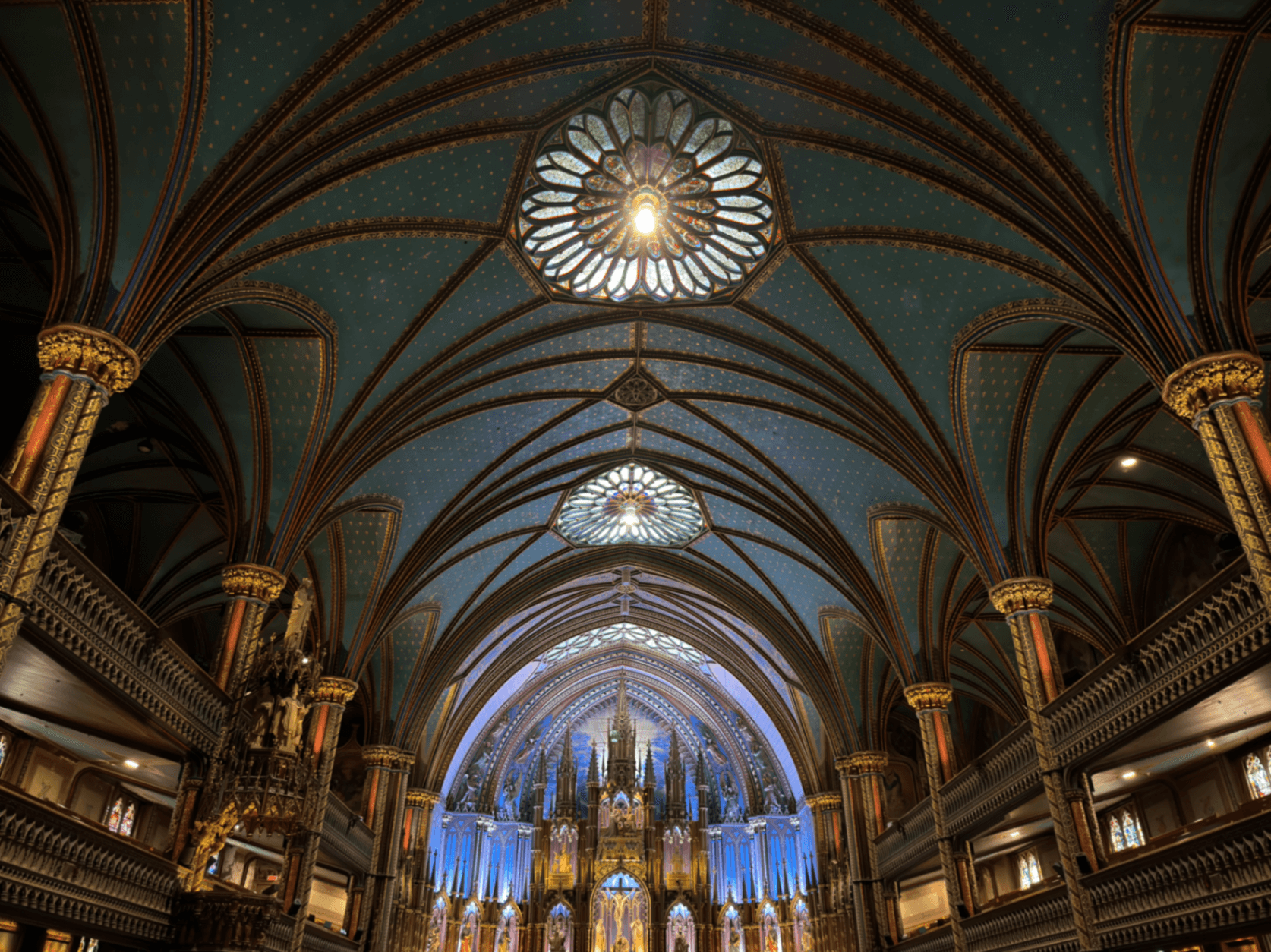
Built between 1824 and 1829, Notre-Dame Basilica is the anchor of the district and one of the most visited religious sites in Canada. The interior is extraordinary, decorated floor to ceiling in deep blues, golds, and carved wood. Entry requires a ticket, and a sound and light show called AURA runs on select evenings for a different kind of experience. Even if you've seen a lot of European churches, this one holds up.
Place d'Armes
The square in front of the basilica is one of the most photographed spots in Montreal. The statue of Paul de Chomedey, Sieur de Maisonneuve, one of the city's founders, stands at the center. The surrounding buildings represent several centuries of architectural ambition in one tight frame, from New York Life's 1888 Romanesque building to the art deco Aldred Building from 1931.
Pointe-à-Callière Museum
This is the city's archaeology and history museum, and it sits directly on the founding site of Ville-Marie. The museum is partly built over actual excavations, so you walk through layers of the city's history underground. It's one of the most intelligently designed history museums in Quebec, and worth a couple of hours even if you're not a history person.
Marché Bonsecours
The silver-domed building at the eastern end of rue Saint-Paul is hard to miss. Bonsecours Market opened in 1847 and served as Montreal's main public market and city hall for decades. Today it houses local designers and artisan shops. The building itself is worth seeing from the outside even if you skip the shopping.
Best Time to Visit
Old Montreal is a year-round destination, and each season changes the experience meaningfully. Summer brings the most activity, the most crowds, and the fully operational terrasse culture that defines Québécois warm-weather dining. If you're visiting in July or August, go early in the morning before the tour groups arrive and the cobblestones start to feel like an obstacle course.
Late September and October are probably the most pleasant weeks to visit. The tourist volume drops, the light is better for photography, and the restaurants are still running full service. Winter is genuinely cold but not without appeal. Snow on the stone buildings looks remarkable, and the relative quiet makes it easier to appreciate the architecture. Some outdoor terrasses close, but most businesses stay open year-round.
Photography Tips
The best light in Old Montreal tends to hit rue Saint-Paul from the east in the morning, which makes that stretch particularly good for walking shots before 10am. The view from the Old Port looking back toward the skyline with the dome of Bonsecours in frame is a classic, and it works best in the late afternoon when the buildings catch warm light from the west.
Place Jacques-Cartier is tricky to photograph well because of the constant foot traffic and the vendor stalls that take over the center of the square in season. The view down toward the river from the top of the square, with the Nelson Column in the foreground, is the clearest shot you'll get. For the basilica's interior, a tripod is helpful given how dark and tall the space is, though check current rules before bringing one in.
Combining with Nearby Attractions
Old Montreal connects naturally to the Old Port, which extends east along the river and includes the Science Centre, a summer beach, and paddleboat rentals depending on the season. The Lachine Canal, a 19th century industrial waterway turned cycling and walking corridor, starts near the western edge of the district and runs several kilometers toward the borough of Saint-Henri. It's one of the better cycling routes in the city and a logical extension of a morning in Old Montreal.
Chinatown is a 10 minute walk north on boulevard Saint-Laurent, and the Latin Quarter is accessible from the eastern end of the neighbourhood. If you're doing a full day, a route that starts at the basilica, moves east along rue Saint-Paul, cuts down to the waterfront, and then loops back through Place Jacques-Cartier covers the core without too much backtracking.
Practical Tips
- Wear comfortable, flat-soled shoes. Cobblestones are charming for about 20 minutes and then your feet will remind you they exist.
- Most restaurants in the district are mid-range to upscale. Budget eaters should look one or two blocks north of rue Notre-Dame for more casual options.
- The neighbourhood gets very busy on weekend afternoons in summer. A Friday evening or a Tuesday morning gives you a noticeably different experience.
- Notre-Dame Basilica requires a ticket even for a basic visit, so plan that into your time and budget.
- Public washrooms are available in the Old Port near the waterfront. Options inside the district itself are limited to cafes and restaurants.
- Many streets in the area are one-way or partially pedestrianized in summer, which can confuse navigation apps. Trust your feet more than your phone.
- If you're visiting in winter, the underground metro connection at Place-d'Armes is a welcome refuge when temperatures drop below minus 15.
Frequently Asked Questions
Is Old Montreal worth visiting if I've already seen European historic districts?
Yes, but for different reasons. It's not trying to be Paris or Prague. The interest here is in seeing how a North American city preserved and reinvented a colonial-era core, and in the particular mix of French, British, and later immigrant influences that shaped the architecture and street culture.
How much time should I budget?
A minimum of half a day if you want to walk the main streets and visit one or two sites. A full day if you're including the Pointe-à-Callière Museum, a sit-down meal, and time along the waterfront. Some people come back multiple times during a longer Montreal stay and find something new each time.
Is it safe to walk around at night?
Generally yes. The main streets and the Old Port area are well lit and active most evenings, especially in summer. Like any urban area, use standard awareness in quieter side streets late at night.
Are there good restaurants in Old Montreal?
Several of Montreal's most talked-about restaurants are in this neighbourhood. The quality tends to be high and so do the prices. Rue Saint-Paul and the surrounding blocks have a dense concentration of options ranging from casual bistros to serious tasting-menu spots. Reservations are strongly recommended for dinner at most of the well-regarded places, especially on weekends.
Reviews
Sign in and mark this place visited to leave a review.
No reviews yet.
Free Trip Planner
Plan your Montreal trip with our free planner
Build a day-by-day itinerary with AI suggestions, hand-picked places, and friends. Free forever — no credit card.
Things to see near Old Montreal

Lachine Canal

Saint Joseph's Oratory of Mount Royal

Montreal Museum of Fine Arts

Mary, Queen of the World Cathedral
Places to eat or drink near Old Montreal


More places in Montreal

Montreal Biodome
Notre-Dame Basilica of Montreal

Bonsecours Market
