Posted by Brandon B.Admin
Preah Khan: Angkor's Forgotten Temple City
Preah Khan sits in the northern reaches of the Angkor Archaeological Park, about 2 kilometers northeast of Angkor Thom's north gate, and it remains one of the most rewarding temple complexes in all of Siem Reap. Where Angkor Wat draws the crowds, Preah Khan tends to attract the visitors who've done a little more homework. The corridors are dimmer, the roots are thicker, and on a weekday morning you might walk for ten minutes without passing another person.
Built in the late 12th century under King Jayavarman VII, Preah Khan was not just a temple but a functioning city. At its peak it reportedly housed thousands of people within its walls, including priests, dancers, and teachers. That scale is hard to grasp from photographs but becomes obvious once you're inside, moving from one roofed gallery to the next, passing through doorway after doorway that stretches toward a vanishing point in the distance.
Why Preah Khan Matters
Most temples in the Angkor complex were built as monuments, places of worship, or royal mausoleums. Preah Khan was all of those things and also a working institution. Inscriptions found at the site suggest it functioned as a Buddhist university, one of the largest educational centers in the Khmer Empire. The name itself translates roughly to "Sacred Sword," which points to a founding legend involving the king's victory over the Cham invaders in 1191.
Jayavarman VII dedicated the temple to his father, and the scale of the dedication was enormous. The surrounding moat, the long causeway lined with stone figures, and the layered enclosures all reflect a king who built at a pace and volume that was almost reckless. Preah Khan was constructed quickly, and you can see that ambition in the uneven stonework and the corridors that don't quite line up from one section to the next.
It's also one of the few temples in the park where the jungle hasn't been entirely pushed back. The Conservation d'Angkor made a deliberate choice to leave parts of Preah Khan in a more ruined state, which gives it a texture that feels genuinely different from the tidied-up enclosures of Angkor Wat.
Quick Facts
- Built: late 12th century, commissioned by King Jayavarman VII
- Religion: primarily Buddhist, with significant Hindu elements
- Location: Angkor Archaeological Park, approximately 2 km northeast of Angkor Thom's north gate
- Entry: covered by the standard Angkor Archaeological Park pass (one-day, three-day, or seven-day options available)
- Best time of day: early morning, ideally before 9am
- Time needed: most visitors spend 1.5 to 2.5 hours here
- Crowds: significantly lighter than Angkor Wat or Bayon, especially on weekday mornings
Getting There
From central Siem Reap, Preah Khan is roughly 15 to 20 minutes by tuk-tuk depending on traffic and which route you take. Most drivers know it well and will factor it naturally into the "Grand Circuit," the longer loop around the Angkor complex that also passes Ta Som and Neak Pean.
If you're cycling the Grand Circuit on your own, Preah Khan is well signposted and the road leading to the main western entrance is shaded for most of its length. Arriving by bicycle around sunrise is genuinely one of the better ways to experience this part of the park, with the mist still on the moat and almost no one else around.
There is a large parking area on the western side. Most tuk-tuk drivers will wait there or return at an agreed time. The main entrance causeway begins on the west, though the temple technically has four gopuras (entrance towers) aligned on the cardinal points.
The Layout and Experience
Preah Khan is built on a roughly east-west axis, with the main entrance on the west and the primary sanctuary at the center. You pass through four concentric enclosures as you move inward, each one marked by a gopura and a change in atmosphere. The outer enclosures are more ruined and overgrown. By the time you reach the central sanctuary, you're in tighter, more intact corridors with carved lintels still in relatively good condition.
The western causeway is one of the most striking approaches in the entire park. Two rows of stone figures line the path, gods on one side and demons on the other, in the same arrangement you find on the causeways leading into Angkor Thom. Many of the figures are headless or damaged, but the procession still has weight to it.
Once inside the outer wall, you'll find yourself navigating a network of covered galleries, collapsed roofs, and half-open chambers. Some corridors are completely intact and roofed with stone; others have caved in, letting light and tree roots pour through. The interplay of dark and light shifts constantly as you move through the complex, which makes Preah Khan particularly rewarding for photographers.
Look for the two-story structure near the center of the complex, a freestanding building with round columns that looks almost Greek in style. It's unusual in Khmer architecture and stands out sharply against the more typical corbelled stone construction everywhere else.
Main Highlights
The Western Causeway and Moat
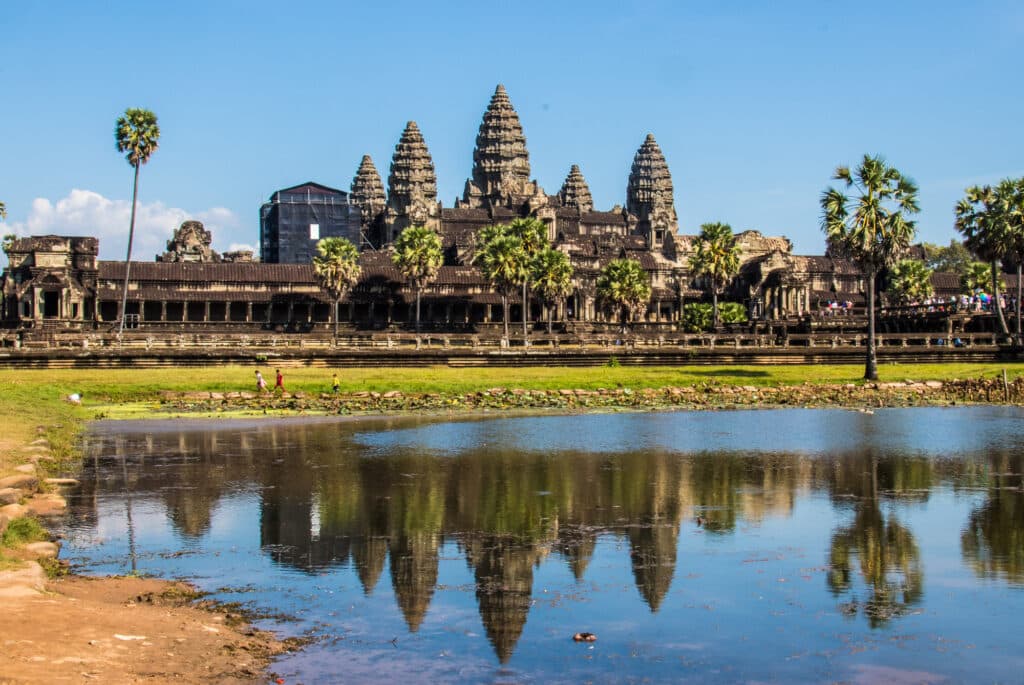
The approach from the west sets the tone. The moat is wide and often still in the early morning, reflecting the stone towers. The causeway with its naga balustrades and the rows of deity figures is roughly 200 meters long and worth walking slowly.
The Hall of Dancers
Inside the second enclosure, a large cruciform hall is decorated with repeating carved apsara (celestial dancer) figures. The reliefs here are among the finest at Preah Khan and have survived in better condition than many sections of the outer walls. This hall is thought to have been used for dance performances as part of religious ceremonies.
The Freestanding Two-Story Building
This structure near the center of the complex is almost anomalous. Round columns are rare in Khmer architecture, and nobody is entirely certain what the building's original function was. It's one of those details that sticks with you after you've left.
The Stupa and Central Sanctuary
The central sanctuary was converted to Buddhist use at some point and houses a stupa. The surrounding chambers still contain carved niches and door guardians (dvarapalas) in various states of preservation. The light inside is low and changes depending on the time of day.
Best Time to Visit
Early morning is the clear answer. If you're visiting Angkor Wat at sunrise (which most visitors do on their first full day), consider saving Preah Khan for the following morning instead. Arrive by 7am and you'll often have large sections of the complex to yourself for at least an hour before the mid-morning tour groups arrive.
The dry season, roughly November through April, makes the paths easier to navigate and the moat more photogenic. That said, Preah Khan in the wet season has its own appeal: the surrounding vegetation is intensely green, the moat is full, and the humidity gives the stone a darker, more saturated color. Mosquitoes are more active in the wet season, so bring repellent regardless of when you go.
Tickets and Entry
Preah Khan is included in the standard Angkor Archaeological Park pass, which you purchase at the official ticket center on the road between Siem Reap and the park entrance. Passes come in one-day, three-day, and seven-day tiers. The three-day pass is the most common choice for visitors who want to cover both the main temples and the outer circuit temples like Preah Khan without feeling rushed.
Keep your pass accessible as wardens check tickets at several points within the park, including at the entrance to Preah Khan itself.
Photography Tips
The covered galleries create natural tunnels of light, and the best shots tend to come from positioning yourself inside a doorway and shooting toward the next chamber. The successive doorframes receding into the distance is a classic Angkor composition and it works particularly well at Preah Khan because the corridors are narrower and the depth greater than at some other sites.
The Hall of Dancers is best photographed in the mid-morning when light enters from the east-facing openings. The apsara carvings have enough depth in the relief to read well even in flat light, but raking light from the side brings out the detail significantly.
Avoid flash. The stone is pale and flash tends to flatten the carvings completely. If your camera struggles in low light, a wide aperture lens will serve you better than any amount of artificial lighting.
Practical Tips
- Wear covered shoulders and knees. This is a religious site and dress codes are enforced at the entrance.
- Bring water. There are vendors just outside the main entrance, but not reliably inside the complex.
- Wear closed-toe shoes with grip. Some interior floors are uneven stone and can be slippery after rain.
- Hire a local guide at the park entrance or arrange one through your guesthouse. The inscriptions and iconography reward context that a solo walk won't give you.
- If you're doing the Grand Circuit, Preah Khan pairs naturally with Ta Som (about 10 minutes further east) and Neak Pean, which is nearby and takes only 20 to 30 minutes to see.
- There are no restaurants inside the complex. The nearest food options are the stalls clustered at the parking area and along the main park road.
Combining with Nearby Attractions
Preah Khan sits at the top of the Grand Circuit, which makes it a natural anchor for a half-day focused on the park's less-visited outer temples. From Preah Khan, it's a short ride to Ta Som, a compact temple with one of the most photographed tree-root doorways in the park. Neak Pean, the unusual island temple set in the middle of a large reservoir, is also just a few minutes away by tuk-tuk.
If you're planning a full day on the Grand Circuit, most drivers will take you through Preah Khan, Ta Som, Neak Pean, and Pre Rup in a single loop. Pre Rup, a temple-mountain from the 10th century, is a particularly good place to end the afternoon since its upper terrace faces west and catches the late light well.
FAQ
Is Preah Khan worth visiting if I've already seen Angkor Wat and the Bayon?
Absolutely, and many visitors find it more atmospheric. It's larger and more complex than it looks on a map, and the combination of intact galleries and ruined sections gives it a character that the more heavily restored temples don't have.
How long should I plan to spend at Preah Khan?
Budget at least 90 minutes. If you're interested in the carvings or photography, two hours goes quickly. The complex is large enough that a rushed visit will leave you feeling like you missed the best parts.
Can I visit Preah Khan without a guide?
Yes, and many people do. The main path through the complex is reasonably clear, and there are some basic signs at key points. That said, a knowledgeable guide adds a lot, particularly for understanding the iconography and the historical context of the site.
Are there facilities at Preah Khan?
There are restrooms near the main parking area on the western side. Vendors sell water and snacks just outside the entrance. Inside the complex itself, there are no facilities.
Reviews
Sign in and mark this place visited to leave a review.
No reviews yet.
Free Trip Planner
Plan your Cambodia trip with our free planner
Build a day-by-day itinerary with AI suggestions, hand-picked places, and friends. Free forever — no credit card.
Things to see near Preah Khan


Places to eat or drink near Preah Khan

Cuisine Wat Damnak Siem Reap

Khmer Grill Restaurant

WILD – Creative Bar & Eatery