Reichstag Building
Platz der Republik 1, 11011 Berlin, GermanyThe Reichstag Building sits on the western edge of Tiergarten park, facing the Spree River with Brandenburg Gate just a few minutes' walk to the east. It has served as the seat of the German parliament, the Bundestag, since 1999, when the legislature moved back to Berlin after decades based in Bonn. Whatever direction you approach from, the building announces itself in two distinct registers: a heavy neo-Renaissance stone facade below, and a glass dome on top that looks like it was dropped there by a different century entirely. For a working seat of government, the Reichstag is unusually open to the public, and that glass dome is the main reason people come. Entry to it is free, which has made this one of the most visited landmarks in Germany.
Why the Reichstag Building Matters
Few buildings in Europe have absorbed this much history in so short a span. The original structure was completed in 1894, designed by architect Paul Wallot in a style meant to project the confidence of the newly unified German Empire. Within fifty years it had survived a suspicious fire in 1933 that the Nazi regime used as pretext to consolidate power, been reduced to a scorched shell by Allied bombing in 1945, and then spent the Cold War decades sitting awkwardly near the border between East and West Berlin. It was too damaged, and too politically loaded, for either side to fully claim or restore. That changed after reunification. British architect Norman Foster won the commission to rebuild and modernize the interior, and the result, completed in 1999, is one of the more convincing conversations between old and new architecture you will find in a European capital. Foster kept Wallot's original stone facades and grand stairways largely intact while gutting most of the interior behind them. The dome he added sits directly above the plenary chamber, and a spiraling ramp inside its glass walls lets visitors look straight down into parliament as it sits in session. That is not a figure of speech. You can genuinely see the seats, and on the right day, the people in them.
Quick Facts
- Address: Platz der Republik 1, 11011 Berlin
- Completed: 1894, restored and reopened: 1999
- Architect: Paul Wallot (original), Norman Foster (restoration)
- Entry to the dome and rooftop: free, but advance registration is required
- Registration is handled online through the Bundestag's official website
- The dome rises approximately 23.5 metres above the rooftop terrace
- Nearest stations: Brandenburger Tor (S-Bahn) or Bundestag (U55)
- A rooftop restaurant operates separately from the dome visit
Getting There
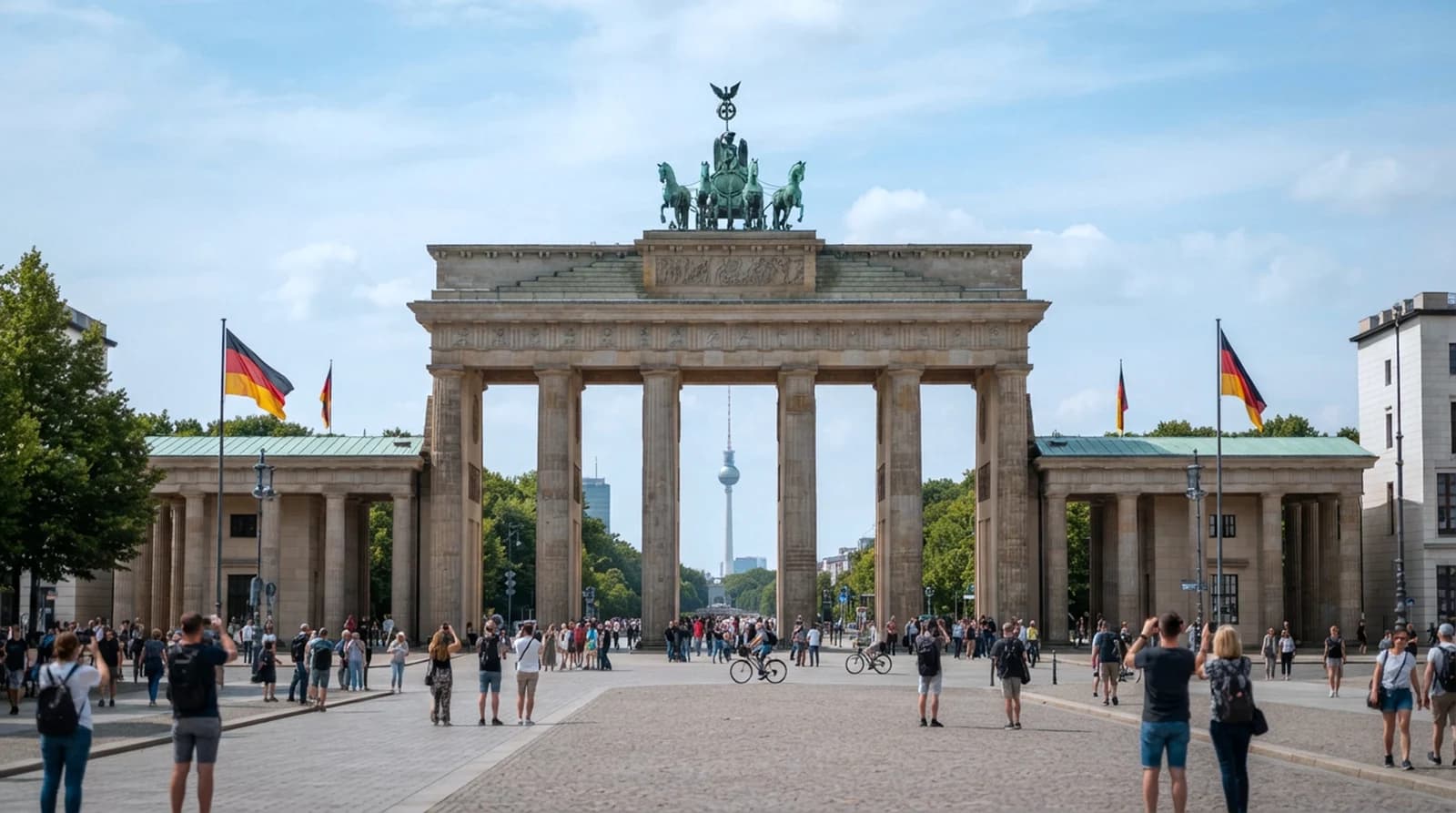
The building sits on Platz der Republik, essentially a large lawn wedged between Tiergarten and the government district. From Brandenburg Gate it is a flat, five-minute walk heading northwest, past the edge of the park. The S-Bahn station Brandenburger Tor drops you almost at the doorstep, and the U55 line stops at Bundestag station, which is closer still to the main entrance. If you are cycling, the riverside path along the Spree from Mitte is straightforward and genuinely pleasant, with the dome visible from a distance well before you arrive. Parking nearby is limited, and the immediate area tends to be thick with tour groups and school trips, so arriving by public transit or on foot is the easier option almost every time.
History and Background: A Building That Kept Surviving
It's worth slowing down on the history here, because the Reichstag's story is really the story of twentieth-century Germany compressed into one address. Wallot's 1894 design was deliberately imposing, built to signal the strength of a young empire barely twenty years old. The inscription across the front, "Dem Deutschen Volke" ("To the German People"), was added later, in 1916, during the First World War, as a concession toward popular sovereignty. The fire of February 1933 is the building's most notorious chapter. A Dutch communist was convicted of setting it, though historians have debated the full circumstances for decades. What is not in dispute is the outcome: the Nazi government used the fire as justification to suspend civil liberties and move rapidly toward dictatorship. The building itself was never fully repaired under Hitler's regime, and it sat in a kind of limbo through the war, used occasionally but never again as parliament's working home. The 1945 Battle of Berlin left it a ruin. Soviet troops famously raised a flag over its wrecked upper floors, an image that became one of the defining photographs of the war's end in Europe. For the following decades, the Reichstag sat close to the dividing line between East and West Berlin, patched up just enough to prevent total collapse but never rebuilt into a functioning government building. It was, for most of the Cold War, a monument to catastrophe rather than a working institution. Then, in 1995, artists Christo and Jeanne-Claude wrapped the entire building in silvery fabric for two weeks. The project took the artists over two decades to get approved, and when it finally happened, more than five million people came to see it. The wrapping is remembered now as one of the most significant public art interventions of the twentieth century, and plenty of Berliners will tell you it did something unexpected: it reawakened public affection for a building that had spent most of living memory as a symbol of division and disaster rather than democracy. The Foster restoration followed soon after, reopening in 1999 as the seat of a reunified Germany's parliament.
Tickets and Entry
Entry to the dome and rooftop terrace is free. This isn't a soft-sell free where you end up paying for everything once inside. The visit is genuinely complimentary, funded by the German parliament as a gesture of civic openness that is fairly rare among national legislatures. The catch, and it's a real one, is the registration requirement. You need to book a time slot in advance through the Bundestag's official website, submitting names and dates of birth for everyone in your group. Registration is typically required several days ahead of your visit, and during peak tourist season, popular slots disappear fast. If you land in Berlin without a booking, check the website daily, as cancellations do open up occasional same-day or next-day spots. Separate guided tours covering the plenary chamber and other parts of the building are available through the Bundestag's visitor service, and these require their own, independent booking. Groups should contact the visitor service well ahead of travel dates. Security screening at the entrance resembles an airport checkpoint, so arrive a few minutes before your slot and travel light if you can.
The Layout and Experience: Inside the Dome
The dome visit is not a passive stroll. A continuous double-helix ramp spirals up to the top, and most visitors take somewhere between twenty and thirty minutes to walk the full circuit at an unhurried pace. Free audio guides, available in multiple languages, activate automatically as you move, pointing out landmarks on the skyline and explaining what you're looking at through the glass. At the center of the dome is a cone-shaped structure the design team called the "light sculptor," clad in 360 mirrors. It isn't just decorative. The funnel channels daylight down into the plenary chamber below and assists with natural ventilation, part of Foster's broader approach to making the building more energy-efficient. Peer down through the central opening and you look straight onto the parliament floor. On days when the Bundestag is in session, you may actually watch it happening in real time. The rooftop terrace, which wraps around the dome's base, gives you a wide panorama of central Berlin. On a clear day you can pick out the Fernsehturm television tower toward Alexanderplatz, the Victory Column rising out of Tiergarten, and the newer government buildings strung along the Spree to the north. The view looking west over the park is particularly good in late afternoon, when the light flattens out and softens.
Best Time to Visit
Sunrise and sunset slots are the most requested, and for good reason. The dome's glass and mirrors behave differently depending on the angle of light, and the rooftop views at golden hour are worth the early alarm. Evening slots, especially in summer when Berlin stays light until well past nine, are also popular and tend to feel less rushed than the midday crush. If your schedule has any give, aim for a weekday morning during autumn or winter. Security lines are shorter and the ramp is noticeably less crowded. Summer months and school holiday periods are consistently the busiest, and heat plus crowds inside a glass structure is not a comfortable combination.
Photography Tips
The exterior photographs best from across the lawn at Platz der Republik, where you can frame the full stone facade with the dome rising above it. Early morning brings soft light and fewer people wandering into frame. Inside, the mirror funnel is the obvious subject, and shooting straight up from its base produces a strong, symmetrical geometric image. Wide-angle lenses handle the interior well. The glass panels on the dome's exterior wall tend to flare and reflect in direct sunlight, so mid-morning or overcast conditions usually give you cleaner shots of the city beyond. Photography is allowed throughout the dome and rooftop, but tripods are generally not permitted given the volume of foot traffic on the ramp.
Combining with Nearby Attractions
The Reichstag anchors a tightly walkable cluster of major Berlin sites. Brandenburg Gate is five minutes east on foot. The Memorial to the Murdered Jews of Europe is another five minutes beyond that, on Cora-Berliner-Strasse. North along the riverbank, the government district continues past the glass-and-steel Chancellery, facing the Bundestag's newer office buildings across the water. A full morning could pair the dome visit with a walk along the Spree toward Hauptbahnhof, Berlin's central station, roughly fifteen minutes on foot, passing the Paul-Löbe-Haus and Marie-Elisabeth-Lüders-Haus, the twin parliamentary office buildings that straddle the river and are connected by a pedestrian bridge. Museum Island and Mitte's main gallery district sit roughly thirty minutes away on foot, or a short S-Bahn ride if you'd rather save your legs for the dome ramp.
Practical Tips
- Book your dome time slot as early as possible, ideally several weeks ahead during summer
- Bring a valid photo ID matching your registration details, as it is checked at the entrance
- The rooftop is exposed and can be cold and windy even on mild days, so bring a layer
- The rooftop restaurant requires a separate reservation and sits at an upscale price tier
- Check the Bundestag's public calendar if parliament may be in session during your visit, as security measures can occasionally affect access
- Audio guides inside the dome are included at no extra charge
- Allow at least ninety minutes for the full visit, including security and the ramp walk
FAQ
Do I really need to book in advance?
Yes. Walk-up entry isn't available. The Bundestag's visitor registration system requires names and dates of birth submitted ahead of time, and your booking is checked against ID at the security entrance. Same-day slots occasionally open up through cancellations, but you shouldn't plan around that.
Can children visit?
Yes, and the dome tends to go over well with kids, who generally enjoy the ramp and the overhead views into the chamber. There are no age restrictions. The ramp is wide enough for strollers, though it's a sustained incline, so plan accordingly.
Is the building accessible?
Lifts are available as an alternative to the ramp, and the Bundestag's visitor service can provide specific accessibility details when you register. It's worth flagging any requirements at the time of booking rather than on arrival.
Can you visit the plenary chamber itself?
Not as part of the standard dome visit. You can see the chamber from above through the dome's central opening, but stepping onto the chamber floor or into other interior areas requires a separate guided tour booked through the Bundestag's visitor service.
Whatever else is on your Berlin itinerary, the Reichstag Building is one of the rare sights in the city that rewards both the history-minded and the purely scenic-minded visitor in equal measure, and it costs nothing but a bit of advance planning to get inside.
Reviews
Sign in and mark this place visited to leave a review.
No reviews yet.
Free Trip Planner
Plan your Berlin trip with our free planner
Build a day-by-day itinerary with AI suggestions, hand-picked places, and friends. Free forever — no credit card.