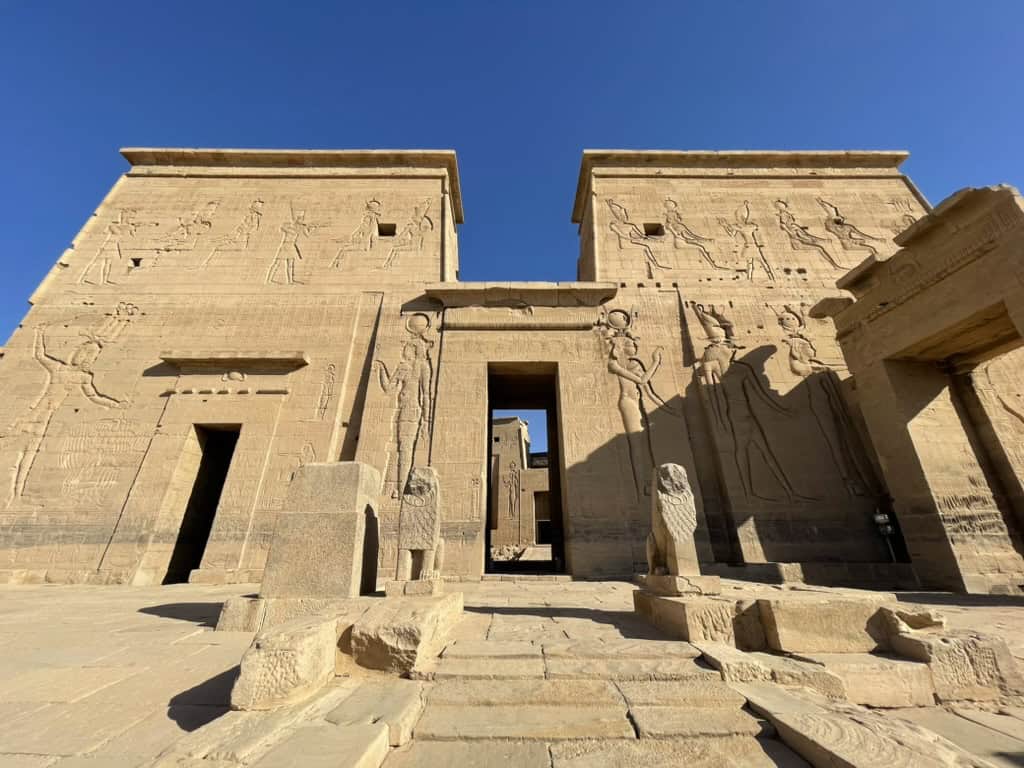
Temple of Kom Ombo
Nagoa Ash Shatb, Kom Ombo 81611 Egypt Posted by bazartravelsAdmin
The Temple of Kom Ombo: Egypt's Dual Sanctuary on the Nile
Perched directly on the east bank of the Nile, the Temple of Kom Ombo is one of the most unusual religious sites in all of Egypt. Unlike virtually every other pharaonic temple, this one was built for two gods simultaneously, its floor plan split almost perfectly down the middle to honor both Sobek, the crocodile god, and Haroeris, a form of Horus the Elder. That double identity shapes everything here, from the twin entrances to the duplicate sanctuaries at the rear. If you arrive around sunset, when the sandstone walls turn a deep amber and the river catches the last of the light, the effect is genuinely hard to forget.
The site sits on the edge of the modern town of Kom Ombo, roughly 45 kilometers north of Aswan. Most visitors arrive by Nile cruise ship, which docks practically at the temple's doorstep, but it's just as reachable by road if you're traveling independently.
Why the Temple of Kom Ombo Matters
Most pharaonic temples were dedicated to a single deity and organized along a single axis. Kom Ombo breaks that convention entirely. The left half of the complex was consecrated to Haroeris, associated with the sky and kingship, while the right half belonged to Sobek, the crocodile deity tied to the Nile's fertility and power. Priests would have conducted parallel rituals on either side, entering through separate doorways, passing through mirrored hypostyle halls, and reaching two distinct inner sanctuaries.
The symmetry is not just architectural curiosity. It reflects a theological statement about balance, the same principle that runs through much of Egyptian religious thought. Standing in the central corridor and looking down both axes at once gives you a rare physical sense of that duality.
Quick Facts
Location: East bank of the Nile, Kom Ombo town, approximately 45 km north of Aswan
Dedicated to: Sobek (crocodile god) and Haroeris (Horus the Elder)
Construction period: Primarily Ptolemaic, with the main structure built between roughly 180 BCE and 47 BCE, though some Roman additions followed
On-site museum: The Crocodile Museum houses a collection of mummified crocodiles found at the site
Entry: Ticketed; timed-entry is not currently required, but this can vary during peak cruise season
Accessibility: The main court and outer halls are mostly flat; the innermost sanctuaries involve some uneven stone
Getting There
The vast majority of travelers reach Kom Ombo as part of a Nile cruise between Luxor and Aswan. The cruise dock sits within a five-minute walk of the temple entrance, making it one of the most convenient stops on the entire river route.
If you're traveling independently from Aswan, the simplest option is a taxi or microbus from the Aswan bus station. The journey takes around 45 minutes to an hour depending on traffic. Some travelers combine it with a visit to Edfu Temple in a single day trip, though that makes for a long afternoon. From Luxor, Kom Ombo is further, typically a two-hour drive south, so it works better as a dedicated stop rather than a quick detour.
There is a small train station in Kom Ombo town if you prefer rail, though trains on this route can run unpredictably. A taxi from the station to the temple is quick and inexpensive.
The Layout and Experience
You enter through a forecourt that opens into an outer hypostyle hall with columns still bearing vivid painted reliefs. The colors have faded over two millennia, but traces of ochre, blue, and green survive in sheltered sections. The carvings here depict the standard ceremonial scenes: pharaohs presenting offerings, gods conferring blessings, priests in procession.
Move deeper and the doubling becomes impossible to miss. Two doorways side by side lead through the inner hypostyle hall toward the offering halls and finally the twin sanctuaries at the back. The sanctuaries themselves are largely stripped of their original contents, but the walls remain covered in intricate reliefs.
One of the most-photographed details in the complex is a carved panel near the outer ambulatory that appears to show a collection of surgical instruments: knives, forceps, bone saws, and what looks like a birthing chair. Egyptologists interpret this as a list of ritual implements or votive objects rather than a literal operating theater, but the debate has kept visitors curious for decades.
The Nilometer, a graduated stone gauge used to measure the Nile's annual flood level, sits near the entrance. It's one of the better-preserved examples along the river and easy to examine up close.
The Crocodile Museum
A small but worthwhile building on the south side of the complex houses dozens of mummified crocodiles unearthed from the site. Crocodiles were sacred to Sobek and were kept, worshipped, and mummified here in significant numbers. Some of the specimens are large enough to be genuinely startling. The museum also displays crocodile eggs and juvenile mummies, which helps explain the full ritual cycle. It's easy to spend 20 minutes here and come away with a much better sense of how animal cults functioned in ancient Egypt.
History and Background
The site was used as a place of worship long before the current structures were raised. Evidence suggests occupation going back to the New Kingdom period, though nothing from that era survives in visible form. The temple you see today is almost entirely Ptolemaic, built during the reign of Ptolemy VI Philometor around 180 BCE and expanded by successive rulers over the following century and a half. Roman emperors later added the outer enclosure wall and the birth house, or mammisi, though those outer sections are now largely ruined.
The name Kom Ombo comes from the ancient Egyptian word for gold, which may reflect the region's historical role as a trade and administrative hub at the edge of Nubian territory. The town controlled caravan routes connecting the Nile Valley to the eastern desert, which made it strategically valuable across multiple dynasties.
Much of the temple's outer structure suffered damage over the centuries, partly from Nile flooding, partly from later inhabitants quarrying the stone. What remains has been stabilized and partially restored, but you'll notice large sections of the outer walls are missing or reduced to foundation level.
Best Time to Visit
Kom Ombo tends to be at its most atmospheric in the late afternoon, when the light is low and the cruise ships that arrive midday have often moved on. If you're on a cruise yourself, your schedule is mostly set for you, but if you have flexibility, aim for a late afternoon arrival.
Winter months (roughly November through February) bring cooler temperatures and the densest concentration of cruise traffic. Summer visits are far quieter but can be extremely hot, with midday temperatures regularly above 40 degrees Celsius in this part of Upper Egypt. Spring and autumn offer a reasonable middle ground. The site is also open into the evening and is sometimes lit at night, which creates a completely different atmosphere worth experiencing if your cruise schedule allows it.
Photography Tips
The temple is fully open-air except for the Crocodile Museum, so natural light is your main tool. Morning light falls on the western face of the outer walls, while late afternoon is better for the main entrance and court. The colonnade of the outer hypostyle hall creates strong shadow patterns that tend to photograph well in the hour before sunset.
The relief carvings are detailed enough to reward close-up shots, particularly the surgical instrument panel and the cartouches in the inner halls. Bring a wide lens if you want to capture the full double-doorway effect looking toward the sanctuaries. The Nilometer photographs best from slightly above, so the graduated markings are legible.
Combining with Nearby Attractions
Edfu Temple, dedicated to Horus, is roughly 60 kilometers north of Kom Ombo and is one of the best-preserved temples in Egypt. Most Nile cruises stop at both in sequence, and the two complement each other well. Edfu is more complete structurally, while Kom Ombo offers the unusual dual layout and the crocodile collection.
Aswan, to the south, is a natural base for independent travelers. From there you can also reach Philae Temple and the High Dam, making the Aswan-Kom Ombo corridor one of the most monument-dense stretches of the entire Nile Valley.
Practical Tips
Bring water. The site is largely unshaded and can get very hot from late morning onward.
Wear closed shoes with a flat sole. The inner sanctuaries have uneven ancient stone that sandals handle poorly.
The Crocodile Museum is included in the main site ticket, so don't skip it assuming it costs extra.
If you're on a cruise, confirm your docking time with your guide. Some ships stop for as little as 90 minutes, which is tight if you want to see both the temple and the museum at a relaxed pace. Two hours is more comfortable.
Vendors operate around the entrance. If you're not interested, a polite but firm response works better than engaging with extended negotiation.
Photography inside the Crocodile Museum is often permitted but worth confirming at the entrance, as policies can shift.
FAQ
How long should I spend at Kom Ombo?
Most visitors find that 90 minutes to two hours covers the temple and the Crocodile Museum without feeling rushed. If you're particularly interested in the reliefs or want to sketch or photograph in detail, allow more time.
Is Kom Ombo suitable for children?
Yes, with a bit of preparation. The crocodile mummies tend to fascinate younger visitors, and the open layout means children can move around freely. The heat is the main challenge, so bring sun protection and water.
Do I need a guide?
Not strictly, but the reliefs make considerably more sense with some context. If you're on a cruise, a guide is usually included. Independent visitors can hire a licensed local guide at the entrance or read up in advance, as many of the carvings reference specific myths and rituals that aren't self-explanatory.
Can I visit independently without a tour or cruise?
Absolutely. Taxis from Aswan are the most practical option, and the entrance is straightforward. The site is well-maintained and clearly laid out, so independent navigation is easy once you're inside.
Reviews
Sign in and mark this place visited to leave a review.
No reviews yet.
Free Trip Planner
Plan your Egypt trip with our free planner
Build a day-by-day itinerary with AI suggestions, hand-picked places, and friends. Free forever — no credit card.