Valley of the Artisans (Deir el-Medina)
Deir el-Medina, Luxor Egypt Posted by Brandon B.Admin
Deir el-Medina: The Village That Built the Valley of the Kings
Most visitors to the Luxor West Bank spend their energy at the Valley of the Kings and never make it the extra ten minutes south to Deir el-Medina. That's a mistake. This ancient settlement, officially known as the Valley of the Artisans, is where the craftsmen, painters, and sculptors who carved Egypt's royal tombs actually lived, worked, argued, and died. The site gives you something the royal valleys rarely do: a human story.
Unlike the grand monuments of Karnak or the sheer scale of Ramesses II's legacy, Deir el-Medina is intimate. The ruins of the workers' village sit in a narrow desert valley, flanked by private tombs that are, in the opinion of many Egyptologists, the most beautifully painted in all of Egypt. For anyone seriously interested in ancient Egyptian life rather than just ancient Egyptian power, this is the place.
Why Deir el-Medina Matters
The village was occupied continuously for roughly 450 years, from around 1550 BCE to 1080 BCE, spanning the New Kingdom period. During that time it housed the artisan community responsible for constructing and decorating the royal tombs across the West Bank. What makes it extraordinary from a historical standpoint is the documentary record that survived. Thousands of ostraca (inscribed pottery shards and limestone flakes) were recovered here, recording everything from work schedules and legal disputes to love poetry and medical complaints. These fragments turned Deir el-Medina into one of the best-documented communities in the ancient world.
The workers were not slaves. They were skilled professionals, many of whom inherited their positions from their fathers. They received government rations of grain, fish, and oil, and they had enough leisure time and material resources to commission elaborate tombs of their own. Those tombs are what you come to see.
Quick Facts
- Location: West Bank of Luxor, roughly 2 kilometers south of the Valley of the Queens
- Site includes: workers' village ruins, private painted tombs, a Ptolemaic temple dedicated to Hathor and Maat
- Tombs open to visitors rotate, but typically include those of Sennedjem, Inherkhau, and Ipuy
- Managed by the Egyptian Ministry of Tourism and Antiquities
- Average visit length: 1.5 to 2.5 hours depending on how long you linger in the tombs
- Separate ticket required from the Valley of the Kings pass
- Photography permits may be purchased on-site; rules inside individual tombs vary
Getting There
Deir el-Medina sits on the West Bank of the Nile, about a 10-minute drive from the main West Bank ticket office near the Colossi of Memnon. If you're coming from central Luxor, you'll cross the Nile by ferry or bridge and then head south through the agricultural fringe before the road climbs into the desert plateau. Most organized tours include it as a half-day stop combined with the Valley of the Queens.
Independent travelers commonly hire a private driver or a microbus for the West Bank circuit. Bicycles are technically possible but the road through the hills is steep and exposed to serious midday heat for much of the year. If you're self-organizing, aim to reach the site by 8am, before tour groups arrive and before the temperature in the valley becomes punishing.
The Layout and Experience
You enter from the north, passing through the remains of the mudbrick village itself. The footprints of individual houses are visible, and information boards explain the layout of a typical worker's home: a front reception room, a living area, a bedroom, a cellar, and a kitchen at the rear. It's modest, but these were not impoverished people by the standards of their era.
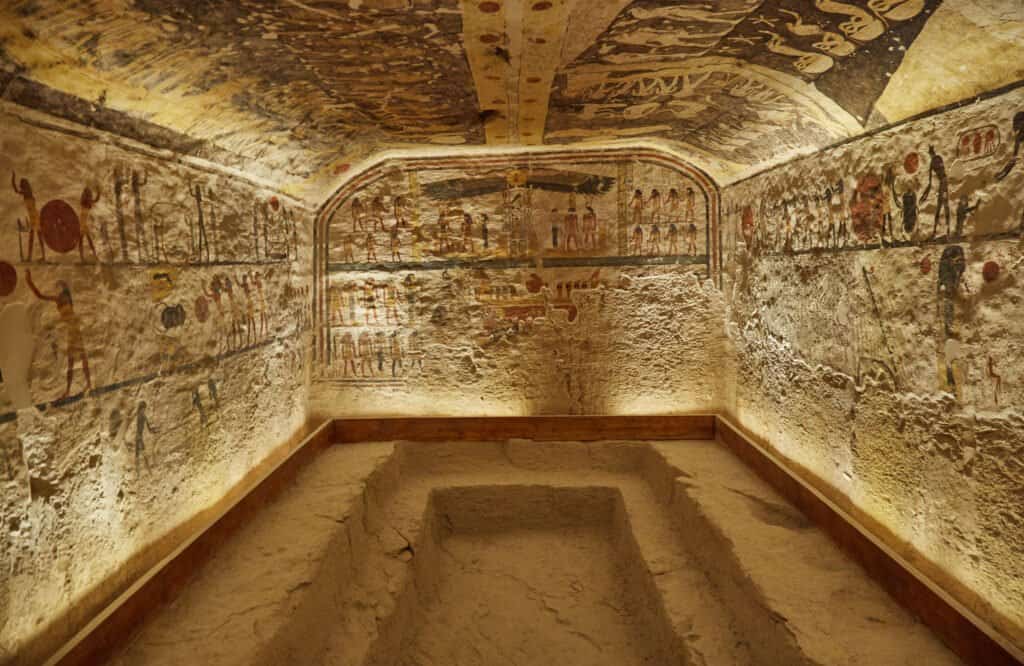
The private tombs are cut into the hillside on the western slope. Each one requires you to descend a short staircase into a chapel, where the painted walls feel almost shockingly vivid given their age. The tomb of Sennedjem, a craftsman who worked during the reigns of Seti I and Ramesses II in the 13th century BCE, is among the most visited. Its ceiling and walls are covered in scenes from the Book of Gates and agricultural imagery so detailed and colorful that photographs rarely do it justice. You need to see it by the light inside the chamber to understand why people keep coming back.
North of the village ruins stands the Ptolemaic temple, built much later than the village itself, around the 3rd to 1st centuries BCE. It's dedicated to Hathor, goddess of beauty and music, and to Maat, goddess of truth and cosmic order. The temple is well-preserved and still has traces of painted relief on its interior walls.
The Tombs in Detail
Not every tomb at Deir el-Medina is open on any given day. The Ministry rotates access to help preserve the paintings, so check with the ticket office when you arrive about which ones are available. That said, a few tombs tend to be accessible most of the time.
Sennedjem's tomb (Tomb TT1) is the standout. The painted burial chamber, discovered intact in 1886, shows Sennedjem and his wife Iyneferti working in the Fields of Aaru, the Egyptian afterlife's version of an ideal harvest landscape. The colors, particularly the deep blue and ochre, have retained a warmth that modern reproductions miss entirely.
The tomb of Inherkhau (TT359) contains a famous image of a spotted cat killing the serpent Apep beneath a persea tree, a scene from the Book of the Dead that you'll recognize from countless museum prints. Seeing the original in its actual scale and context is different from any reproduction.
Ipuy's tomb (TT217) is less famous but rewards the patient visitor. It includes remarkably domestic scenes: a garden, a man receiving medical treatment, shipbuilders at work. These are not scenes of gods and pharaohs. They are scenes of life.
Tickets and Entry
Deir el-Medina requires a separate ticket from the general West Bank combination pass. Individual tombs may have their own small entry fees on top of the site admission. Guided tours typically bundle everything, but independent visitors should budget for multiple small payments at the gate. Arrive with cash in Egyptian pounds; card facilities are unreliable at smaller West Bank sites.
Timed entry is not currently in use at Deir el-Medina the way it is at the Valley of the Kings, but access inside individual tombs is limited to small groups at a time, so you may wait a few minutes at peak hours.
Best Time to Visit
October through February is the most comfortable window. The valley traps heat efficiently, and in summer months the temperature inside can exceed what feels manageable, especially in the enclosed tomb chambers. Early morning visits year-round are strongly preferable: the light is softer, the crowds are thinner, and the custodians tend to be more willing to linger and answer questions before the buses arrive.
Avoid Friday midday if possible, as visitor patterns tend to shift around prayer times and the site can either be unusually quiet or suddenly crowded depending on the tour schedule that week.
Photography Tips
Flash photography is prohibited inside the tombs, which is the right call for preservation reasons but does make shooting the paintings genuinely difficult. A camera or phone with strong low-light performance will serve you far better than one with a good zoom. The tombs are small, so wide-angle lenses are more useful than telephoto.
The village ruins and the Ptolemaic temple photograph beautifully in the hour after sunrise, when the low angle of light catches the texture of the mudbrick and the carved limestone reliefs. The hillside backdrop of the Western Desert cliffs gives the exterior shots a drama that the interior spaces can't match.
Combining with Nearby Attractions
Deir el-Medina sits naturally at the end of a West Bank loop that includes the Valley of the Queens (about 10 minutes north by road) and the Ramesseum, the mortuary temple of Ramesses II. Most visitors pair it with the Valley of the Kings on the same day, though that makes for a long morning. If you have the flexibility to split the West Bank across two days, devoting one afternoon exclusively to Deir el-Medina and the Valley of the Queens gives you more time to actually absorb the paintings rather than rushing through.
The workers' village of Deir el-Medina also makes more sense if you've already seen a royal tomb. Once you've stood inside the tomb of Ramesses VI or Seti I and wondered who actually made those ceilings, coming here and seeing where those people lived closes a loop that most West Bank itineraries leave open.
Practical Tips
- Bring water and more of it than you think you need. There are limited vendors inside the site and the valley offers no shade between structures.
- Wear shoes you can take on and off easily. Some tomb entrances require removing footwear.
- A small torch or phone flashlight helps in the deeper tomb chambers where the installed lighting is dim.
- Hire a licensed Egyptologist guide if this is a priority stop. The iconography in the tombs is dense and a good guide transforms the visit.
- The custodians at individual tombs often know the paintings in detail and appreciate genuine questions. Tipping them is standard practice.
- Keep tickets on your person throughout the visit as they are checked at each tomb entrance separately.
FAQ
Is Deir el-Medina suitable for children?
Generally yes, though the narrow staircase descents into the tombs can be challenging for very young children or anyone with mobility difficulties. The open village ruins and temple are fully accessible at ground level.
How much time should I set aside?
Plan for at least two hours if you want to see the village ruins, two or three tombs, and the Ptolemaic temple without rushing. If you're combining with the Valley of the Queens, allow a full half-day for both.
Can I visit independently without a tour?
Yes. Independent access is straightforward if you have your own transport on the West Bank. The site is well signed, and the ticket office staff speak enough English to direct you. That said, the tombs are far more rewarding with some background knowledge, so even a brief self-guided audio tour or a good guidebook makes a difference.
Are the tomb paintings original?
Yes. The paintings inside the tombs at Deir el-Medina are original ancient works, not reproductions. That's part of what makes the site so remarkable and why preservation rules around photography and group sizes exist.
Reviews
Sign in and mark this place visited to leave a review.
No reviews yet.
Free Trip Planner
Plan your Egypt trip with our free planner
Build a day-by-day itinerary with AI suggestions, hand-picked places, and friends. Free forever — no credit card.