Tomb of Seti I
Luxor Egypt Posted by Brandon B.Admin
Inside the Tomb of Seti I, the Most Elaborate Royal Burial in the Valley of the Kings
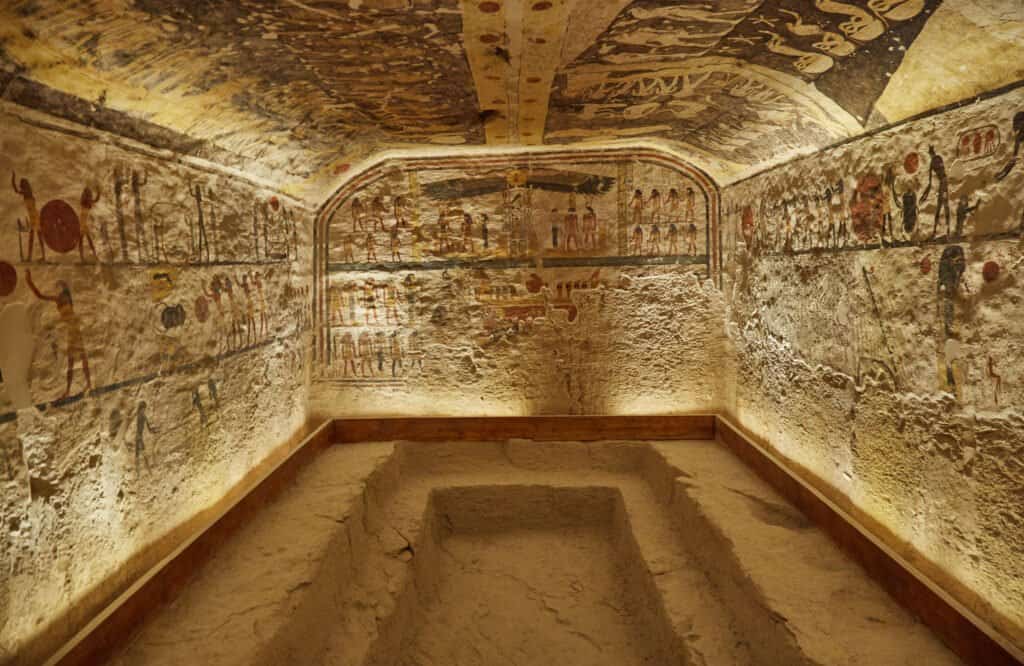
The Tomb of Seti I sits deep in the limestone cliffs of the Valley of the Kings on Luxor's West Bank, and by almost any measure it is the most extraordinary royal tomb ever cut into Egyptian rock. Nothing else in the valley quite prepares you for the scale of it. The burial chamber alone descends more than 120 meters from the entrance, making it the longest tomb in the entire necropolis. Every wall, every ceiling, every pillar is covered in painted relief work of a quality that has not been matched anywhere else in the valley.
Seti I ruled during the 19th Dynasty, around the 13th century BCE. He was the father of Ramesses II, the pharaoh whose monuments dominate Upper Egypt, yet Seti's own tomb eclipses his son's burial place in terms of artistic refinement. The colors in certain chambers still carry a warmth that is difficult to believe given their age.
Why the Tomb of Seti I Matters
Most visitors to the Valley of the Kings arrive with a general admission ticket that covers three tombs. The Tomb of Seti I is not included in that standard ticket. It requires a separate, supplementary ticket purchased at the entrance gate, and that distinction alone tells you something. The Egyptian authorities have historically restricted access here more than elsewhere in the valley, partly because of conservation concerns, partly because the tomb spent decades closed for restoration work.
Giovanni Belzoni, the Italian explorer, cleared the entrance in 1817. That discovery sent shockwaves through European intellectual circles. The French artist Alexandre Nestor Millon and others made detailed facsimile copies of the paintings in the years that followed, and those copies now sit in institutions across Europe. The originals, however, are still here, and standing in front of them is a different experience entirely.
What makes this tomb stand apart is the combination of depth, decoration, and text. The walls carry scenes from the Amduat, the Book of Gates, the Litany of Ra, and the Opening of the Mouth ritual. Each corridor leads you further into a cosmological program that the ancient Egyptians believed would guide the pharaoh through the twelve hours of the night and into resurrection. You are not just looking at decoration. You are walking through a theological argument carved into stone.
Quick Facts
- Located in the Valley of the Kings on Luxor's West Bank, roughly a 30-minute drive from central Luxor
- Designated as tomb KV17 in the official Valley of the Kings numbering system
- Extends approximately 137 meters from entrance to burial chamber, the longest tomb in the valley
- Requires a separate supplementary ticket on top of the standard Valley of the Kings admission
- Access has been restricted at various points for conservation; confirm current opening status before visiting
- Photography inside is typically prohibited or tightly restricted to protect the painted surfaces
- Seti I ruled circa 1294 to 1279 BCE
Getting There
The Valley of the Kings sits on the West Bank of the Nile, across from Luxor city. From the East Bank, you take a local ferry or a felucca across the river, then either hire a taxi or join a guided tour. Most drivers and tour operators know the valley well. If you are traveling independently, a taxi from the ferry landing to the valley entrance takes around 20 minutes depending on traffic and your exact starting point.
The entrance gate is where you buy all tickets, including the supplementary ticket for Seti I. Do this before boarding the small electric tram (or walking) toward the tombs themselves. The ticket booth does not accept foreign currency at all times, so having Egyptian pounds available is sensible.
The Layout and Experience
The tomb descends through a series of corridors and chambers that grow progressively more elaborate the deeper you go. The first corridors are wide and tall, their ceilings painted with astronomical figures and vultures with outstretched wings. As you move further in, the wall paintings shift from introductory hymns and texts to full narrative scenes of the pharaoh being received by the gods.
The pillared hall is where most visitors stop and simply stare. The columns are decorated on all four faces, and the ceiling above them carries one of the most complete astronomical ceilings known from ancient Egypt. Further along, the burial chamber itself is shaped like a cartouche, the oval royal seal. Belzoni found a beautiful alabaster sarcophagus here in 1817. He could not convince the Egyptian authorities of the day to let him keep it indefinitely, and it eventually made its way to Sir John Soane's Museum in London, where it remains today.
The sarcophagus is gone, but the chamber it occupied is not diminished by its absence. The astronomical ceiling here was one of the first to be fully mapped by Egyptologists, and looking up at it, even in the relatively dim lighting that conservation requirements impose, is genuinely affecting.
Best Time to Visit
The Valley of the Kings is open most mornings, and arriving early makes a real difference. Tour groups from Luxor hotels tend to arrive mid-morning, so getting there when the gates open means you may have the Tomb of Seti I nearly to yourself for a short window. This matters more here than in other tombs because the space, while large, has narrow corridors where groups quickly create bottlenecks.
Summer temperatures in the valley can be extreme. The tombs themselves stay cooler than the outside air, but the walk between them and the wait at the entrance can be punishing between late morning and late afternoon from roughly May through September. Winter months, particularly November through February, offer much more comfortable conditions and are generally considered the best time to visit Luxor overall.
Photography Tips
Photography inside the Tomb of Seti I has historically been prohibited or permitted only under specific conditions, and the rules can change. Check the current policy when you buy your ticket. Attempting to photograph despite a prohibition is genuinely harmful here. The painted reliefs are sensitive to flash and to the cumulative heat and humidity that cameras and crowds generate. The colors you see today exist partly because previous generations of visitors and authorities took conservation seriously.
Outside the tomb, the entrance facade and the landscape of the valley itself photograph well in the early morning when the low angle light catches the limestone cliffs. The contrast between the pale rock and the blue sky is strongest before 9am.
Combining with Nearby Attractions
The West Bank is dense with significant sites, and a single day can reasonably cover several of them. The tomb of Ramesses VI (KV9) is included in the standard valley ticket and gives a vivid sense of how another 19th and 20th Dynasty royal burial compares to Seti's. The tomb of Tutankhamun (KV62) also requires a separate ticket and draws large crowds, but the contrast between its modest size and the enormous scale of Seti I's tomb is instructive.
Beyond the valley itself, the Mortuary Temple of Seti I at Abydos is further afield, but his temple on the West Bank at Luxor, often called the Temple of Seti I at Gurna, is close enough to include in a half-day itinerary. The Colossi of Memnon stand at the entrance road to the West Bank sites and take only a few minutes to see. Medinet Habu, the mortuary temple of Ramesses III, is another 20 minutes further south and is far less crowded than most sites in the area.
Practical Tips
- Buy your supplementary ticket at the main entrance booth before heading to the tombs. You cannot buy it at the tomb itself.
- Wear shoes with grip. The descending corridors can be worn smooth and are occasionally slippery.
- Bring water. The valley has limited shade and the walk between tombs is exposed.
- A small pocket torch or phone light can help you see details in darker corners, even where overhead lights are installed.
- Guided tours with a licensed Egyptologist add real value here. The iconographic program is complex, and knowing which texts you are looking at transforms the experience.
- Confirm opening status before your visit. The tomb has closed for restoration periods in the past and may do so again.
- The electric tram inside the valley is optional. The walk between most tombs takes under 10 minutes.
FAQ
Is the Tomb of Seti I always open?
Not always. It has undergone restoration work that required temporary closure at various points. Check with your hotel, a local tour operator, or the official Luxor tourism authority before building your day around it.
Why does it cost more than the other tombs?
The supplementary ticket reflects both the exceptional status of the tomb and the conservation costs involved in maintaining access to a site this sensitive. Think of it as a specialist admission rather than a premium upsell.
How long does a visit take?
Most visitors spend between 30 and 60 minutes inside, depending on how carefully they read the walls and how crowded the corridors are. If you have a guide who knows the iconography, you could easily spend longer.
Is it accessible for visitors with mobility limitations?
The tomb descends steeply and the corridors are uneven in places. It is not well suited to visitors who have difficulty with stairs or uneven ground. The entrance area of the valley is relatively flat, but the tomb itself is challenging.
What happened to the sarcophagus?
Belzoni removed the alabaster sarcophagus of Seti I in 1821 and it was eventually acquired by the architect Sir John Soane. It is now a permanent fixture at Sir John Soane's Museum in London, where it can be seen on Lincoln's Inn Fields.
Opening hours
Reviews
Sign in and mark this place visited to leave a review.
No reviews yet.
Free Trip Planner
Plan your Egypt trip with our free planner
Build a day-by-day itinerary with AI suggestions, hand-picked places, and friends. Free forever — no credit card.