
The Ultimate 7-Day Portugal Road Trip: From Lisbon to Porto via Coastal Towns and Hidden Gems
By
Ask me what I remember most about Portugal and I will not say the monuments. I will say the smell of grilled sardines drifting across a harbor, the sound of a cork popping in a tiny wine cellar, and the moment my partner and I pulled over on a cliff road just because the light on the Atlantic looked too good to drive past. That is the kind of trip a road trip gives you, and Portugal might be the best country in Europe for one.
The route from Lisbon to Porto is only about 315 kilometers (roughly 195 miles) on the fastest road, but taking the coast instead of the highway turns it into a week of castles, beaches, canals, and very good pastries. Here is the seven-day itinerary I would repeat, with the practical lessons I picked up along the way.
Explore Lisbon and the Beautiful Surrounding Coast
Days 1 and 2: Lisbon on Foot
Do not pick up your rental car on arrival. Lisbon is built on seven hills, its streets are narrow and often one-way, and parking in the old neighborhoods is a headache. I spent the first two days without a car and never missed it.
Start in Alfama, the oldest district, where laundry hangs between whitewashed walls and the alleys twist without any logic. Walk up to the Miradouro de Santa Luzia for a view over the red rooftops and the Tagus River, then continue to the Miradouro da Senhora do Monte, which has one of the best sunset views in the city. In Baixa, the grid of elegant streets rebuilt after the 1755 earthquake leads to Praça do Comércio, a huge waterfront square. Take the famous Tram 28 if you like, but expect crowds. Walking is often faster.
For food, skip the places with giant laminated menus. Look for small tascas serving the dish of the day, usually grilled fish, a bean stew, or bacalhau (salt cod) prepared in one of its many ways. A pastel de nata still warm from the oven, with a dusting of cinnamon, is nonnegotiable. Have one at breakfast, another in the afternoon, and do not apologize.
Day 3: Sintra, Cabo da Roca, and Cascais
This is the day you collect the car, and it is the best one for driving. Sintra is about 30 kilometers from Lisbon, and the road climbs into a misty, forested hill range dotted with palaces. The colorful Pena Palace gets most of the attention, but the Quinta da Regaleira, with its spiral initiation well and hidden tunnels, was my favorite. Go early. By midday, the narrow road up to Pena is packed, and parking is limited.
From Sintra, the drive to Cabo da Roca takes about 20 minutes. It is the westernmost point of mainland Europe, and standing at the edge of the cliffs with the wind pulling at your jacket feels properly dramatic. Bring a layer even in summer, because the wind is stronger than you expect.
End the day in Cascais, a relaxed seaside town with a pretty marina, small beaches, and a promenade for an evening stroll. I had grilled sea bass at a family restaurant a few streets back from the water, and it cost far less than anything on the main strip. Sleep here instead of returning to Lisbon, which saves you the evening traffic and gives you an easier start north the next morning.
Discover Portugal’s Coastal Towns and Scenic Driving Routes
Day 4: Óbidos and Nazaré
Head north from Cascais, and by mid-morning you will reach Óbidos, a medieval walled town about an hour and a half away. Park outside the walls and walk in through the gate lined with blue-and-white tiles. The cobbled main street is touristy, but the side lanes are quiet and lovely. Try ginjinha, the local cherry liqueur, which is served in a small chocolate cup. You can drink the liqueur and then eat the cup, which is a very good system.
Walk to the top of the town walls if you are comfortable with heights. There are no handrails in many places, so keep an eye on children and watch your footing.
From Óbidos, continue about 45 minutes to Nazaré. The town has a charming fishing-village feel, with women in traditional layered skirts selling dried fish, but it is best known for enormous waves. In winter, surfers ride some of the biggest waves in the world near the Nazaré lighthouse, and crowds gather on the cliff to watch. In summer the sea is calmer, and the beach is a pleasant place to sit with a grilled sardine sandwich. Take the funicular up to the Sítio district for a view over the whole bay.
Day 5: Aveiro and the Costa Nova
The drive from Nazaré to Aveiro is about two and a half hours if you take the main road, but stop along the way. I detoured to Praia de Mira, a wide, quiet beach with almost no one on it, and had a long, slow lunch of grilled fish and potatoes at a roadside restaurant where nobody spoke English and the menu was handwritten.
Aveiro is often called the Venice of Portugal, which is a stretch, but its canals and colorful moliceiro boats are charming. Take a short boat ride, then try ovos moles, a sweet made from egg yolk and sugar and wrapped in thin wafers shaped like shells. They are rich, so share a few.
Drive ten minutes to Costa Nova, a beach village known for houses painted in bold stripes. It is touristy, but it makes a fun photo stop and a pleasant sunset walk along the dunes.
Driving Tips for the Coast
The coastal roads are a mix of modern highways and smaller national roads. The smaller roads are slower but more scenic, and they pass through villages where you can stop for coffee or fresh fruit. Plan for roughly three hours of driving on the longest days, and leave room for unplanned stops. Some of my best memories came from places I had not looked up beforehand, like a viewpoint with a single food truck and a view that made us stay for an hour.
Finish in Porto and Plan the Practical Side of Your Road Trip
Days 6 and 7: Porto
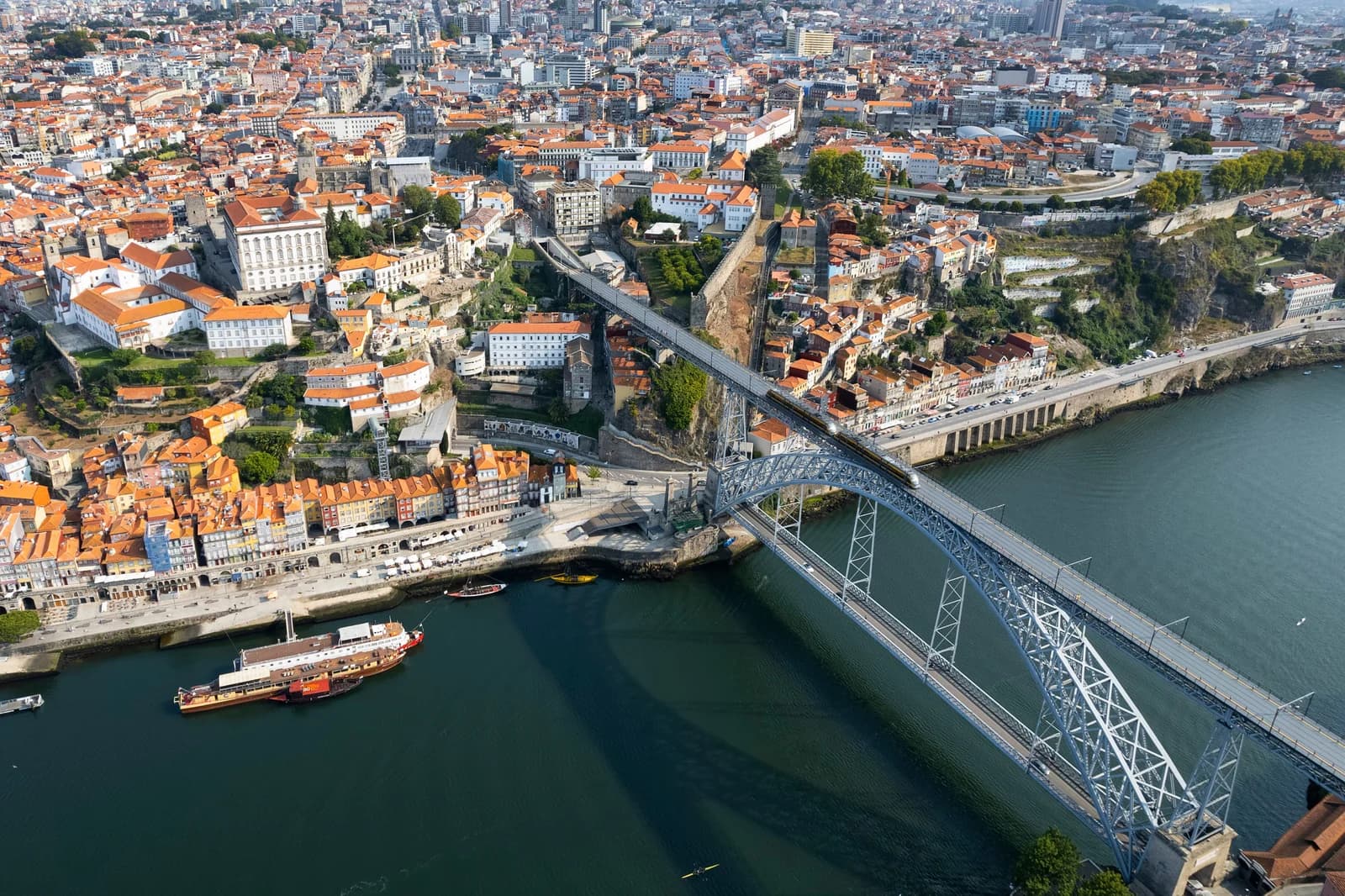
From Aveiro, Porto is only about an hour away, so you can take the morning slowly. Porto is hillier than it looks, so wear comfortable shoes. Begin in the Ribeira district along the Douro River, where narrow houses stack up the hillside and restaurants spill into the street. Walk across the upper deck of the Dom Luís I Bridge for a wide view over the river and the port cellars on the opposite bank in Vila Nova de Gaia.
Cross over to Gaia and take a cellar tour with a tasting. Learning how port wine is aged in oak barrels was far more interesting than I expected, and the tastings are good value. Back in Porto, visit the São Bento railway station to admire the blue azulejo tile murals, then grab a seat at a café for a coffee.
Food in Porto is hearty. The local specialty is the francesinha, a sandwich layered with meat, covered in melted cheese, and drowned in a rich sauce. It is enormous and not subtle, but it is worth trying once. For something lighter, order grilled octopus or a simple seafood rice.
Planning the Rental Car
The car is what makes this itinerary work. Trains and buses connect Portugal’s big cities well, but they don’t reach the cliffs at Cabo da Roca, the quiet beaches, or the villages off the main roads. Planning around timetables would have cost us hours every day, so I started looking at rentals early.
Comparing Offers on Discover Cars
I used Discover Cars to compare rental prices and pick-up and drop-off options between Lisbon and Porto, and it made the planning much simpler. Seeing the different suppliers side by side helped me spot the difference between a cheap-looking offer and one that actually fit our plans. The filters let me narrow things down by vehicle size, transmission and other preferences, which mattered because manual cars are still very common in Portugal and I wanted an automatic. All the conditions and prices were shown upfront, with no surprises at the desk, which I appreciated after past trips where the final bill did not match the quote.
Since I only needed the car from day 3, I searched for a five-day rental picked up in Lisbon and dropped off at Porto Airport. It returned 1,020 offers. That’s too many to scan by hand, so the filters did most of the work.
The price range across all offers runs from €60.36 to €2,379.41 for the five days. These totals are for the one-way trip, so I compared the total rather than the daily rate. Prices shown were correct at the time of writing and will change with your dates and demand.
Supplier Ratings
Every offer shows a customer rating for the company providing the car, grouped as Good (8+), Very Good (8.5+) and Excellent (9+). I stayed at 8 or above, which made a real difference to the price. The cheapest offers overall come from a supplier rated 7.7 (Average), and filtering to 8+ raised the cheapest total from €60.36 to €168.55. The cheapest option at each level:
Good 8+: from €168.55
Very Good 8.5+: from €175.82
Excellent 9+: from €308.46
The number of ratings appears beside each score. For example, one Thrifty offer had 8.2 (Good) from 307 ratings, while the cheapest Goldcar offers had 7.7 from 6,876. I trusted scores backed by thousands of reviews more. Discover Cars also has a rental conditions score filter (Good from €314.07, Fair from €60.36).
Deposit Details
Each listing shows its security deposit before you book:
High deposits: €1,600 on the MG ZS from Goldcar, and €2,100 on the SEAT Arona from U-Save
Average deposit: from €60.36
Low deposit option: from €168.55
No deposit: from €262.63
Usually, you need to keep in mind that a security deposit will be held on the main driver’s card, and it can take up to about 30 days to be released after you return the car. It is a hold, not a charge, but it still ties up part of your credit limit. Discover Cars now also offers no-deposit options, though. Tick the “No deposit” filter on the results page, and each matching offer is marked with a green “No deposit” badge. Hover over the info icon and it confirms no security deposit is required at pick-up, but a card is still needed for verification. If you choose a regular deposit instead, make sure the full amount fits on one card. I checked my limit before booking.
Discover Cars also lists No deductible offers from €168.55.
Full Coverage
Village streets in Portugal are narrow and parking spaces are small, so I added Full Coverage. Its price depends on the car, destination and trip length, and it appears next to each offer at checkout. It reimburses the excess and covers items basic waivers often leave out: tires, wheels, windows, mirrors, undercarriage damage, towing and lost keys.
You pay the supplier first, then claim the money back.
It doesn’t include third-party liability, which is normally part of the rental price.
It doesn’t remove the security deposit.
If the desk offers extra insurance at pick-up, you can politely decline.
Extras
The extras screen is easy to click past. Offers with these extras available start at:
Additional driver: from €113.43
Baby seat (0 to 13 kg): from €135.11
Booster seat (15 to 45 kg): from €110.57
Final seat and driver prices are set by each supplier, so check the checkout screen. I also made a note to ask about a toll transponder at pick-up, since Portugal’s electronic tolls are hard to handle without one.
Sample Offers I Saw
City pick-up (the option that fits collecting the car on day 3)
Peugeot 2008 (manual compact crossover) with Thrifty: €214.94 for 5 days. Rental office downtown. Average deposit. Rated 8.2 (Good) from 307 ratings.
Suppliers on the Platform
The supplier list includes Avis, Budget, Dollar, Europcar, Firefly, Goldcar, Hertz, SIXT, Thrifty, Drivalia, GreenMotion, U-Save and many local companies. The cheapest options from the supplier filter:
Budget-friendly: Goldcar (€60.36), GreenMotion (€80.57), U-Save (€82.75), Tangerine Rent A Car (€124.48), Record go (€137.84), Keddy (€175.82), Drive4Move (€205.61), Surprice (€207.72), International Car (€209.48), DiscoverCars choice (€221.26), Drivalia (€222.28)
Major brands, from: Thrifty €188.93, SIXT €261.01, Budget €266.70, Europcar €293.61, Avis €342.05, Dollar €352.69, Firefly €465.32, Hertz €473.31
Flexibility and Support
Free changes and cancellations up to 48 hours before pick-up
Help in 15+ languages, any time of day
35-language website and app, with full rental details and directions to the rental desk. Prices are sometimes even better in the app.
Rental Tips That Saved Me Trouble
Do not set your pick-up time to match your arrival time. On a previous trip I booked a car for the exact minute my flight landed. Between passport control, a slow baggage belt, and a long walk to the rental desk, I arrived over an hour late and nearly lost the reservation. For this trip I picked up the car in the city on day 3, which removed that stress entirely. If you do collect at the airport, give yourself a generous cushion.
Bring a credit card. Most rental desks require one in the main driver’s name for the deposit, and a debit card is often refused.
Choose full coverage. Portuguese village streets are tight, parking spaces are small, and a scrape is easy to get. Full coverage let me park without worrying and enjoy the trip.
Check the mileage and fuel policy. A full-to-full fuel policy is usually the simplest.
Tolls, Parking, and Driving Distances
Portugal has a mix of toll systems, and this is the part that confuses visitors most. Some highways, including the A1 between Lisbon and Porto, have toll plazas, while others use electronic-only tolls. Ask the rental company about a toll transponder when you pick up the car, because it lets you drive through without stopping and pays the tolls later. Without one, paying electronic tolls can become complicated. The bridges over the Tagus in Lisbon also charge tolls in one direction.
Parking is easiest in underground garages, which are common in Porto and Lisbon and usually cheaper than street parking in the center. In Sintra and Óbidos, use the lots at the edge of town. Do not leave luggage visible in the car anywhere. This is good advice in every European city, not just Portugal.
Distances are manageable. Lisbon to Sintra is about 40 minutes, Cascais to Óbidos about an hour and a half, Nazaré to Aveiro two to two and a half hours, and Aveiro to Porto around an hour. The fastest direct route from Lisbon to Porto takes about three hours.
Return to Porto or Lisbon?
This is the big decision. Returning the car in Lisbon means looping back, which adds driving time. Dropping it in Porto is far easier, though it often comes with a one-way fee. When you compare options, look at the total price including that fee rather than the headline daily rate. For me, paying the extra amount was worth it, since it saved almost a full day of driving and let me spend that time in Porto. If you are short on time, a one-way rental is the better choice. If you are on a tight budget, compare both options before you book.
Final Thoughts
A week is enough to experience the best of Portugal’s coast without rushing, as long as you stay flexible. Spend the first days in Lisbon without a car, then collect one for the coast and the hills of Sintra. Let the road carry you through Óbidos, Nazaré, and Aveiro, and finish with a slow evening by the river in Porto. Compare rental options carefully, think about whether you want to return the car in Porto or Lisbon, and leave room in the schedule for surprises.
The best moments of my trip were not on any list. They were the beach with no crowds, the handwritten menu, and the viewpoint where we stayed an hour longer than planned. Plan the basics, keep your days loose, and the rest will take care of itself.