
ValenciaSpainDestinationsTravel Guides
València: A Local's Guide to Spain's City of Water and Fire
By
The bridges give her away.
Stroll through València's Turia Gardens and you'll pass beneath centuries-old stone bridges built to carry people over a river. Only there's no river anymore. Below the bridges you'll find walking paths, playing fields, trees, cyclists and people zipping along on electric scooters.
Following catastrophic floods in 1957, the Turia River was diverted south of the city. Its former bed was eventually transformed into a remarkable urban park.
Each March, València finds another extraordinary use for its public spaces. Neighborhoods erect enormous, elaborate and frequently satirical sculptures in the streets. Tourists and locals alike spend days admiring them, judging them and celebrating the artists who created them. Then they set the whole lot on fire.
I've spent much of my adult life working, traveling and filming around the world. Now Zee and I have made our home in València, Spain's third most populous city. For a first visit, I'd send you wandering down medieval streets, into bustling markets, along the former riverbed and eventually to the beach for a proper rice lunch.
I'd also suggest looking up. There's a good deal to see above street level.
Begin with the market
Start at Mercado Central in the morning, when the stalls are busy and the vegetables, fruit, cheeses and cured meats will compete with the architecture for your attention.
Look for the ingredients you'll meet again at lunch: flat green beans and the large, broad white garrofó beans used in traditional Valencian paella. If you're hungry, you'll find plenty to eat without ever leaving the market. Zee and I particularly enjoy the fresh oysters.
The market is normally open Monday through Saturday, from 7:30 a.m. until 3 p.m., though things really do start to wind down closer to 2 p.m.
Across the street you’ll find La Lonja de la Seda, the city's UNESCO-listed Silk Exchange. Built between 1482 and 1533, this was where merchants gathered to negotiate contracts and conduct the business of the enormously profitable silk trade. At the time, València was among the Mediterranean's wealthiest commercial cities, and its merchants clearly weren't inclined to conduct business in modest surroundings.
Inside the main trading hall, enormous stone columns twist upward into a vaulted ceiling. It's a rather grand setting for the buying and selling of fabric.
The Cathedral, the Grail and the Rooftops
Continue toward the Cathedral (Catedral Basílica Metropolitana de la Asunción de Nuestra Señora de València) between Plaza de la Reina and Plaza de la Virgen. Construction began in 1262 on the site of the city's former principal mosque, and successive generations left their architectural marks. Its entrances alone offer Romanesque, Gothic and Baroque styles to compare.
Inside, one chapel holds the Holy Chalice, venerated as the cup Jesus used at the Last Supper. The relic itself is the polished agate bowl at the top. The elaborate gold handles and base were added centuries later.
Whether you believe in its provenance or not, it's worth a look.
Above the main altar, look for the Renaissance frescoes of angels playing musical instruments. Hidden behind a later Baroque vault for centuries, they were rediscovered during restoration work in 2004. Next, if you’re feeling adventurous, climb El Miguelete, the Cathedral's Gothic bell tower.
The tower's narrow spiral staircase has 207 steps, but once you’re at the top, you're rewarded with a sweeping view of tiled rooftops, domes, towers and the Mediterranean in the distance.
Back at ground level, Thursdays bring another reason to linger. The Tribunal de las Aguas, or Water Court, meets at noon outside the Cathedral's Apostles' Door. This centuries-old institution settles disputes over irrigation water among farmers. The oftentimes remarkably brief proceedings are public and conducted in Valencian (which to my ear sounds like a blend of Spanish and Italian with some French thrown in).
Farther north, the Torres de Serranos offer another climb and another view, this time toward the Turia Gardens. Built in the late 14th century, these enormous fortified gates rise approximately 33 meters, or 108 feet, above the street. Their massive stone walls once guarded one of the principal entrances to medieval València.
For views that require considerably less exertion, try Atenea Sky, overlooking Plaza del Ayuntamiento, or the Lladró Lounge Bar Rooftop at Hotel Palacio Vallier, with its views toward the Cathedral.

Follow the old river
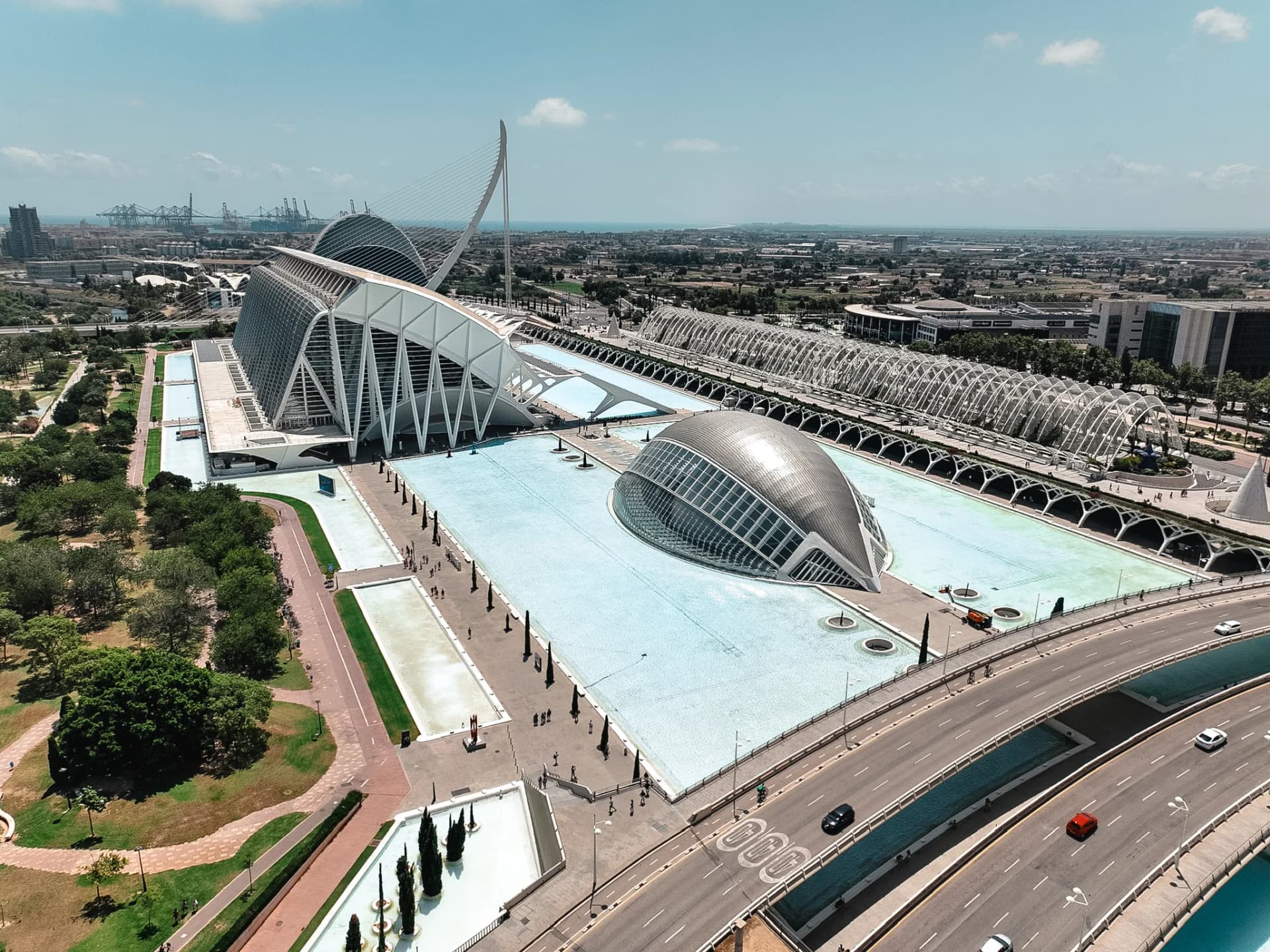
Follow the old riverbed toward the Mediterranean and you'll eventually reach the City of Arts and Sciences, where the architecture takes a considerable leap forward in time.
Most of this extraordinary complex was designed by València-born architect and engineer Santiago Calatrava, whose work includes New York's World Trade Center Transportation Hub, better known as the Oculus.
The Hemisfèric resembles an enormous eye rising from a reflecting pool. Nearby stand the Science Museum, the Palau de les Arts opera house and the Oceanogràfic, Europe's largest aquarium.
For a short visit, I'd begin with the exteriors. You can admire the architecture, walk the paths and take photographs without paying admission.
March belongs to Fallas
If you want to experience València at its loudest, most crowded and arguably most spectacular, come for Fallas.
The main festival days fall between March 15 and 19, when the streets fill with enormous sculptures, traditional dress, music, processions and fireworks. Public figures, politicians and current events provide a dependable supply of material for the sculptors, who spend much of the preceding year preparing their creations.
But the sound of Fallas arrives earlier in the month.
From March 1 through 19, the main mascletà is traditionally held in Plaza del Ayuntamiento at 2 p.m. This isn't a conventional fireworks display intended primarily for the eyes. It's an increasingly ferocious, carefully choreographed barrage of explosions intended to be not only heard but felt.
Bring ear protection. Seriously. And arrive well before the start.
The festival concludes on March 19 with the cremà, when the elaborate monuments are burned. Selected individual figures, called ninots, are spared by public vote and preserved in the Fallas Museum. Almost everything else, the product of months of skilled and painstaking labor, goes up in flames.
I remember pushing through the crowds with everyone else to get a better view of one particular falla on the night of the cremà. Then they lit it.
The heat was astonishing. Suddenly, nobody wanted to be quite so close, and the firefighters' hoses provided additional encouragement to retreat.
Book accommodation well in advance, expect street closures and don't count on a peaceful night's sleep. If you want quiet, visit during another month.
Make room for lunch
Traditional paella valenciana generally includes chicken, rabbit, green beans and garrofó beans, although recipes vary across the region. Seafood rice dishes have their own place at the table.
Most importantly, paella is a lunch, not a dinner, tradition. Reserve where possible and ask whether you need to order your rice in advance.
There is also esmorzaret, the Valencian midmorning meal, typically built around a substantial sandwich accompanied by olives, peanuts and something to drink. It can be a serious undertaking.
For something sweet, order horchata de chufa, a cold drink made from tiger nuts and traditionally served with fartons, the long, soft pastries meant for dipping.
Elsewhere on the menu, look for esgarraet, made with roasted peppers, salt cod, garlic and olive oil. Around L'Albufera, you'll also find all i pebre, a traditional eel and potato stew.
Then there are the drinks.
Agua de València is a potent combination of orange juice, cava, gin and vodka. Cava, incidentally, is Spanish sparkling wine.
Sangria? Sure, although you're more likely to see pitchers of it on tables crowded with tourists, but who am I to judge? If you'd like something simpler and more refreshing, try tinto de verano, red wine mixed with lemon soda and served over ice.
Make time for pilota
València has another Cathedral, though this one has rather less to do with religion: the Trinquet de Pelayo, near Estació del Nord.
Opened in 1868, it's a landmark of pilota valenciana, the region's traditional handball sport. The court is reached through a restaurant, which strikes me as an excellent arrangement.
When I went with Zee and friends, I found it easier to follow the crowd's applause than the rules. The experienced spectators had brought seat cushions, which they raised to protect themselves whenever the small, hard leather ball came flying toward the stands.
I was busy filming the match for my squash-playing father when the ball caught me squarely in the shoulder.
I suppose I should have been paying closer attention.
Check the schedule in advance, ask the staff where to sit and keep your eyes on the ball.
Choose a neighborhood, then explore another
For a first visit, I'd stay in Ciutat Vella or the adjoining L'Eixample district.
Ciutat Vella puts the historic center practically outside your door, although a room overlooking a lively square may come with more atmosphere than you'd prefer at midnight.
Within L'Eixample, Gran Via and Pla del Remei offer attractive central bases. Russafa, also commonly spelled Ruzafa, is an excellent choice for cafés, independent shops, restaurants and evenings that have a habit of running away from you.
Stop at Mercado de Colón, too. Opened in 1916, this beautiful Modernist market building now houses cafés, restaurants and bars beneath its colorful brick arches and ceramic decoration.
For the coast, head to El Cabanyal, a former fishing neighborhood whose streets retain row upon row of distinctive tiled houses. Look closely at their colors and patterns before continuing to the broad sands of Cabanyal and Malvarrosa.
Give the seafront time of its own. A walk along the promenade and lunch overlooking the beach can comfortably become the day's main event.
Take the rice road south

South of the city, L'Albufera Natural Park brings much of València's food, water and landscape together. Rice fields surround a vast lagoon, and fishing remains part of the area's identity.
El Palmar is a good destination for a traditional rice lunch followed by a boat trip through the lagoon's shallow waters.
If sunset is your priority, arrange the boat trip accordingly. In summer, lunch and sunset can be many hours apart, so plan for the considerable stretch of afternoon in between.
You can get there without renting a car as EMT bus 24 serves El Palmar.
Plan around the city you're visiting
For walking and sightseeing, I'd suggest spring or autumn, while allowing for plenty of heat in June and September and the possibility of heavy rain in autumn.
Summer can be hot and humid. Winter is generally milder than northern Europe, although you'll still want a jacket for the evenings. Check official weather warnings, especially if you're planning excursions outside the city.
Zee and I find Citymapper invaluable for getting around. I'd walk the historic center and use buses or the metro for longer journeys.
For public transportation, compare SUMA tickets with individual fares and visitor passes. Payment arrangements differ between operators, so don't assume that tapping a bank card will work everywhere.
What I'd leave time for
One afternoon, Zee and I escaped a downpour in a bar near Plaza del Ayuntamiento. Valencia CF scarves hung above the counter, and losing lottery tickets covered the walls.
Zee ordered herself a cava and a tinto (red wine) for me. Then I noticed what was playing on the television.
The Spanish version of Jeopardy!
After a career spent working on the American show, I had opinions about what I was seeing. Quite a few opinions, actually.
Unfazed, Zee kept drinking her cava and I, my tinto.
“Salud,” I said. We cheersed again and smiled. For no reason in particular.
About the author
Brett Schneider is a writer, screenwriter and former producer/director of Jeopardy!, where his work earned a Peabody Award and eight Emmys. He lives in València with his partner, Zee James, with whom he created Voyagers Escape. He’s also the author of WORLDWIND, a young adult fantasy adventure. You can read its opening chapter free at Voyagers Escape.
About the photographer
Zee James is a SAG Award-winning actress, stunt performer, voice-over artist and producer whose screen credits include Black Panther, Bosch, Good Girls, Mistresses, Straight Out of Compton and many more. Zee founded Voyagers Escape alongside Brett Schneider.