
Tribunal de las Aguas
Plaça de la Mare de Déu, 1, Ciutat Vella, 46001 València, Valencia, SpainEvery Thursday at noon, in the small square outside the Door of the Apostles at Valencia Cathedral, eight men in black smocks carry out a half-circle of chairs, sit down, and begin hearing water disputes in Valencian. This is the Tribunal de las Aguas, the water court of the Valencian huerta, and it is almost certainly the oldest functioning judicial body in Europe. It meets in the open air, in Plaça de la Mare de Déu, with no lawyers, no paperwork, and no right of appeal. If you time a Thursday visit around it, you are watching something that has nothing to do with tourism and everything to do with how this city has managed its water for roughly a thousand years.
Why the Tribunal de las Aguas matters
Valencia sits on a plain fed by the Turia river, and for centuries that plain has been divided into irrigation channels, or acequias, that carry river water out to the farms of the huerta. Sharing that water fairly, especially in dry summers, has always needed some form of arbitration. The Tribunal de las Aguas is that arbitration made permanent: a court made up of farmers, elected by farmers, that exists purely to settle disputes over who gets water, when, and how much. UNESCO recognised it in 2009, adding the Tribunal to its list of Intangible Cultural Heritage, not for its age alone but because it is still a living system rather than a preserved one. Nobody re-enacts the Tribunal. It simply keeps doing what it has always done.
What makes it worth building a Thursday around, honestly, is how little spectacle there is. There's no script, no amplification, no concession to visitors who don't speak Valencian. You are watching a working institution go about ordinary business, which is rarer in a historic city center than almost anything else on offer.
Quick facts
- Meets every Thursday at noon outside the Door of the Apostles, Valencia Cathedral, Plaça de la Mare de Déu
- Eight judges, one representing each of the historic acequias that draw from the Turia
- Judges are elected by the irrigators of their own channel, for two-year terms
- Added to UNESCO's Intangible Cultural Heritage list in 2009
- Proceedings are conducted entirely in Valencian, with no written record kept
- Sessions typically last ten to fifteen minutes, sometimes with no cases to hear at all
- Free and open to the public, standing only, no tickets or reservations
- If a public holiday falls on a Thursday, the session moves to the preceding Wednesday
History and background
The roots of the Tribunal go back to the irrigation administration of Al-Andalus, when Islamic rule organized the huerta's water distribution through local channel assemblies. After the Christian conquest of Valencia in 1238, Jaume I confirmed and formalized the existing water customs rather than replacing them, which is part of why the court still operates in Valencian and still follows oral procedure rather than the written civil law that governs almost everything else in Spain. The Tribunal has continued, with interruptions during periods of upheaval but without any real institutional break, ever since. It predates the cathedral square it now meets in front of and has outlasted several forms of government.
The eight seats correspond to the historic acequias of the Valencian huerta, channels with names like Rascanya, Mestalla, and Favara, each drawing from the Turia at a different point and feeding a different stretch of farmland around the city. Irrigators within each acequia elect their own representative, so the judges are working farmers rather than appointed officials, and the court's authority rests entirely on the consent of the people who use the water.
The layout and experience
The setting is plain and that is the point. The Door of the Apostles, the cathedral's Gothic side entrance facing Plaça de la Mare de Déu, forms the backdrop. A bailiff calls the parties forward by name. Each side states its case briefly, standing in front of the seated judges. The judges confer among themselves, quietly, and then deliver a verdict out loud, right there, with no deliberation room and no delay. Fines, when imposed, are measured in a traditional water unit rather than a cash sum, a detail that underlines how little this procedure has adapted to modern administrative habits.
There is no barrier separating spectators from the proceedings beyond common sense and a respectful distance. You can stand close enough to see the judges' faces and hear the rhythm of the exchange even if you don't follow the Valencian. Some Thursdays there are two or three cases. Some Thursdays there are none, and the court convenes, confirms there is nothing on the docket, and disperses within a couple of minutes. Either outcome is the real thing, not a disappointing version of it.
Best time to visit
Thursday, just before noon, is the only time this exists. Arrive by around 11:45 to get a position with a clear sightline, since the square is small and a modest crowd forms along the edges each week, partly tourists and partly locals who still bring disputes or simply like to watch. There's no indoor fallback and no rain date beyond the holiday-to-Wednesday rule, so check whether the Thursday you're planning around happens to be a public holiday in Valencia, since the session shifts a day earlier in that case.
Combining with nearby attractions
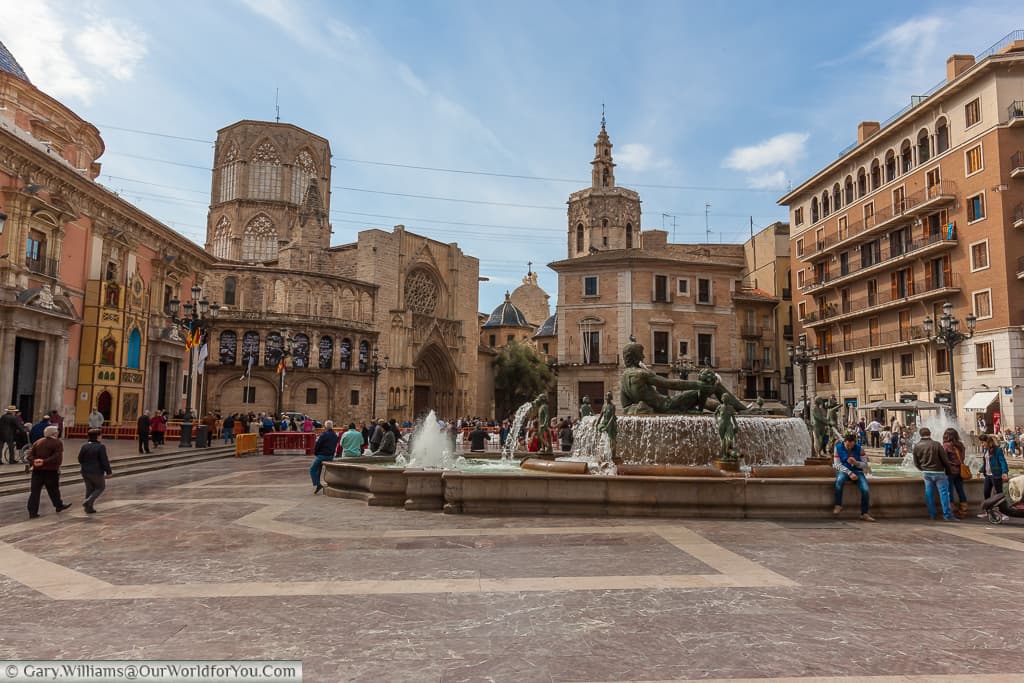
The Tribunal meets right outside Valencia Cathedral, so pairing the two is the obvious move. You can go inside the cathedral afterward to see the chapel that holds the Holy Grail relic, or climb the Miguelete bell tower a short walk from the square. Plaça de la Mare de Déu itself is worth a few minutes before or after, with its Turia fountain representing the river and its surrounding acequias as stone figures, a nice visual echo of what you've just watched decided in person. The Lonja de la Seda, Valencia's UNESCO-listed silk exchange, is a five to ten minute walk away in Ciutat Vella, and the Central Market sits just beyond that, making a Thursday midday easy to build into a longer loop through the old town.
Sample visit plan
Arrive in Plaça de la Mare de Déu by 11:45 and find a spot near the Door of the Apostles. Watch the session, which rarely runs past 12:15. Step into the cathedral afterward, or circle around to the Lonja de la Seda and the Central Market for lunch, both within easy walking distance. If you have more time, the Plaza de la Virgen area has cafes where you can sit and read up on what you just saw, since very little is explained on site.
Practical tips
- Nothing is translated or narrated, so a little background beforehand helps more than anything you'll find on site
- Stand toward the edges nearest the cathedral door for the clearest view of the judges
- Sessions are short, so don't build an entire morning around travel time, just be there by 11:45
- Photography is generally fine from a respectful distance, but this is a functioning court, not a photo op, so keep flash and intrusive behavior out of it
- Check the date against the Spanish and Valencian holiday calendar if your trip falls near one, since the session may shift to Wednesday
- There's no seating for spectators, and the square can be sunny and exposed around midday
FAQ
Is the Tribunal de las Aguas free to attend?
Yes. It's a public judicial proceeding in an open square, not a ticketed event, and there is no cost to watch.
Do I need to understand Valencian to follow it?
Not to follow the shape of what's happening, but you won't understand the content of the cases. Most visitors watch it as a piece of living tradition rather than for the legal detail.
What happens if there are no cases that week?
The eight judges still convene, confirm there's nothing to hear, and the session ends within a few minutes. This happens fairly often and is considered a normal outcome, not a cancellation.
Where exactly should I stand?
Right outside the Door of the Apostles on Plaça de la Mare de Déu, facing the cathedral. The space is small enough that there's no bad vantage point if you arrive a few minutes early.
Is this the same as a tourist reenactment?
No. The Tribunal de las Aguas is an active court handling real irrigation disputes among the farmers of the Valencian huerta. Nothing about it is staged for visitors, which is also why it can feel anticlimactic to anyone expecting a show.
Reviews
Sign in and mark this place visited to leave a review.
No reviews yet.
Free Trip Planner
Plan your Valencia trip with our free planner
Build a day-by-day itinerary with AI suggestions, hand-picked places, and friends. Free forever — no credit card.
Related reading

Things to see near Tribunal de las Aguas



Places to eat or drink near Tribunal de las Aguas

El Poblet

Keksy Cookies

Atenea Sky

Central Bar
More places in Valencia

La Lonja de la Seda

Lladró Lounge Bar

Plaza De Toros. Monumental De Valencia
