
Basilica of Santa Maria Novella
Open now
Basilica of Santa Maria Novella
Piazza di Santa Maria Novella 18, 50123, Florence Italy Posted by Brandon B.Admin
The Basilica of Santa Maria Novella, Florence
The Basilica of Santa Maria Novella stands at the northwestern edge of Florence's historic center, facing a long rectangular piazza that still carries its name. It is one of the oldest and most important Gothic churches in Tuscany, and for many visitors arriving by train, it is literally the first major monument they see. The station next door was named after it. That proximity is either a convenience or a trap, depending on whether you walk past without stopping.
Don't walk past without stopping.
Why Santa Maria Novella Matters
This basilica is not just a pretty facade. It holds one of the most consequential paintings in Western art history: Masaccio's Trinity fresco from around 1427, widely considered the first painted image to use mathematically correct linear perspective. Seeing it in person, understanding what it meant to Florentine painters who stood in front of it and suddenly saw depth rendered on a flat wall for the first time, is one of those genuinely affecting museum experiences.
Beyond Masaccio, the church contains frescoes by Ghirlandaio in the Tornabuoni Chapel, a crucifix by Brunelleschi, and works connected to Filippino Lippi. The Dominican friars who commissioned much of this work were among the most influential patrons in 15th-century Florence. The building itself, with its famous green-and-white marble facade completed by Leon Battista Alberti in 1470, helped define what Renaissance architecture would look like for the next two centuries.
Quick Facts
- Location: Piazza di Santa Maria Novella, a short walk from the Santa Maria Novella train station
- Type: Active Dominican basilica and museum complex
- Facade completed: 1470, by Leon Battista Alberti
- Original construction began: around 1246
- Key works: Masaccio's Trinity (c. 1427), Ghirlandaio's Tornabuoni Chapel frescoes, Brunelleschi's wooden crucifix
- The complex includes the church, cloisters, and the Spanish Chapel
- Entry requires a ticket for the museum sections; the church proper may have different access depending on the time of day
Getting There
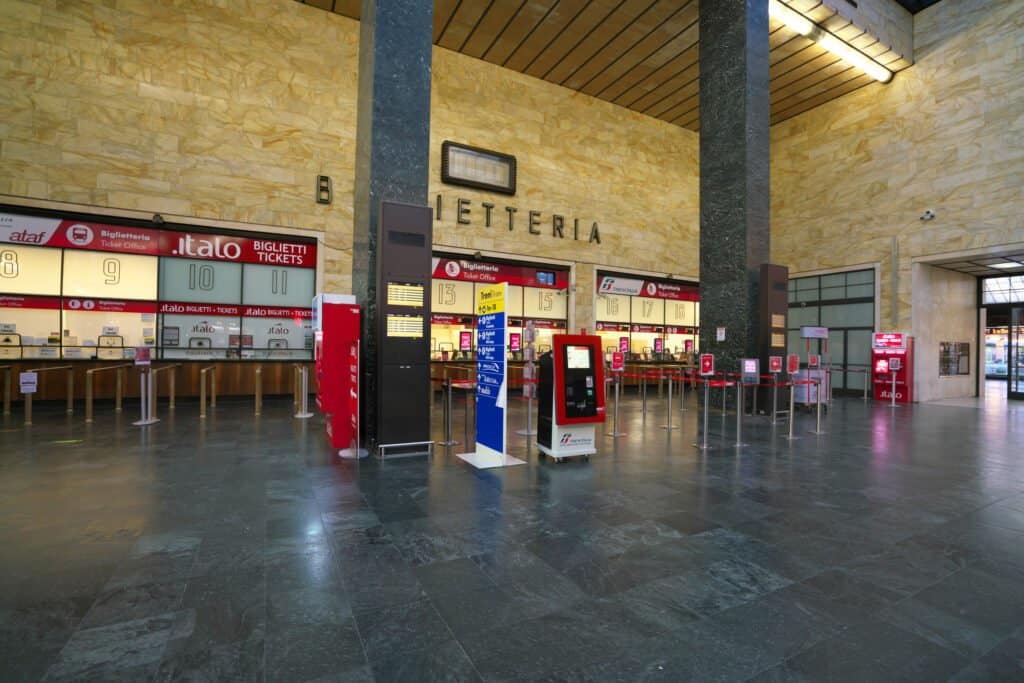
The basilica is about a two-minute walk from Stazione di Santa Maria Novella, Florence's main rail hub. If you arrive in Florence by train, you will almost certainly exit facing the piazza. Turn left out of the main station entrance and the facade is directly ahead of you.
From the Duomo, the walk takes roughly ten to fifteen minutes on foot through the city center. The piazza itself is wide and usually busy, with outdoor seating from nearby cafes spilling into the square on warmer days.
The Layout and Experience
The complex is larger than most visitors expect. You enter through the ticketing area and move through the church interior first, then out into a series of cloisters. The first cloister, the Chiostro Verde (Green Cloister), takes its name from the greenish tone of Paolo Uccello's frescoes on its walls, painted in the 1430s. The second, the Great Cloister, is typically reserved for the Carabinieri school that uses part of the complex and is not always accessible to the public.
The Spanish Chapel, off the Green Cloister, is a room that tends to stop people cold. The entire interior is covered floor to ceiling with 14th-century frescoes by Andrea di Bonaiuto, depicting Dominican theology in dense, almost overwhelming visual detail. It was originally built as the chapter house and later assigned to the Spanish community accompanying Eleanor of Toledo, wife of Cosimo I de' Medici.
The church nave is long and austere by Florentine standards, with pointed Gothic arches and a nave wide enough to hold a congregation of thousands. Light enters from high windows and falls at a low angle in the afternoons, which is worth timing your visit around if you care about that sort of thing.
Main Highlights
Masaccio's Trinity
On the left wall of the nave, roughly two-thirds of the way toward the altar, is the Trinity. It is not large. But the barrel-vaulted ceiling Masaccio painted above the figures recedes into the wall with such convincing depth that the fresco looks like a window cut into the stone. Painted around 1427, it predates much of what most people think of as "Renaissance painting." Give it more than a glance.
The Tornabuoni Chapel
The main altar chapel, commissioned by Giovanni Tornabuoni in the 1480s, was frescoed by Domenico Ghirlandaio between 1485 and 1490. The young Michelangelo worked in Ghirlandaio's workshop during this period, though attribution of specific work here to him is contested. The frescoes depict scenes from the lives of the Virgin and John the Baptist, populated with recognizable portraits of wealthy Florentine families dressed in contemporary 15th-century clothing. It is essentially a society portrait gallery disguised as sacred art.
Brunelleschi's Crucifix
Hanging in the Gondi Chapel on the left side of the nave is a carved wooden crucifix attributed to Filippo Brunelleschi. According to Vasari, Brunelleschi made it in response to seeing Donatello's crucifix at Santa Croce and finding it too rustic. Whether or not that story is entirely accurate, the two crucifixes make an interesting comparison if you visit both churches on the same day.
Tickets and Entry
Entry to the museum complex (which includes the cloisters, Spanish Chapel, and associated rooms) requires a paid ticket. The church nave itself is sometimes accessible for free during non-religious hours, but this can change depending on the time of year and liturgical calendar. Timed entry is not always required, though during peak season in summer the queue can build up, particularly in the late morning.
Combination tickets with other city museums are sometimes available. It is worth checking the official Museo di Santa Maria Novella website before your visit for current arrangements, since ticketing in Florence has shifted around in recent years.
Best Time to Visit
Mornings on weekdays tend to be quieter, especially before 10am. The piazza itself is liveliest in the early evening when locals cross it on their way to and from the station. Summer afternoons bring large tour groups into the nave, which makes quiet contemplation of the Masaccio fresco difficult.
Late autumn and winter visits reward those who don't mind cooler temperatures. The light through the nave windows is lower and more dramatic in November and December, and the crowds thin out considerably after the school holiday rush ends.
Combining with Nearby Attractions
The Museo Nazionale Alinari della Fotografia, dedicated to the history of photography, sits just off the piazza. The Officina Profumo-Farmaceutica di Santa Maria Novella, one of the oldest pharmacies in the world and connected to the Dominican friars who founded the basilica, is located on Via della Scala a few minutes' walk away. It sells herbal preparations, perfumes, and cosmetics that trace their origins back to the 14th century and is worth a visit even if you don't buy anything.
From the basilica, you can walk to the Duomo in about twelve minutes, passing through the Piazza della Repubblica. Santa Croce, which holds Donatello's crucifix for the Brunelleschi comparison, is about twenty minutes on foot to the east.
Practical Tips
- Dress code is enforced: shoulders and knees must be covered to enter the church
- Photography is generally permitted in the museum areas but may be restricted in certain chapels during services
- The complex is closed on certain religious holidays; check ahead if your visit falls around Easter or major feast days
- Audio guides are available at the entrance and add meaningful context to the frescoes, particularly in the Spanish Chapel
- Arrive early or later in the afternoon to avoid the midday tour group peak
- The piazza has several cafe terraces if you want to sit and look at the facade after your visit
- Allow at least ninety minutes for a thorough visit; the cloisters alone take longer than most people expect
Frequently Asked Questions
Is the Basilica of Santa Maria Novella free to enter?
The museum complex and cloisters require a paid ticket. The church nave may be accessible without charge during specific hours outside of museum opening times, but this varies. It is safest to assume you will pay for entry and treat any free access as a bonus.
How long does a visit take?
Most visitors spend between one and two hours. If you are interested in the frescoes in depth, particularly the Spanish Chapel and the Tornabuoni cycle, budget closer to two hours.
Can you visit both the church and the cloisters on one ticket?
Generally yes. The standard ticket covers the church interior and the museum sections including the cloisters and Spanish Chapel. Confirm at the ticket desk when you arrive.
Is it accessible for visitors with mobility limitations?
The main church floor is largely flat and accessible, but some parts of the cloister complex involve uneven stone surfaces. It is worth contacting the museum directly if accessibility is a specific concern before your visit.
Is this the same Santa Maria Novella as the famous pharmacy?
Yes and no. The pharmacy, the Officina Profumo-Farmaceutica di Santa Maria Novella, was originally founded by Dominican friars from this basilica in the 13th century. It is now a separate commercial operation located nearby on Via della Scala, but the historical connection is genuine.
Opening hours
Reviews
Sign in and mark this place visited to leave a review.
No reviews yet.
Free Trip Planner
Plan your Florence trip with our free planner
Build a day-by-day itinerary with AI suggestions, hand-picked places, and friends. Free forever — no credit card.
Things to see near Basilica of Santa Maria Novella

Museo dell’Acqua

Porta Camollia

Basilica dell’Osservanza

Certosa di Pontignano
Places to eat or drink near Basilica of Santa Maria Novella



More places in Florence
Santa Maria Novella Florence Train Station

Basilica San Miniato al Monte
Ponte Vecchio
