Hospital de los Venerables
Plaza Venerables 8 Barrio Santa Cruz, 41004 Seville Spain Posted by Brandon B.Admin
Hospital de los Venerables: A Baroque Gem in Seville's Old Quarter
Tucked into a quiet square in the Barrio Santa Cruz, the Hospital de los Venerables is one of Seville's most rewarding cultural stops. Built in the late 17th century as a residence and care home for elderly priests, it has since become a museum and arts foundation that most visitors to the city walk right past. That's their loss. The building itself is worth the detour, and what's inside, particularly the collection of works by Velázquez and his circle, makes it genuinely hard to leave.
It sits on Plaza Venerables, a small, sun-drenched square that feels removed from the crowds on nearby Calle Mateos Gago. You'll hear the orange trees before you see them.
Why Hospital de los Venerables Matters
Seville has no shortage of ornate churches and historic courtyards. What sets this place apart is the combination of an almost perfectly preserved Baroque interior and a focused, serious art collection that doesn't try to be everything at once. The FOCUS Foundation, which manages the building, has arranged the space around a permanent collection dedicated to Velázquez, the Seville-born painter who went on to define Spanish portraiture. This isn't a broad survey of Golden Age painting. It's a deliberate, intimate look at one artist and his world, housed in a building that dates from the same era.
The church attached to the hospital is arguably the finest Baroque interior in a city full of them. Frescoes by Juan de Valdés Leal and his son Lucas Valdés cover the ceiling and walls. The gilded altarpiece catches the afternoon light in a way that photographs simply don't capture.
Quick Facts
- Address: Plaza Venerables 8, Barrio Santa Cruz, Seville
- Managed by the FOCUS-Abengoa Foundation
- Construction completed in 1697
- Houses the Centro Velázquez permanent collection
- Includes a 17th-century church, two-story courtyard, and underground crypt
- General admission required; guided tours sometimes available
- Located roughly 5 minutes on foot from the Seville Cathedral
Getting There
The hospital sits inside the Barrio Santa Cruz, Seville's old Jewish quarter and the neighborhood most visitors spend their first day exploring. From the Seville Cathedral, head northeast along the edge of the Alcázar walls and into the barrio. It takes about 5 minutes at a relaxed pace. There's no direct tram stop at the door, but the area is entirely walkable from the city center.
If you're coming from the Alameda de Hércules or the Triana neighborhood, allow closer to 20 minutes on foot, or take a taxi to Plaza Santa Cruz and walk the last two minutes from there.
The Layout and Experience
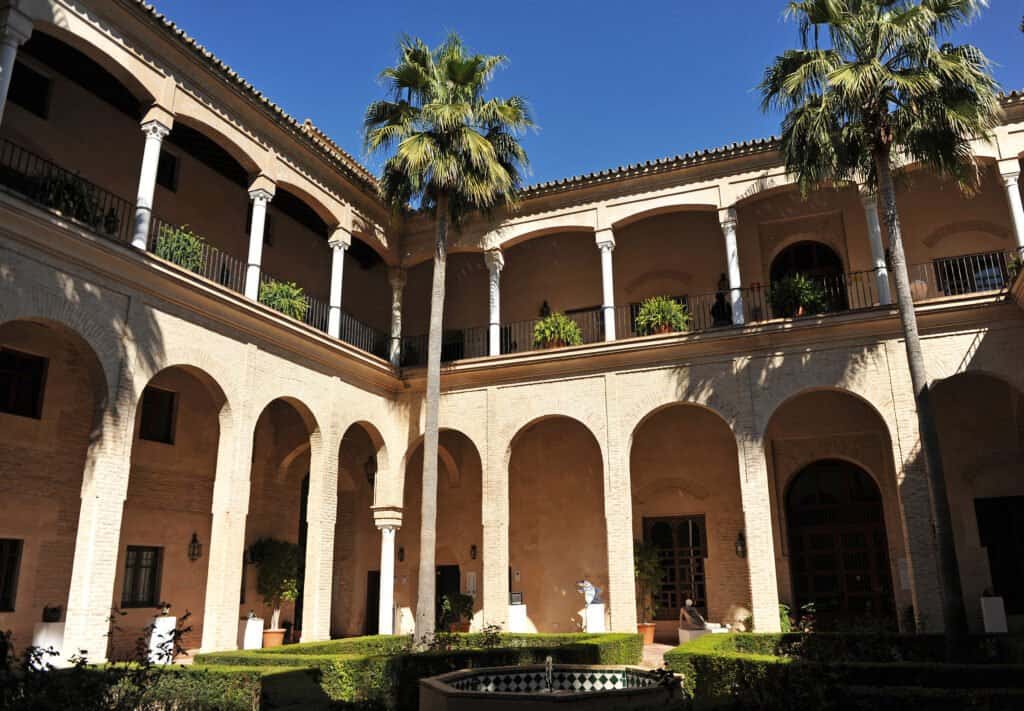
You enter through a doorway on Plaza Venerables into a central courtyard with a fountain, double-height arcades, and the kind of proportions that Baroque architects got exactly right. The courtyard is the organizing spine of the building. Galleries branch off from it, and the church sits at the far end of the ground floor.
The Centro Velázquez occupies several rooms on the upper floor. The collection includes works attributed to Velázquez himself alongside pieces by his contemporaries and students, presented with enough context that you don't need an art history background to follow the thread. Wall text is available in Spanish and English.
The church is a separate but connected experience. Plan to spend time there. The ceiling frescoes by Valdés Leal are detailed enough to reward a long look upward, and the space is small enough that nothing feels distant. There's also access to the underground crypt, which is cool and quiet even on hot days.
History and Background
The hospital was founded in 1675 under the patronage of Archbishop Ambrosio Spínola de la Cerda, designed to provide housing and medical care for retired and indigent priests, who were referred to as "venerables." The architect Juan Domínguez oversaw most of the construction, which wrapped up in 1697. For roughly two centuries the building functioned as it was intended, housing elderly clergy until the 19th century brought a series of political upheavals that disrupted religious institutions across Spain.
The building passed through different hands and uses before the FOCUS Foundation undertook a major restoration in the 1980s and 1990s. The restoration brought the frescoes back to something close to their original condition and established the current museum program. The Centro Velázquez opened as a dedicated space to honor Seville's most famous painter, who was born in the city in 1599, just a short walk from where this building would later rise.
Main Highlights
The Church of San Fernando
The church attached to the hospital is the heart of the visit for many people. Valdés Leal and his son Lucas painted the ceiling frescoes and much of the decorative program, and the quality is remarkable. The gilded altarpiece draws the eye immediately, but give the ceiling the time it deserves. A mirror is sometimes provided to spare your neck.
Centro Velázquez
The permanent collection focuses on Diego Velázquez and the Sevillian school of painting from the 17th century. Works here include pieces that show his early development in Seville before his move to Madrid. The curation is careful and the rooms are never overcrowded, which gives the experience a quietness that the big museums in the city rarely manage.
The Courtyard
Even if you spent the whole visit in the courtyard, it would be worth the entry fee. The double arcade, the central fountain, and the proportions of the space are exactly what you come to Seville hoping to find. It's also a useful place to orient yourself before moving through the rest of the building.
The Crypt
The underground crypt is easy to overlook but worth seeking out. It's a simple, vaulted space that offers a different texture from the gilded excess of the church above. Depending on the time of year, it can also be a genuine relief from the heat.
Best Time to Visit
Mornings on weekdays tend to be the quietest. The Barrio Santa Cruz fills up quickly once tour groups arrive, often by mid-morning, so if you want the courtyard mostly to yourself, aim for shortly after opening. Afternoon visits work well in summer because the building stays cool, but the square outside gets very hot by early afternoon.
Spring and autumn are the most comfortable seasons in Seville generally. If you're visiting during Semana Santa or the Feria de Abril, the city is packed and even off-the-beaten-path spots like this one see more foot traffic than usual.
Combining with Nearby Attractions
The hospital is surrounded by some of Seville's most visited sites, which makes it easy to fold into a full morning or afternoon in the old city. The Alcázar is a 5-minute walk to the southwest. The Seville Cathedral and Giralda tower are similarly close. The Hospital de la Caridad, another Baroque institution with paintings by Murillo and Valdés Leal, is about 15 minutes on foot heading toward the river.
For a focused Baroque art morning, pair the Venerables with the Hospital de la Caridad and finish with a walk along the riverfront. That combination covers the major works of Valdés Leal in Seville and gives you a sense of the city's 17th-century artistic output that the cathedral and Alcázar don't fully provide.
Practical Tips
- Buy tickets at the door or check the FOCUS Foundation website in advance, especially during high season
- The building is air-conditioned, making it a good midday stop in summer
- Photography is generally allowed in the courtyard; rules inside the church and galleries may differ, so check on arrival
- Audio guides and guided tours are sometimes available and worth considering for the church frescoes specifically
- Wear comfortable shoes; the barrio's cobblestones are uneven and the streets leading here from the cathedral are not always obvious
- The square outside has a small bar nearby, useful for a coffee before or after
- Allow at least 60 to 90 minutes for a thorough visit
FAQ
Is the Hospital de los Venerables suitable for children?
It can work well for older children with an interest in art or history, but it's a quiet, contemplative space rather than an interactive one. Very young children may find it hard to engage with for a full visit.
How long should I plan for the visit?
Most visitors spend between 60 and 90 minutes. If you want to spend serious time with the Velázquez collection and the church, budget closer to two hours.
Is the site accessible for visitors with mobility limitations?
The ground floor courtyard and church are generally accessible, but the building's age means some areas involve steps. It's worth contacting the foundation directly to confirm current accessibility provisions before your visit.
Is it better to visit before or after the Alcázar?
After tends to work better. The Alcázar often requires timed entry and can take two to three hours. The Venerables is a quieter, slower experience that works well as a follow-up once the main Alcázar crowds have dispersed slightly.
The Hospital de los Venerables rewards the visitors who find it. It doesn't advertise itself aggressively, it doesn't need to. The building has been here since 1697, and it's in no hurry. If you're spending any meaningful time in Seville's old quarter, this is the kind of place that stays with you longer than the famous sights that everyone photographs and immediately forgets.
Reviews
Sign in and mark this place visited to leave a review.
No reviews yet.
Free Trip Planner
Plan your Seville trip with our free planner
Build a day-by-day itinerary with AI suggestions, hand-picked places, and friends. Free forever — no credit card.
Related reading


Things to see near Hospital de los Venerables


Places to eat or drink near Hospital de los Venerables

Bodeguita Antonio Romero Arfe

Mercado de Triana

Las Teresas

Taberna Álvaro Peregil
More places in Seville

Setas de Sevilla (Metropol Parasol)

Iglesia de Santa Maria la Blanca
Palacio de los marqueses de la Algaba