Museo Palacio de la Condesa de Lebrija
Calle Cuna 8, 41004 Seville Spain Posted by Brandon B.Admin
A Palace Frozen in Time on Calle Cuna
The Museo Palacio de la Condesa de Lebrija sits quietly on Calle Cuna 8 in central Seville, easy to miss if you don't know to look for it. No grand plaza announces it. No tour buses idle out front. You push through an ornate doorway and find yourself inside one of the most personal, idiosyncratic collections in all of Andalusia — a private palace that has barely changed since the early twentieth century.
This is not a state museum with curated wall labels and gift shop tote bags. It's closer to stepping into someone's extraordinarily well-traveled home, if that someone happened to have a passion for Roman mosaics, pre-Columbian ceramics, and Flemish tapestries all at once.
Why the Condesa de Lebrija Matters
The palace owes its current character almost entirely to one woman: Regla Manjón y Mergelina, the Countess of Lebrija, who acquired the building in 1901 and spent decades filling it with antiquities she excavated, purchased, and collected with genuine scholarly intent. She was not simply a wealthy eccentric decorating a townhouse. She participated in archaeological digs near the town of Lebrija, about 60 kilometers south of Seville, and brought many of the finds back here, embedding Roman mosaics directly into the floors of the palace's rooms and patios.
The result is something genuinely strange and wonderful. You walk across a second-century Roman mosaic as if it were floor tile. You look up and see Mudéjar plasterwork from the fifteenth century. You turn and find a Chinese export porcelain piece next to a Roman funerary urn. The Countess didn't organize things by period or provenance. She organized them by how they looked together, and somehow it works.
Quick Facts
- Address: Calle Cuna 8, 41004 Seville
- Neighborhood: Historic center, roughly 5 minutes on foot from the Cathedral
- Ticket types: General admission covers the ground floor; a separate ticket is required to access the upper floor (private family quarters)
- Guided tours available in Spanish and English on certain days
- The building dates to the fifteenth century, with significant renovations in the sixteenth century
- Photography is permitted in most areas of the ground floor
- The palace remains privately owned by the Countess's descendants
Getting There
Calle Cuna runs through the Santa Cruz and Centro neighborhoods, within easy walking distance of most of Seville's major sights. From the Giralda tower, the walk takes roughly 5 minutes heading north through the old city streets. From the Metropol Parasol on Plaza de la Encarnación, you're about the same distance heading south. The streets here are narrow and designed for pedestrians, so arriving on foot is genuinely the easiest option.
If you're coming from further out, the nearest tram stop on the T1 line at Plaza Nueva puts you about 8 minutes away on foot. There's no dedicated parking nearby, and the surrounding streets are largely restricted, so driving is not worth the hassle.
The Layout and Experience
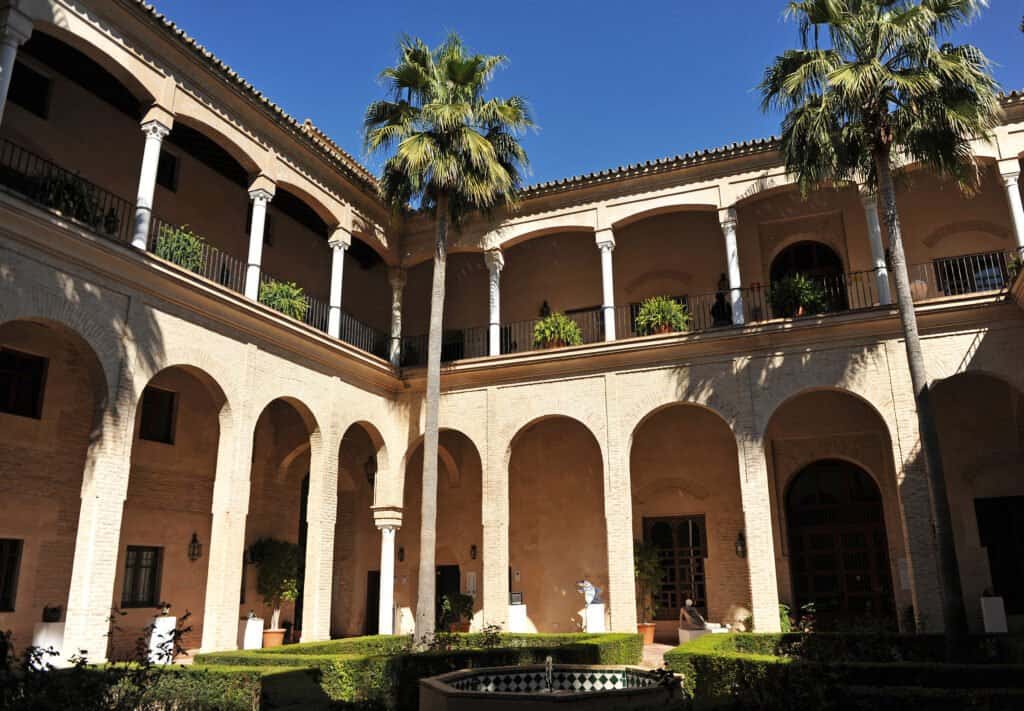
The palace is built around a central courtyard in the Sevillian tradition, and that courtyard is the first thing that stops you in your tracks. Roman mosaic panels cover most of the floor, salvaged from excavations at the ancient site of Nabrissa near the modern town of Lebrija. The mosaics are extraordinarily well preserved, depicting geometric patterns and figural scenes. You're not looking at them through glass. You're standing on them, or next to them, separated only by a low rope in some sections.
The ground floor includes the main reception rooms, the courtyard, and a series of galleries displaying the Countess's collection of Roman artifacts, Greek ceramics, coins, and decorative objects from across several centuries and continents. The Mudéjar architectural details throughout — carved plasterwork, azulejo tile dadoes, artesonado wooden ceilings — date to the building's earlier life before the Countess arrived.
The upper floor is a different experience entirely. This is where the family actually lived, and the rooms have been left largely as they were in the early twentieth century. Furniture, personal objects, tapestries, and paintings remain in place. It feels more intimate and, depending on your interests, more affecting than the formal collection below. A separate ticket is required for this floor, which helps keep the crowds manageable.
Main Highlights
The Roman Mosaic Floors
These are the reason most visitors come, and they deliver. The main courtyard mosaic is the largest and most impressive, but smaller mosaic panels appear throughout the ground floor rooms as well. The Countess had them lifted from their original locations and relaid here, a practice that would raise conservation eyebrows today but has resulted in an unusually immersive encounter with Roman material culture. You're not in a museum. You're in a house with Roman floors.
The Mudéjar Architecture
The building itself predates the collection by several centuries. The carved plasterwork in the arches around the courtyard, the geometric tile work, and the wooden ceiling in the main hall are all worth examining slowly. This style of architecture, developed in medieval Iberia by Muslim craftsmen working within Christian-commissioned buildings, is everywhere in Seville, but the Lebrija palace offers it in an intimate scale you don't get at the Alcázar.
The Upper Floor Rooms
The library, the drawing room, the dining room — all preserved with the furniture and decorative objects the family used in daily life. There's a particular melancholy to a room where someone's reading glasses might still be on the table, metaphorically speaking. This floor tends to reward visitors who slow down and look at individual objects rather than moving through quickly.
History and Background
The building has been standing in various forms since the fifteenth century, and its architectural history is layered in the way most old Sevillian palaces are. The Countess purchased it in 1901 and immediately began a restoration project that was also, in effect, a reinvention. She was working on the excavations at Nabrissa around the same time, and the two projects fed each other: the palace became the permanent home for what she was pulling out of the ground.
Regla Manjón died in 1938. The palace passed to her family and has remained in private hands ever since. The decision to open it to the public was made by her descendants, and the family's continued ownership is part of what gives the place its unusual atmosphere. It is maintained as both a museum and a living legacy.
Tickets and Entry
There are two ticket tiers. The ground floor ticket covers the courtyard, the Roman mosaic collection, and the main reception rooms. The combined ticket adds access to the upper floor with the family's private apartments and the full furniture and decorative arts collection. If you have any interest in early twentieth-century aristocratic interiors, the combined ticket is worth it. The upper floor is the part most visitors remember longest.
Guided tours in English are available on certain days and are worth checking in advance, especially if you want context for the archaeological material. Without a guide, the ground floor collection can feel somewhat decontextualized, though the space itself carries you through.
Best Time to Visit
Seville's summers are genuinely brutal, with temperatures regularly exceeding 40°C in July and August. The palace, being an old building with thick walls and a shaded courtyard, stays relatively cool, which makes it a good midday stop during summer months when outdoor sightseeing becomes difficult. Spring and autumn are the most comfortable seasons overall, and the city is less crowded outside of Semana Santa and Feria de Abril in April.
Mornings tend to be quieter. If you arrive when the palace opens, you'll often have the courtyard almost to yourself, which is the right way to see those mosaics — without twenty other people in the frame.
Combining with Nearby Attractions
Calle Cuna puts you in an ideal position to combine a visit here with several other stops. The Iglesia de la Anunciación is very close by. The Museo de Bellas Artes, housed in a former convent about 10 minutes on foot to the northwest, makes for a natural pairing if you're spending a full day on Seville's museums. The Cathedral and Alcázar are both within 10 minutes in the other direction, though those require considerably more time and energy.
The streets between Calle Cuna and Plaza del Salvador are lined with small bars and cafés, good for a coffee or a quick lunch before or after your visit.
Practical Tips
- Check opening hours before you go — the palace keeps reduced hours on certain days and may close for private events
- Wear comfortable shoes; the mosaic floors are uneven in places
- If guided tours in English matter to you, contact the museum in advance to confirm the schedule for your travel dates
- The ground floor courtyard can be photographed freely; ask staff about restrictions in the upper floor rooms before shooting
- The palace is not heavily signposted from the street; look for the carved stone doorway on Calle Cuna
- Combine with the Museo de Bellas Artes if you want a full day of indoor culture away from the summer heat
FAQ
Is the Palacio de la Condesa de Lebrija suitable for children?
It depends on the child. Older children who can engage with history often find the mosaic floors genuinely exciting. Very young children may find the space challenging since much of the collection is at floor level and the rooms are not particularly child-proofed. The visit is relatively short, which helps.
How long should I plan to spend here?
Most visitors spend between 45 minutes and 90 minutes, depending on whether they take the upper floor and how closely they look at the collection. A guided tour will extend that toward the upper end.
Is the palace accessible for visitors with mobility issues?
The ground floor courtyard and main rooms are accessible, but the building is old and the upper floor involves a staircase. Contact the museum directly if accessibility is a concern before your visit.
Can I visit without booking in advance?
Walk-in visits are generally possible, though availability for English-language guided tours is limited and worth reserving ahead. During busy periods like Semana Santa or the weeks around Feria, it's sensible to check in advance.
Reviews
Sign in and mark this place visited to leave a review.
No reviews yet.
Free Trip Planner
Plan your Seville trip with our free planner
Build a day-by-day itinerary with AI suggestions, hand-picked places, and friends. Free forever — no credit card.
Related reading

Things to see near Museo Palacio de la Condesa de Lebrija


Places to eat or drink near Museo Palacio de la Condesa de Lebrija

Bodeguita Antonio Romero Arfe

Mercado de Triana

Las Teresas

Taberna Álvaro Peregil
More places in Seville

Setas de Sevilla (Metropol Parasol)

Iglesia de Santa Maria la Blanca
Palacio de los marqueses de la Algaba