The Olympic Sculpture Park sits at the northern edge of Belltown, where Seattle's downtown grid gives up and the land starts sloping hard toward Elliott Bay. It belongs to the Seattle Art Museum, but it doesn't feel like a museum annex once you're in it. Nine acres of reclaimed industrial land zigzag down from Western Avenue to the waterfront, threading through sculptures by Richard Serra, Alexander Calder, and Louise Bourgeois before spitting you out onto a narrow beach with the Olympic Mountains stacked up across the Sound. Admission is free and the grounds are open at all hours, which puts it in a short list of major American sculpture parks you can wander into at dusk with no ticket and no gate.
What makes it worth a special trip, rather than a quick detour, is the site itself. This was not parkland set aside for art. It was a fuel-transfer facility, a stretch of waterfront so thoroughly industrial that cleaning it up for public use took years of remediation before a single sculpture went in. The park opened in 2007 as the result of that effort, and the bones of its former life are still legible if you know to look, in the straight concrete lines of the switchbacking paths and the way the land has been engineered, not simply landscaped.
Why the Olympic Sculpture Park matters
Most sculpture parks ask you to walk a flat lawn and admire objects at a comfortable remove. This one makes you descend. The path drops roughly 40 feet from street level to the water in a Z-shaped course, so the art reveals itself in stages rather than all at once, and the city, the railway tracks, and the bay all stay in view the entire time. It's one of the few places in Seattle where industrial history, serious contemporary art, and an unobstructed mountain view occupy the same few hundred yards, and it costs nothing to see all three.
Quick facts
- Run by the Seattle Art Museum (SAM), opened to the public in 2007
- Nine acres, built on a former industrial fuel-transfer site
- Free admission, grounds open at all hours
- Located in Belltown at 2901 Western Ave, Seattle
- Key works include Richard Serra's Wake, Alexander Calder's Eagle, and Louise Bourgeois's Eye Benches
- Faces directly onto Elliott Bay with views across to the Olympic Mountains
Getting there
The park sits at the western edge of Belltown, close enough to downtown Seattle that walking makes sense if you're already near Pike Place Market or the waterfront piers. From Pike Place it's a flat-ish walk of about 15 to 20 minutes along Western Avenue or the waterfront path. If you're coming from Seattle Center or the Space Needle, it's closer still, a short walk south along the water.
Parking in Belltown is limited and mostly metered street parking, so if you're driving, budget time to circle a bit or look at a garage a few blocks inland. The Elliott Bay Trail, a paved path used by cyclists and runners, runs directly through the park, connecting south toward the piers and north toward Myrtle Edwards Park, so arriving by bike is easy and the connecting trail is one of the nicer stretches of Seattle's waterfront.
The layout and experience
The park unfolds as a continuous Z-shaped path rather than a grid of lawns, which means there's really one route through it, not a maze of choices. You start near Western Avenue, at the top of the slope, and the path switches back three times as it drops toward the water, crossing over a rail corridor and Elliott Avenue on bridges built into the design. Each switchback opens onto a different zone of plantings, native grasses and Pacific Northwest trees mixed with open lawn, so the park reads almost like a series of connected rooms rather than one flat field.
By the time you reach the bottom, you're at a small shoreline area with a pebble beach, benches facing straight out at the water, and often more people just sitting than looking at sculpture. That's fine. The park was designed to work that way.
Main highlights
Richard Serra's Wake is the piece most people remember, five pairs of towering curved steel plates arranged so you walk between and around them, the proportions shifting with every step. It's a serious, heavy, slightly disorienting piece, and it photographs completely differently depending on where you stand.
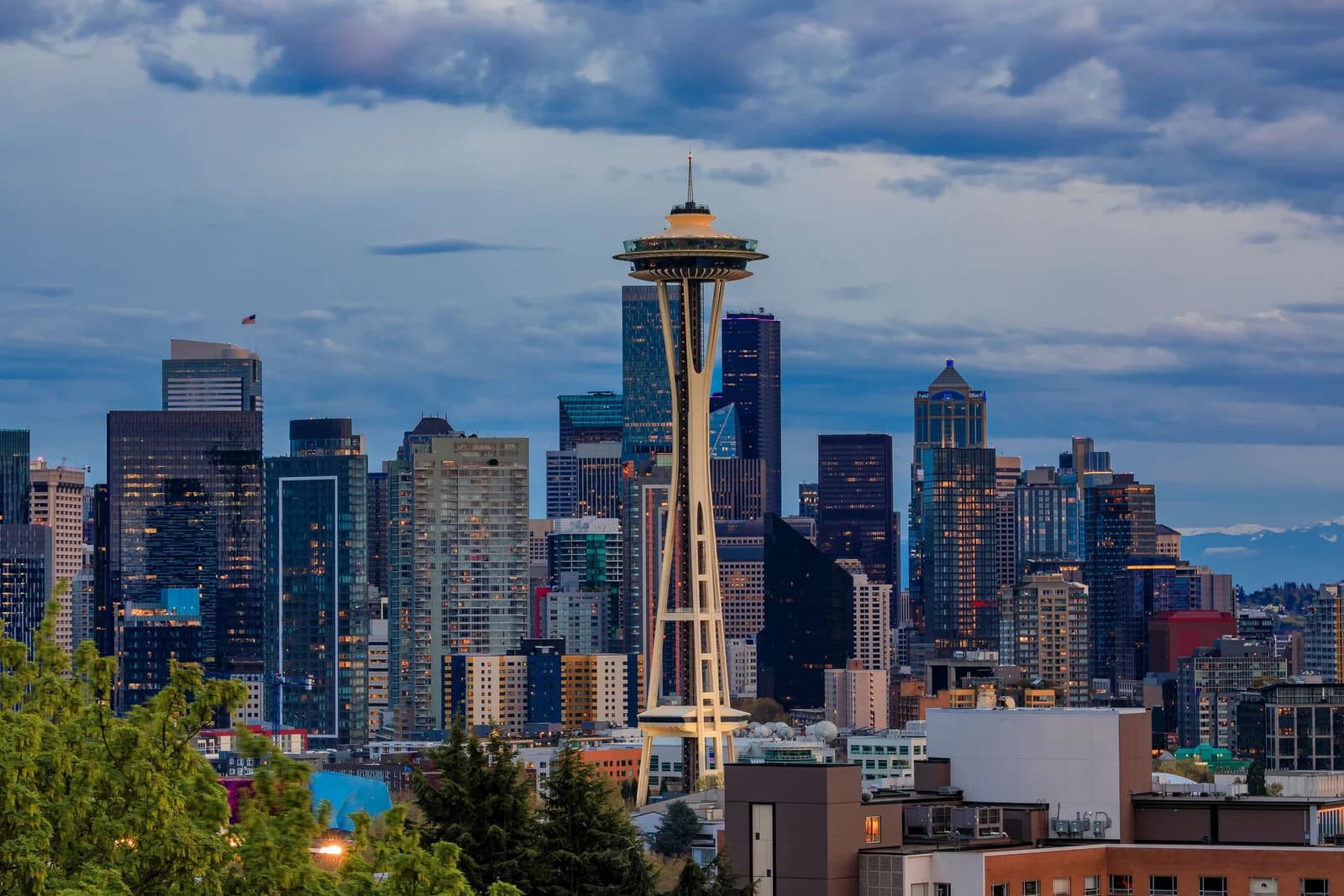
Alexander Calder's Eagle is the park's unofficial mascot, a huge red-orange stabile near the top of the slope that has become one of the more photographed pieces of public art in Seattle, partly because its bright color and open form frame the Space Needle and the skyline behind it if you angle a shot right.
Louise Bourgeois contributed the Eye Benches, a pair of polished granite eyeball-shaped seats that double as functional furniture, odd and a little unsettling up close in a way that's typical of her work. They sit lower in the park, closer to the water, and are easy to miss if you're moving fast.
Beyond these three, the collection rotates and expands over time, so expect to find other pieces scattered through the grounds that may not have been there the last time you visited.
History and background
Before it was a park, this stretch of shoreline did unglamorous industrial work for most of the 20th century, most recently as a fuel-transfer and storage site tied to the rail and shipping traffic along Elliott Bay. Soil contamination from decades of industrial use meant any public reuse of the land required extensive environmental remediation before construction could even begin. The Seattle Art Museum acquired the site and spent years on cleanup and design, turning what had been an inaccessible, polluted waterfront lot into public ground. The park opened in 2007, and the decision to make it free and permanently open to the public, rather than ticketed like SAM's downtown building, was part of the original intent.
Best time to visit
Come at sunset if you can manage it, particularly on a clear evening between spring and fall. The Olympic Mountains sit almost directly across the water from the park, and on a good evening they go pink and then violet as the sun drops, with Calder's Eagle or Serra's steel plates silhouetted in front. It's the one time the park stops feeling like an outdoor extension of a museum and starts feeling like its own thing, a genuine Seattle viewpoint that happens to have world-class sculpture in it.
Weekday mornings are the quietest time if you want the paths to yourself. Weekends, especially sunny ones, bring out runners, dog walkers, and families using the lawns, which isn't a bad atmosphere, just a busier one.
Photography tips
The Calder Eagle works best shot from below and slightly to the side, where its open red form frames the downtown skyline or the Space Needle in the gap between its curves. Serra's Wake rewards close, low angles inside the steel corridors, where the rust-colored plates block out everything but sky. For the water view, the lower section near the Eye Benches gives you an unobstructed line across Elliott Bay to the Olympics, especially useful in the last hour before sunset when the light is low and warm.
Facilities and preparation
The park is outdoor and exposed for most of its length, with limited shade, so dress for Seattle's wind off the water even on days that start sunny downtown. The paths are paved and wheelchair accessible along the main switchback route, though the grade is noticeable in places. There's a pavilion near the Western Avenue entrance that has historically hosted a small visitor space and occasional public programs, though exact hours and current use are worth checking before you go. Benches are scattered throughout, and the beach area at the bottom has informal seating facing the water.
Combining with nearby attractions
The Elliott Bay Trail makes it easy to extend your visit north into Myrtle Edwards Park, another strip of waterfront green space that continues the same shoreline path without any sculpture but with the same water views. South along the waterfront, it's a walkable distance to the Seattle Aquarium, the piers, and eventually Pike Place Market, making the sculpture park a natural bookend to a full day spent along the water. Seattle Center and the Space Needle are close enough from the park's northern edge that combining the two into one outing is straightforward, particularly on foot or by a short rideshare.
Practical tips
- Visit at sunset for the best light on both the sculptures and the mountains across the water
- Wear layers, the waterfront is windier and cooler than downtown just a few blocks inland
- Walk the park top to bottom starting from Western Avenue to follow the intended Z-shaped route
- Bring a bike or walk the Elliott Bay Trail to connect to Myrtle Edwards Park just to the north
- Check for any current construction or closures along the waterfront before visiting, as nearby seawall and pier projects have periodically affected access
FAQ
Is the Olympic Sculpture Park free?
Yes. There's no admission charge and no ticket required, which sets it apart from the Seattle Art Museum's main downtown building.
What are the hours?
The outdoor grounds are open to the public at all hours, though any indoor pavilion space may operate on a more limited schedule.
How long does a visit take?
Most people spend 45 minutes to an hour and a half, depending on how much time you linger at the waterfront or stop to look closely at each piece.
Is it suitable for kids or wheelchair users?
The main paths are paved and sloped but accessible, and the open lawns and beach area make it an easy, low-pressure outing for families.
What's the best single reason to go?
The combination of Richard Serra's steel work and the Olympic Mountains view at sunset is hard to find anywhere else in Seattle, and it's free.
Reviews
Sign in and mark this place visited to leave a review.
No reviews yet.
Free Trip Planner
Plan your United States trip with our free planner
Build a day-by-day itinerary with AI suggestions, hand-picked places, and friends. Free forever — no credit card.