
DestinationsTravel Inspiration
Things to Do in Seattle: Must-Sees and Hidden Gems with Map
By
Explore on the map
37 places from the destinations in this story. Tap a pin to open the listing.
Seattle is an easy city to do badly. The Space Needle, the fish throwers, a queue outside a Starbucks that is only famous for being old — a full day can disappear into things that are not very interesting, in a city that is.
What follows is both halves: the landmarks that genuinely earn the visit, and the places people who live here send visitors instead. Everything is on the map above, grouped by where it sits, so you can do a district at a time rather than crossing the city four times.
Downtown and the waterfront
Pike Place Market has been a working market since 1907 and is still one, underneath the crowd — the lower levels and the Post Alley side are where that is obvious. Go before nine or accept the crush.
The Central Library is the building to see downtown. Rem Koolhaas finished it in 2004 and it is still strange: shifted glass platforms, a blood-red corridor on level four, and the Books Spiral running the entire non-fiction collection up four storeys in one unbroken ramp. Free to walk into.
Seattle Art Museum is strongest where you would not expect — the Northwest Coast Native and Australian Aboriginal galleries. The Seattle Aquarium pumps its water from the bay it stands on, which makes the local tanks unusually convincing, and the Great Wheel swings out past the end of Pier 57 over open water.
Two downtown things most visitors miss. Sky View Observatory on the Columbia Center's 73rd floor is nearly four hundred feet higher than the Space Needle's deck, cheaper, and usually has no queue — you look down on the Needle rather than across at it. And Ye Olde Curiosity Shop on Pier 54 has been trading since 1899 and is a genuine cabinet of curiosities wearing a souvenir shop as a disguise: two mummies, shrunken heads, fleas in dresses. Free.
Pioneer Square
Pioneer Square is where the city started, burned down in 1889, and rebuilt itself in red brick. It has had a hard couple of decades and parts still show it, but the Richardsonian Romanesque blocks are the best architecture in Seattle and the galleries are real.
The Klondike Gold Rush museum is free, run by the Park Service, and explains the city better than anything else here: Seattle got rich in 1897 by selling outfits and passage to a hundred thousand people heading to the Yukon, and made far more than almost anyone made digging. Smith Tower next door was the tallest building west of the Mississippi when it opened in 1914 — brass lifts with operators, a carved Chinese Room, and a bar on the observation floor.
Seattle Center
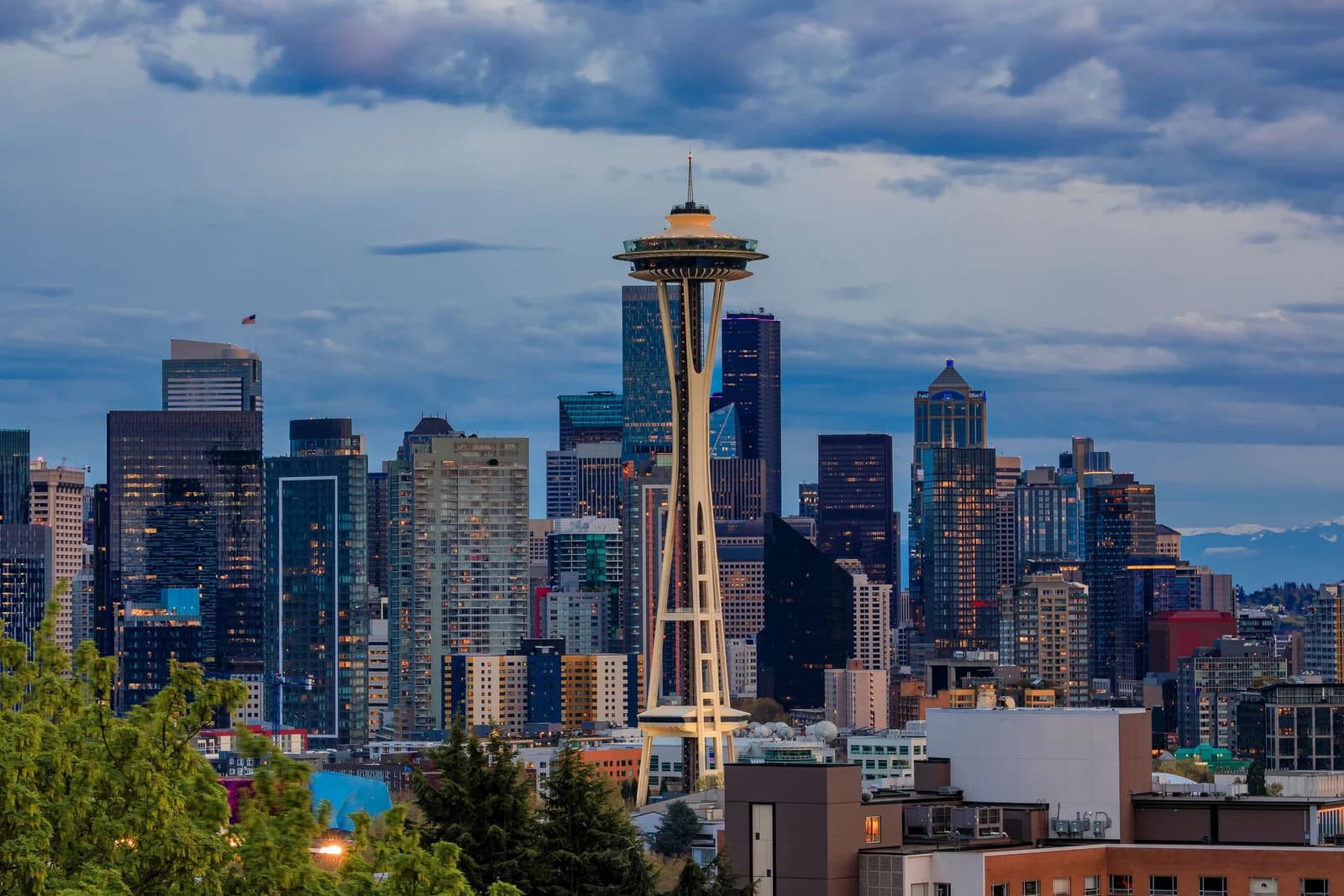
The Space Needle is worth it on a clear day and a waste of a timed ticket on a grey one, so check before you book. The glass floor added in 2018 is the part that gets people.
Chihuly Garden and Glass next door is better than it sounds — a glasshouse with a hundred-foot sculpture hanging in it and a garden where the glass is planted among real plants. MoPOP is in Frank Gehry's crumpled building and holds the definitive Nirvana and Hendrix material.
Ten minutes away, Kerry Park on Queen Anne Hill is the view on every Seattle postcard: skyline, Needle, bay, and Rainier floating behind on a clear day. It is a strip of pavement with a railing and it is packed at sunset. Go at dawn.
Capitol Hill and First Hill
Volunteer Park Conservatory is a 1912 glasshouse of five climate rooms, and in the same Olmsted park there is a brick water tower you can climb for free — 107 steps to an observation deck with the skyline framed in arched windows. Almost nobody does.
The Frye Art Museum is free and always will be: the founders left their collection to the city on that condition, and it is written into the terms. The founding Munich School paintings are an acquired taste; the contemporary programme in the other galleries is consistently among the best in the city.
Elliott Bay Book Company has around 150,000 books on cedar shelving under skylights, with handwritten staff cards under a remarkable number of them.
The International District
The Wing Luke Museum is the only pan-Asian Pacific American museum in the country, built into a 1910 building where the preserved immigrant hotel rooms upstairs — belongings still in place — are reachable only on a guided tour. Take the tour; it is the whole point.
The Panama Hotel is the quietest and heaviest room in Seattle. When Executive Order 9066 sent the city's Japanese American community to the camps in 1942, families stored their belongings in the basement. Some were never collected, and those trunks are still down there, visible through a glass panel set into the tea room floor.
Fremont, Wallingford and Ballard
Gas Works Park kept the rusting 1906 gasification plant standing when it was turned into parkland in 1975, which is why it looks like nowhere else — cracking towers on a green mound with downtown directly across Lake Union. The Fremont Troll is eighteen feet of concrete under the Aurora Bridge, clutching a real VW Beetle, free and always there.
Archie McPhee in Wallingford is responsible for a meaningful share of the world's absurd novelty goods and keeps a free Rubber Chicken Museum at the back.
The Ballard Locks are the best free thing in Seattle. Boats are raised 22 feet between salt water and fresh using nothing but gravity, and underneath there is a glass-walled fish ladder where you stand below the waterline and watch salmon climb through — strongest June to September. Golden Gardens past the marina has sand, fire pits and the Olympics straight across the water, and is where the city goes on a clear evening.
Also in Ballard, wedged against a concrete wall: the Edith Macefield house. She turned down a million dollars in 2006, so the development was built around three sides of her 1900s farmhouse instead. Two minutes to look at, and it stays with you.
Parks worth the trip
Discovery Park is 534 acres of bluff, forest and beach on a decommissioned army post, with a lighthouse at the tip and a real climb back up. Washington Park Arboretum holds the ticketed Seattle Japanese Garden inside it, a 1960 Juki Iida design and the best few acres in the park.
Seward Park has one of the last stands of old-growth forest inside any American city — Douglas firs up to 250 years old, never logged, minutes from a bus stop. Kubota Garden in Rainier Beach is twenty acres built by Fujitaro Kubota over five decades, interrupted by the years his family spent interned at Minidoka. It is free, a long way off the tourist map, and on a weekday morning you will have it to yourself.
West Seattle and the south
Alki Beach is where the Denny Party landed in 1851 and named the place New York Alki — "by and by" — before moving across the bay within the year. Two and a half miles of sand facing the skyline.
Jack Block Park is the one to know. It is owned by the Port, reached down an access road through a working container terminal, and has an observation tower level with the gantry cranes and square on to downtown. The view rivals Kerry Park, costs nothing, and you may be alone up there.
In Georgetown, the Georgetown Steam Plant holds the last two vertical Curtis steam turbines of their kind anywhere, installed in 1906 and never removed — a National Historic Landmark that opens only on limited public days, so check first. A few streets away, Hat 'n' Boots is a 44-foot cowboy hat and two giant boots rescued from a 1950s petrol station and restored in a city park.
Further out, the Museum of Flight lets you walk through a Concorde, the Air Force One that carried Eisenhower through Nixon, and the first 747 ever built.
How long do you need?
Three days covers it comfortably. One downtown and Pioneer Square, one for Seattle Center and the north — Fremont, the locks, Ballard — and one for whichever of the parks and the outlying oddities appeal. Two days is enough if you skip the museums.
FAQ
Is the Space Needle worth it?
On a clear day, yes. On an overcast one you are paying to stand inside a cloud, and Seattle has a lot of those. If the forecast is grey, Sky View Observatory on the Columbia Center is higher, cheaper and indoors — or Kerry Park is free and gets the Needle in the photograph, which the Needle cannot.
What is the best free thing to do in Seattle?
The Ballard Locks, for the boats and the salmon ladder together. After that: Olympic Sculpture Park, the Central Library, the Fremont Troll, Kubota Garden, the Klondike Gold Rush museum and the Frye are all free.
Is the original Starbucks worth visiting?
Not really. It is a small shop at Pike Place with a long queue and nothing inside you cannot get elsewhere. Seattle's coffee is genuinely good — just drink it somewhere a local would.
What should you do in Seattle when it rains?
It rains less than the reputation suggests but greys over constantly. The Central Library, the Frye, MoPOP, the Wing Luke, the Museum of Flight and Volunteer Park Conservatory are all indoors, and the Panama Hotel is the right room for a wet afternoon.
Which Seattle hidden gem is the best one?
Kubota Garden if you want quiet and beauty, Jack Block Park if you want the view nobody else has, and the Panama Hotel if you want the one that stays with you.