
Overview
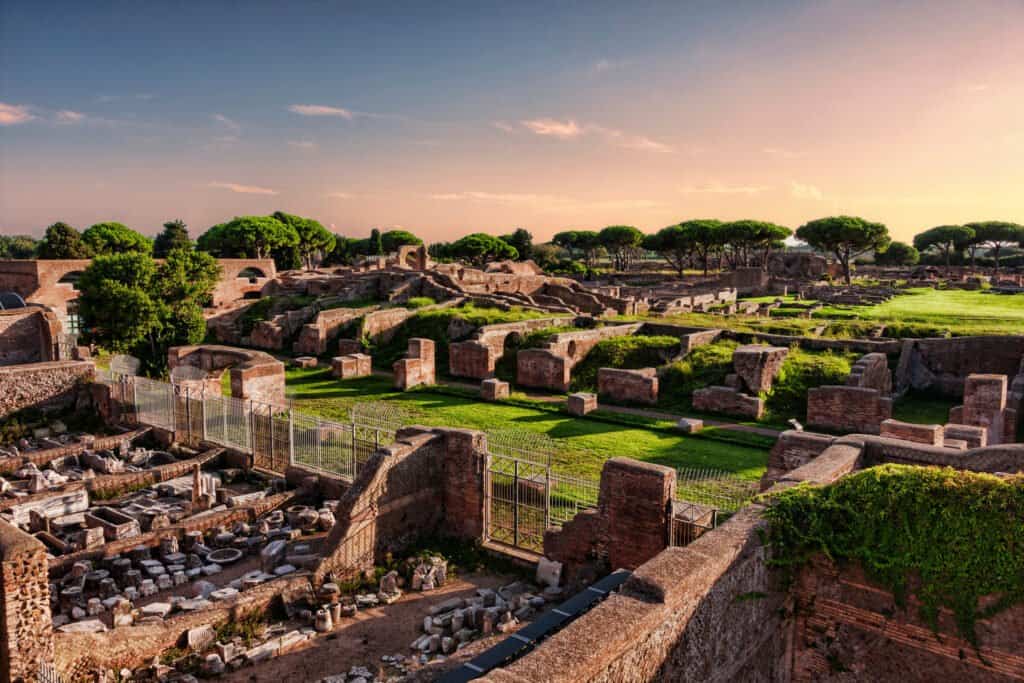
Walk through the streets of Ostia and you're walking through the second most important city of the Roman Empire. The ruins rise in a way few ancient sites do: not isolated fragments on a hillside, but entire neighborhoods laid out in proper streets, with apartment buildings still standing to second and third stories. You can see the grooves worn into stone by cart wheels. You can read graffiti scratched onto walls two thousand years ago. The scale is intimate enough that you understand how people actually lived here, not as an abstract concept but as a physical fact.
Ostia was Rome's port city from roughly the fourth century BCE until the fifth century CE. The Tiber River once flowed differently, and Ostia sat at the mouth where goods arrived from across the Mediterranean. When the empire fell and the river silted up, the city was abandoned and buried. What emerged when excavations began in the 1800s is one of the most intact Roman urban centers anywhere. Unlike the Forum in Rome itself, where centuries of rebuilding and treasure hunting have left gaps, Ostia shows you what a functioning Roman city looked like: the homes, the bars, the brothels, the warehouses, the streets worn smooth by daily life.
Why this place matters
Most people know Rome through its monuments: the Colosseum, the Pantheon, the Forum. Those are the public face of empire, built to impress. Ostia is different. It's the place where ordinary Romans lived and worked. The buildings here are not temples or palaces but apartment blocks called insulae, five or six stories tall, designed to house workers and merchants. The ground floors held shops and bars. Families lived above. This was the real Rome.
What you learn at Ostia changes how you see the city of Rome itself. The scale of trade becomes clear. The sophistication of urban planning shows itself. You understand that Rome was not just about emperors and conquest but about logistics, commerce, and the daily grind of maintaining a vast network of supply routes.
Quick facts
- Location: About 25 kilometers southwest of central Rome, accessible by regional train
- Founded: Fourth century BCE as a military outpost; grew into a major port city
- Peak population: Estimated around 50,000 to 100,000 residents at its height
- Area: The excavated zone covers roughly 70 hectares, though the ancient city was larger
- Best preserved buildings: The Baths of Neptune, the House of Diana, the Amphitheatre, and the Forum
- Current status: Archaeological site and UNESCO World Heritage location (part of Historic Centers of Rome)
- Admission: General entry ticket required; discounts available for EU residents under 25
Getting there
The most straightforward route is by train from Rome. Take the regional train (Trenitalia) from Stazione Termini or from other central stations toward Lido di Ostia. Get off at Ostia Antica, not Ostia Lido. The journey takes about 30 minutes. From the station, it's a 10-minute walk downhill to the archaeological site entrance. Follow the signs or ask at the station; locals know where tourists are headed.
If you're driving, head toward the coast from Rome on Via Ostiense. Parking is available near the entrance, though arriving early helps avoid the midday crush during summer. The site sits on the left bank of the Tiber, and once you're in the parking area, the entrance is clearly marked.
Buses also connect Rome to Ostia, but the train is faster and more direct. Once you arrive, there is no shuttle or internal transport within the archaeological zone. Plan to walk the entire site.
The layout and experience
The entrance sits at the northern edge of the excavated area. You move south into the site, and the street plan of the ancient city becomes apparent almost immediately. You're walking along the Decumanus Maximus, the main east-west thoroughfare. This street would have been lined with shops, warehouses, and businesses. Now it's lined with roofless buildings, their brick walls intact but their stories lost.
To your left and right, smaller streets branch off into residential neighborhoods. The House of Diana sits on one of these side streets, and it's the closest thing to a "mansion" you'll find here: a four-story apartment building with a central courtyard, windows overlooking the street, and rooms that still show the patterns of their original decoration. Walk through it and you feel the narrowness of ancient Roman living spaces, the way sound would have carried through thin walls, the constant presence of neighbors.
The Baths of Neptune lie to the northwest, inland from the main street. These public baths are among the finest preserved structures in Ostia. The floor mosaics are stunning: Neptune driving sea creatures, fish and dolphins rendered in tiny tiles. The scale of the bathing complex shows how central public bathing was to Roman urban life. These weren't luxuries but everyday social spaces.
Further south, the Forum opens up as a large rectangular plaza, surrounded by what remains of administrative buildings, shops, and temples. This is the civic center, where business and governance happened. The scale is smaller than you might expect, which is precisely the point: Roman cities were compact, walkable, designed for face-to-face interaction.
The Amphitheatre sits toward the southern edge. It's much smaller than the Colosseum but shows the same essential design. Locals sat here watching performances. The stone walls still stand to a fair height, and climbing to the top gives you a view across the entire site and out toward the river.
Main highlights
The Baths of Neptune deserve an hour on their own. The mosaics are remarkable, and unlike many Roman mosaics, they remain in situ, undisturbed. The black-and-white geometric patterns are intricate. The color mosaics showing marine scenes are vivid. The architecture of the bathing rooms shows the Roman engineering that allowed for heating and circulation of hot water. Stand in the frigidarium, the cold room, and imagine the shock of plunging into it after the hot baths.
The House of Diana offers something different: a sense of domestic life. Four stories of brick and stone, with a central courtyard open to the sky. Windows on multiple levels. Small rooms. It's crowded, efficient, and utterly real. Unlike a palace or temple, this building doesn't try to impress. It just houses people.
The Amphitheatre is worth climbing. The views from the upper tiers show the extent of the excavated area and give a sense of the city's size. On clear days you can see toward Rome itself. The structure is remarkably intact, and walking through the corridors and chambers beneath the seating level reveals the engineering that made the building function.
Wander into the smaller streets and courtyards. The graffiti on the walls is extraordinary: names scratched into plaster, prices written in charcoal, crude drawings. These are not curated museum pieces but raw evidence of human presence. Someone sat in a bar 2,000 years ago and scratched a comment onto the wall. It's still there.
History and background
Ostia began as a military fort controlling the mouth of the Tiber. By the second century BCE, Rome's expansion meant an explosion in trade. Goods flowed in from Egypt, North Africa, Spain, and the eastern Mediterranean. Ostia became the processing center for this enormous volume. Warehouses lined the riverbanks. Ships were unloaded, cargo stored, and goods redistributed to Rome and beyond.
The city's real growth came during the early Imperial period, particularly under the Julio-Claudian emperors. The construction of new harbors by Claudius and Trajan in the first and second centuries CE increased capacity and reduced Ostia's direct importance as a port, but the city remained a thriving commercial and administrative hub. Apartment buildings rose to house the workers and traders. Public baths were built for leisure and hygiene. The city developed the density and complexity of a true urban center.
By the third century CE, decline had begun. Economic pressures on the empire, changes in trade routes, and eventually barbarian invasions weakened Rome's grip on its provinces. The Tiber began to silt up, making navigation difficult. By the fifth century, Ostia was effectively abandoned. The buildings were left to decay, and over centuries, sand and silt buried much of the site.
Systematic excavation began in the 1800s and continued through the twentieth century. What emerged was not a gleaming marble showcase but a city of brick, concrete, and practical ingenuity. The buildings are less ornate than those in Rome itself, but they're far more complete. You see the actual urban fabric, the real texture of Roman life.
Tickets and entry
Admission requires a ticket purchased at the entrance or, increasingly, online before arrival. There are different tiers: general admission covers access to all excavated areas. Discounts are available for EU citizens under 25 and for residents of the European Union and other eligible categories. Children under a certain age may enter free. Guided tours are available, both group tours and private arrangements. Audio guides can be rented at the entrance.
The site is open most days, with reduced hours in winter months. Check opening hours before you go, as they shift seasonally. The last entry is typically an hour or more before closing time, which allows you to spend time inside the site even if you arrive late in the day.
Best time to visit
Spring and early fall offer the most comfortable temperatures. The site is largely unshaded, so summer midday heat can be brutal. If you visit in July or August, arrive early, by nine in the morning if possible, and plan to leave by early afternoon. Winter is cool but the site is still walkable, and you'll have fewer crowds.
Weekdays are quieter than weekends. June through August sees the heaviest tourist traffic. If you prefer solitude and a slower pace, visit in May, September, or October.
The light is best in early morning and late afternoon. If photography matters to you, arrive before ten in the morning or after four in the afternoon. Midday sun creates harsh shadows that flatten detail.
Photography tips
Bring a wide-angle lens if you have one. The streets are narrow and the buildings tall, and you'll want to capture the scale of the structures and the arrangement of the streets. The Decumanus Maximus is particularly photogenic from certain angles, especially when the light catches the brick facades.
The mosaics in the Baths of Neptune photograph beautifully in soft light. Avoid harsh midday sun, which can wash out the colors. Early morning or late afternoon light brings out detail in the black-and-white geometric patterns and the richer colors of the marine scenes.
Drone photography may be restricted or prohibited. Check regulations before bringing a drone to the site.
Facilities and preparation
There is a small museum at the entrance with artifacts found on site, plus a cafe with basic refreshments. The cafe is useful but limited in menu and pricing tends toward the high end, so bring snacks if you plan a long visit. Water fountains exist at a few points in the site, but they're not abundant. Bring a water bottle and refill it if you can.
The site is largely unshaded. Sunscreen, a hat, and sunglasses are essential in warm months. Wear comfortable walking shoes with good grip; the ancient stone can be slippery when wet or worn smooth by centuries of footsteps. Some areas have uneven surfaces and minor obstacles, so watch your footing.
Restrooms are available near the entrance and at the museum. There are no facilities deeper in the site, so use them before you venture out.
Most of the site is wheelchair accessible or nearly so, though some paths are uneven. The terrain is generally flat, which helps. Check with staff at the entrance about specific accessibility questions.
How it compares to similar places
Ostia differs significantly from Pompeii, the other major Roman city preserved in the archaeological record. Pompeii was frozen in time by the eruption of Vesuvius in 79 CE and shows a snapshot of a single moment. Ostia was gradually abandoned and reburied, which means it shows layers of occupation and change over centuries. The buildings at Pompeii are often more ornate, with colorful frescoes and decorated walls. Ostia is plainer, more utilitarian, more focused on the ordinary infrastructure of urban life.
Compared to the Roman Forum in Rome itself, Ostia is far more complete. The Forum in Rome has been built over, quarried for stone, and thoroughly excavated and reconstructed over the centuries. Ostia sits largely undisturbed, showing the actual street plan, the actual spatial relationships, and the actual density of a Roman city. You understand urban planning here in a way that's harder to do in Rome.
Ostia is also much quieter and less crowded than major sites in Rome. You're not competing with thousands of other visitors for a view. You can stand in a street and think without being jostled.
Combining with nearby attractions
Ostia Lido, the beach town, is a short train ride away if you want to see the modern seaside. It's not particularly distinguished, but it's there if you want a walk on the beach after the ruins.
If you're driving, Villa d'Este in Tivoli is reachable in about an hour, though it requires going back toward Rome first. It's a different kind of Roman experience, a Renaissance villa built on the site of an ancient estate, with fountains and gardens.
Most visitors combine Ostia with time in Rome itself. The train connection makes it easy to spend a morning or afternoon here and be back in the city center by evening.
Sample visit plan
Arrive early, by nine in the morning if possible. Take the train from Rome or drive if you prefer. Spend the first 30 minutes orienting yourself at the entrance museum and with a map of the site.
Walk the Decumanus Maximus from north to south, exploring the side streets and buildings as you go. This takes about an hour to an hour and a half, depending on how much you linger. Stop at the House of Diana and spend 20 minutes exploring it in detail.
Head northwest to the Baths of Neptune. Spend 45 minutes here. Walk through the bathing rooms, study the mosaics, and imagine the social rituals that played out in these spaces.
Return to the main street and continue south. Explore the Forum and the surrounding buildings. Spend 30 minutes here.
Visit the Amphitheatre. Climb to the top for views. Spend 20 minutes exploring it.
If you have remaining time, wander into quieter neighborhoods and smaller streets. These often feel less visited and offer a sense of discovery.
Budget three to four hours for a thorough visit, longer if you're particularly interested in archaeology or Roman history. The site is large enough that you could easily spend a full day here and still find new details.
Practical tips
- Bring more water than you think you'll need. The site is exposed and you'll be walking for hours.
- Wear layers. The site is exposed, and temperature can change significantly from sun to shadow.
- If you're visiting in summer, start very early. The site is brutal in midday heat, and you'll be far more comfortable in the morning.
- The audio guide is useful and helps you understand what you're looking at. Consider renting one at the entrance.
- Take time to read the graffiti. It's everywhere and it's a direct line to the people who lived here.
- If you're interested in Roman history, buy a guidebook at the entrance or bring one with you. Context makes the ruins far more meaningful.
- Photography is generally permitted, but check for any restrictions on tripods or professional equipment.
- Respect the site. Don't climb on fragile structures or remove anything. Ostia is ancient and irreplaceable.
FAQ
How long does a typical visit take? Three to four hours is standard for a good overview. You could spend a full day here if you're thorough. Two hours is possible if you're rushed, but you'll miss details.
Is the site crowded? It can be busy in summer, especially midday, but it's never as crowded as major sites in Rome. Arriving early helps significantly.
Can I bring food and drinks? Picnicking is generally allowed. The cafe at the entrance is limited and expensive. Bringing snacks and water is wise.
Is a guide necessary? No, but a guidebook or audio guide enhances the experience significantly. Without context, the ruins are harder to interpret.
What's the best time of year to visit? May, September, and October offer comfortable temperatures and fewer crowds. Avoid July and August midday if you're heat-sensitive.
Reviews
Sign in and mark this place visited to leave a review.
No reviews yet.
Free Trip Planner
Plan your Ostia trip with our free planner
Build a day-by-day itinerary with AI suggestions, hand-picked places, and friends. Free forever — no credit card.
Things to see near Ostia

Oasi Naturista Capocotta
Ostia Antica

Castello di Giulio II
Palazzo della Civiltà Italiana
Places to eat or drink near Ostia
Arianna al Borghetto

La Pietra Scheggiata – Osteria/Pizzeria

Pasticceria Barberini
