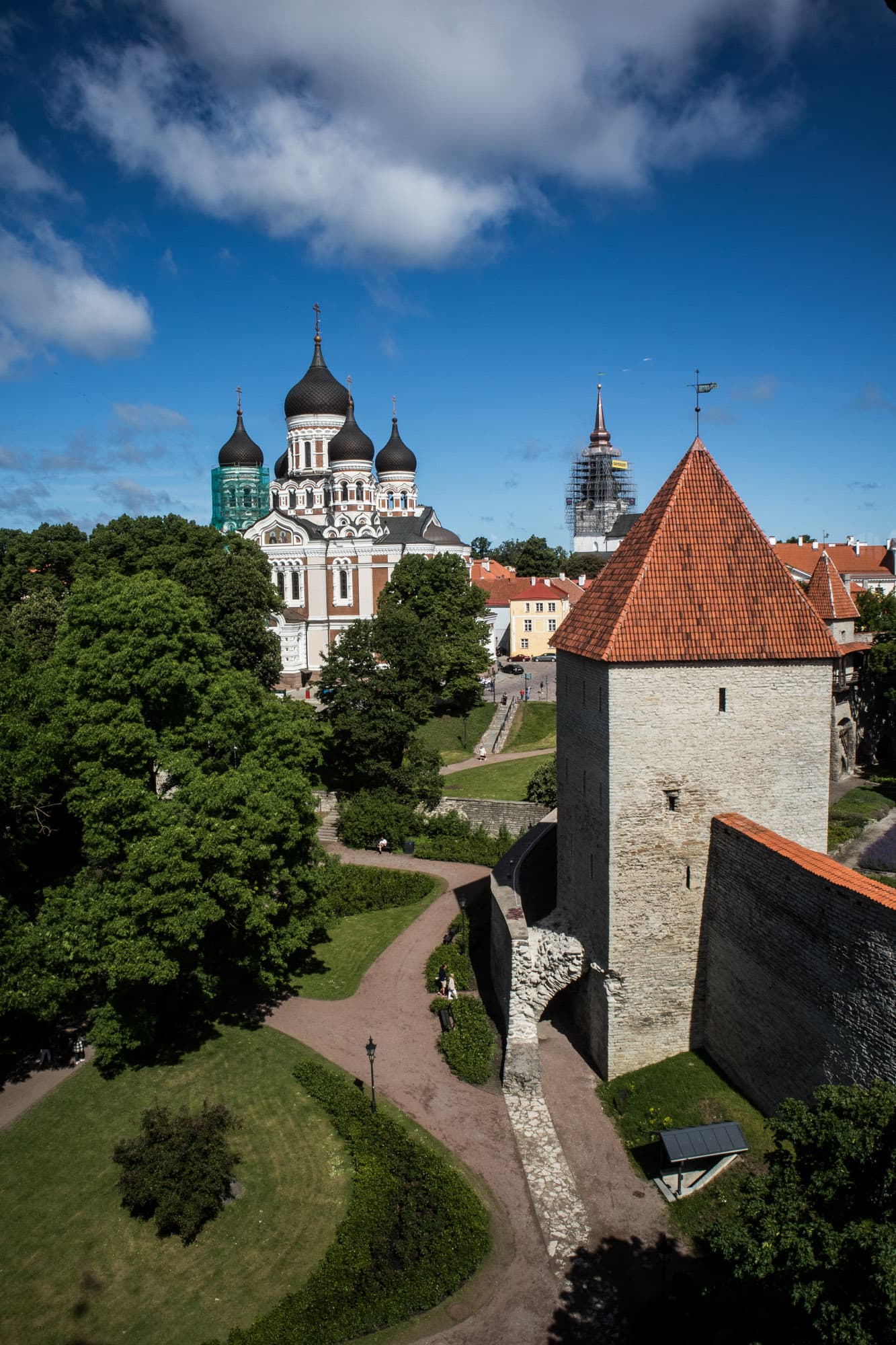
Patkuli Viewing Platform
Rahukohtu tn 5, 10130 Tallinn, EstoniaOverview
Patkuli Viewing Platform sits on the edge of Tallinn's Old Town, perched high enough that the red-tiled roofs of the medieval city spread out below you like a map someone has folded and left open. This isn't a tower with an elevator or a modern glass-enclosed observation deck. It's a working platform built into the fortification walls, weathered stone and iron railings, where you stand at roughly 30 meters above the lower town and watch the light change across the spires of Alexander Nevsky Cathedral and the Town Hall.
The platform itself is modest in scale but enormous in what it reveals. From this single vantage point you can trace the shape of medieval Tallinn almost completely: the geometry of the Old Town's street grid, the bulky presence of Toompea Castle on the hill behind, the harbor and the modern city spreading eastward. It's free to access and takes perhaps ten minutes to reach on foot from the heart of the Old Town.
Why this place matters
Patkuli is where Tallinn's two cities meet in your view. The lower Old Town (Vanalinn) and the upper town (Toompea) are physically separated by topography and historically by status and governance. From this platform, that relationship becomes clear in a way no street-level walk quite manages. You see how the walls and towers were positioned to defend both settlements, how the rooflines step up toward the castle, how the modern city beyond respects (or doesn't) the medieval footprint.
The platform itself is part of the old fortification system. Tallinn's defensive walls date from the 13th century onward, and Patkuli stands on a section restored and repurposed as a public viewpoint. It's not a reconstruction or a tourist addition but a genuine part of the city's physical history, now simply opened to visitors.
Quick facts
- Location: Rahukohtu Street, on the eastern edge of the Old Town
- Cost: Free
- Elevation: Approximately 30 meters above the lower town
- Best light: Early morning (golden light on cathedral spires) or late afternoon (long shadows across rooflines)
- Time needed: 10 to 15 minutes
- Wheelchair access: Limited; the platform is reached via stairs and narrow passages
Getting there
The platform is accessible from several points along the fortification walls. The most direct approach is from Rahukohtu Street itself, which runs along the eastern edge of the Old Town. If you're already exploring the medieval streets, the easiest route is to exit the Old Town near the Kiek in de Kök tower (a cannon tower that's now a museum) and follow the wall pathway upward. The walk takes roughly five minutes from the main Old Town area.
If you're coming from elsewhere in Tallinn, the Old Town is compact and walkable from the harbor or the train station, though the final approach does involve climbing. There's no public transport that goes directly to Patkuli itself; it's a pedestrian-only destination reached on foot.
The layout and experience
Patkuli is not a building or enclosed space. It's an open platform built into the fortification wall, with iron railings and a clear view outward. The platform is roughly rectangular and can hold perhaps two dozen people comfortably; on quiet days you might have it nearly to yourself.
The experience is immediate and unmediated. You arrive, you stand at the railing, and the city is simply there. There are no interactive displays, no audio guides, no interpretation boards (or very minimal ones). What you understand comes from looking and recognizing the landmarks you may already know: the spires, the castle, the harbor. This directness is part of Patkuli's value. You're not being told what to see; you're seeing it yourself.
The platform tends to be quieter in early morning and late afternoon. Mid-day and early evening can bring clusters of tourists, especially in summer months. If you prefer solitude or clearer photographs, aim for the fringes of the day.
Main highlights
The view itself is the highlight. From left to right, you can identify Alexander Nevsky Cathedral with its golden domes (built in the late 1800s), the Town Hall tower in the center of the Old Town, and the cluster of medieval church spires. Behind and above, Toompea Castle sits on its hill. To your right, the land falls away toward the harbor and the modern city beyond.
The fortification wall you're standing on is itself worth noticing. The stonework shows different eras of repair and maintenance. The iron railings are functional and worn, not ornamental, which gives the whole thing a working-fortress feeling rather than a polished tourist experience.
On clear days, visibility extends well beyond the city center, and you can see the landscape rolling away toward the suburbs and the edge of the Tallinn region.
History and background
Tallinn's fortification walls were constructed over several centuries, beginning in the 13th century as the city grew in importance as a Baltic trading port. The walls served both the lower town (controlled by merchants and craftspeople) and the upper town (seat of the bishop and later the nobility). The system included multiple towers, gates, and defensive sections.
Patkuli itself is named after Pontus De la Gardie, a Swedish military officer and nobleman who lived in the 16th and 17th centuries. The platform area was restored in the 1980s and opened to the public as a viewing point, making the fortification walls accessible to visitors in a way that respects their historical function while allowing modern appreciation of the city's layout and architecture.
Best time to visit
Early morning, especially in summer, offers the clearest light and the fewest people. The sun rises in the northeast, so the cathedral and the spires catch golden light before the city wakes up. This is ideal for photography.
Late afternoon in spring and early autumn brings warm, angled light across the rooflines and casts long shadows that emphasize the medieval street pattern. The light at these hours is softer and more painterly than midday's harsh brightness.
Winter offers excellent visibility on clear days, and the snow-covered roofs intensify the view's visual impact. However, icy conditions on the stairs and platform can make access tricky. Summer mid-days bring crowds, especially if a cruise ship is in port.
Photography tips
The view is wide and dominated by horizontals (the roofline, the wall, the distant horizon), so consider framing to emphasize the vertical elements: pick out a single spire or the cathedral dome and let the roofscape lead the eye toward it.
The platform's iron railings will appear in foreground shots. Some photographers use this to frame the view; others try to shoot above or between them. Depending on your angle and the time of day, the railings can either clutter the shot or add compositional depth.
Golden hour (the hour after sunrise or before sunset) is when the cathedral's golden domes and the red roofing glow most intensely. Overcast days flatten the contrast but can produce evenly lit, moody images with rich detail in both shadow and highlight.
Facilities and preparation
There are no facilities at Patkuli itself. No restrooms, no water, no seating, no shelter from weather. The platform is open to the elements year-round. If you need to use a restroom, do so in the Old Town before arriving at the platform.
The approach involves climbing stairs and navigating narrow passages along the fortification wall. Wear comfortable shoes with good grip, especially in wet or icy conditions. The platform is exposed, so bring a layer if the weather is cool or windy, which is common in Tallinn even in summer.
The view is worth visiting even on overcast days. Cloud cover can actually improve the texture of the sky and reduce harsh shadows on the roofscape.
How it compares to similar places
Tallinn has other high viewpoints. Toompea Castle's grounds offer views from a higher elevation, and the Town Hall tower (when open to the public) provides a more enclosed, elevated perspective. Patkuli differs in being free, always accessible, and positioned at precisely the right height and angle to see both the upper and lower towns in relation to each other. It's less dramatic than a tower-top view but more informative about the city's actual structure.
Compared to observation decks in larger European cities, Patkuli is small-scale and unpolished. There's no gift shop, no café, no ticketing system. This is a feature, not a bug: it's the reason the view remains intimate and relatively uncrowded.
Combining with nearby attractions
Patkuli is on the edge of the Old Town, so it works well as a starting or ending point for a walk through the medieval streets. The Kiek in de Kök tower (a museum focused on the history of Tallinn's fortifications) is immediately adjacent, making it easy to combine a view with historical context and indoor time.
St. Catherine's Passage, a narrow medieval alley lined with artisan studios, is a short walk away. Alexander Nevsky Cathedral is visible from Patkuli and reachable on foot in a few minutes. Toompea Castle's grounds are also nearby and offer a different perspective on the city from higher elevation.
A walk down through the Old Town's main streets (Pikk Street, Vene Street) can be threaded with a visit to Patkuli, giving you both the street-level experience and the bird's-eye view in a single outing.
Sample visit plan
Arrive at Patkuli early in the morning, spend 15 minutes taking in the view and photographs. Walk down into the Old Town and spend an hour or two exploring the medieval streets at street level. Grab lunch or coffee at a café in the center of the Old Town. If you want more history, visit Kiek in de Kök tower. Finish by returning to Patkuli in late afternoon light for a second look before the sun sets.
Alternatively, if you're short on time, Patkuli works as a quick 20-minute stop: arrive, view, photograph, leave. It doesn't require a lengthy commitment.
Practical tips
- Go early or late to avoid crowds and catch the best light
- Bring a camera or phone with good zoom capability to pick out distant landmarks
- The platform is exposed to wind; dress in layers even if the weather seems mild
- The stairs leading up can be slippery in rain or ice; use the handrail
- There's no food or water at the platform; plan accordingly
- In summer, if a cruise ship is in port, expect more visitors mid-day
- The view is free and accessible 24/7, so you can return at different times to see how the light and mood change
FAQ
Is Patkuli accessible by wheelchair? No. The approach involves stairs and narrow passages along the fortification wall. The platform itself has railings but is not designed for wheelchair access.
What's the best time of year to visit? Spring (May to June) and early autumn (August to September) offer the clearest weather and warmest temperatures. Summer is busiest. Winter can be beautiful on clear days but icy and slippery.
Can I visit at night? The platform is technically accessible 24/7 and free, but there's no lighting, so after dark the view is limited to city lights and any moon. Early dusk or pre-dawn may offer better results if you're looking for twilight photography.
How long should I spend at Patkuli? Ten to fifteen minutes is typical for a first visit. If you're photographing or simply taking time to absorb the view, you might stay 30 minutes. It's not a destination that requires hours.
Is there a fee to visit? No. Patkuli is free and always open.
Opening hours
Reviews
Sign in and mark this place visited to leave a review.
No reviews yet.
Free Trip Planner
Plan your Tallinn trip with our free planner
Build a day-by-day itinerary with AI suggestions, hand-picked places, and friends. Free forever — no credit card.