Seattle Central Library sits at 1000 4th Ave in downtown Seattle, wedged between 4th and 5th Avenues at Madison Street, and it is still the most interesting building in the city two decades after it opened. Designed by Rem Koolhaas's firm OMA with Joshua Prince-Ramus of LMN Architects, it finished construction in 2004 and immediately became the thing people pointed to when they wanted to argue that a public building could also be strange. From outside it reads as a stack of tilted glass-and-steel platforms, faceted like something cut rather than built. Inside, it gets stranger still. This is a working library, not a monument, and you can walk through most of it for free.
Why Seattle Central Library matters
Public libraries rarely get this kind of architectural ambition. Koolhaas and Prince-Ramus were given a brief to solve a real problem: how do you house a growing, unpredictable collection in a building that won't feel obsolete in twenty years. Their answer was to stop thinking of the library as a series of stacked floors and instead treat it as a set of programmatic platforms, each one shifted against the next, connected by the Books Spiral, a continuous ramp that carries the entire non-fiction collection up four storeys without a single floor break. You can walk from 000 to 999 in the Dewey Decimal system without ever taking a stair or an elevator. It's a genuinely useful piece of architectural problem-solving, and it's also just a weird, disorienting pleasure to walk.
Quick facts
- Address: 1000 4th Ave, Seattle, WA 98104
- Architects: Rem Koolhaas and Joshua Prince-Ramus (OMA/LMN)
- Completed: 2004
- Admission: free to enter and explore the public areas
- Type: working public library, 11th branch of the Seattle Public Library system's central location
Getting there
The library sits in downtown Seattle, a few blocks from Pike Place Market and an easy walk from the waterfront. If you're coming from the light rail, University Street station and Pioneer Square station both put you within a five to ten minute walk. Several downtown bus routes stop within a block or two on 4th or 5th Avenue. Parking downtown is expensive and often scarce, so most visitors are better off walking in from a hotel in Belltown, the retail core, or Pioneer Square rather than driving.
The layout and experience
The building reads from outside as a series of glass boxes that don't quite line up, each one shifted a few degrees off the one below it, wrapped in a steel diagrid that gives the whole facade a faceted, almost crystalline look depending on the light. Inside, the disorientation is the point. Escalators cut through voids at odd angles, ceilings drop and rise without warning, and the whole building avoids the sense of a predictable grid.
Two things are worth seeking out specifically. The first is the red corridor on level four, a run of meeting rooms, stairs and escalators painted a saturated, almost lurid red, lit in a way that makes it feel more like a stage set than library infrastructure. It's one of the few genuinely surprising interior spaces in American public architecture. The second is the reading room on the tenth floor, which sits under a sloped glass ceiling and gets a flood of natural light that most libraries would never risk, given what direct sun does to books and reading screens. It's quiet, it's underused by tourists, and it has some of the best views in the building over downtown and Elliott Bay.
The Books Spiral itself is worth experiencing as a walk even if you have no interest in the Dewey Decimal system. Because the ramp never breaks, you lose the usual cues that tell you which floor you're on, and the effect is closer to walking through a continuous landscape than climbing a building.
Main highlights
- The Books Spiral, a four-storey uninterrupted ramp housing the full non-fiction collection
- The red corridor on level four, with its saturated color and stage-lit escalators
- The tenth-floor reading room, glass-roofed and quiet
- The exterior facade itself, best seen from across 4th Avenue or from Fifth Avenue looking up
History and background
The current building replaced an earlier Seattle Central Library that had become too small and too outdated for a modern collection and a modern public. The 2004 building was part of a larger push, funded through a city bond measure in the late 1990s, to rebuild and expand the Seattle Public Library system across several neighborhoods. Koolhaas and OMA had built a reputation for conceptually aggressive, often theoretical architecture, and the library commission gave them a rare chance to apply that thinking to a genuinely public, heavily used civic building rather than a gallery or a corporate headquarters. The building won significant architectural recognition in the years after it opened and is frequently cited in architecture courses as one of the defining American public buildings of the early 2000s.
Tickets and entry
There's no admission charge. You can walk in, explore the public floors, ride the escalators and ramp, and sit in the reading room without a ticket or a library card. A library card is only needed if you want to borrow materials or use certain reserved services. Bag checks and basic security screening are standard at a public library in a major downtown, so don't be surprised by a quick look at your bag on the way in.
Best time to visit
Weekday mornings tend to be the quietest, before the lunch crowd and after-school visitors arrive. The tenth-floor reading room gets noticeably better light on clear days, which in Seattle means you should take advantage of it whenever the sky cooperates rather than waiting for a specific season. Weekends bring more foot traffic, including a fair number of visitors who are there purely for the architecture rather than the books, so if you want a quieter experience, aim for a weekday.
Photography tips
The exterior facets catch the light differently depending on the time of day, and overcast Seattle skies, which are common, tend to flatten the glass into a more uniform grey than you'll want. Late afternoon sun, when it appears, picks out the angles of the diagrid structure well. Inside, the red corridor practically photographs itself, but it's a tight space, so a wider lens helps. The Books Spiral is hard to capture in a single frame given its scale, and you'll generally get a better sense of it by shooting up or down the ramp rather than trying to fit a whole floor into one shot.
Combining with nearby attractions
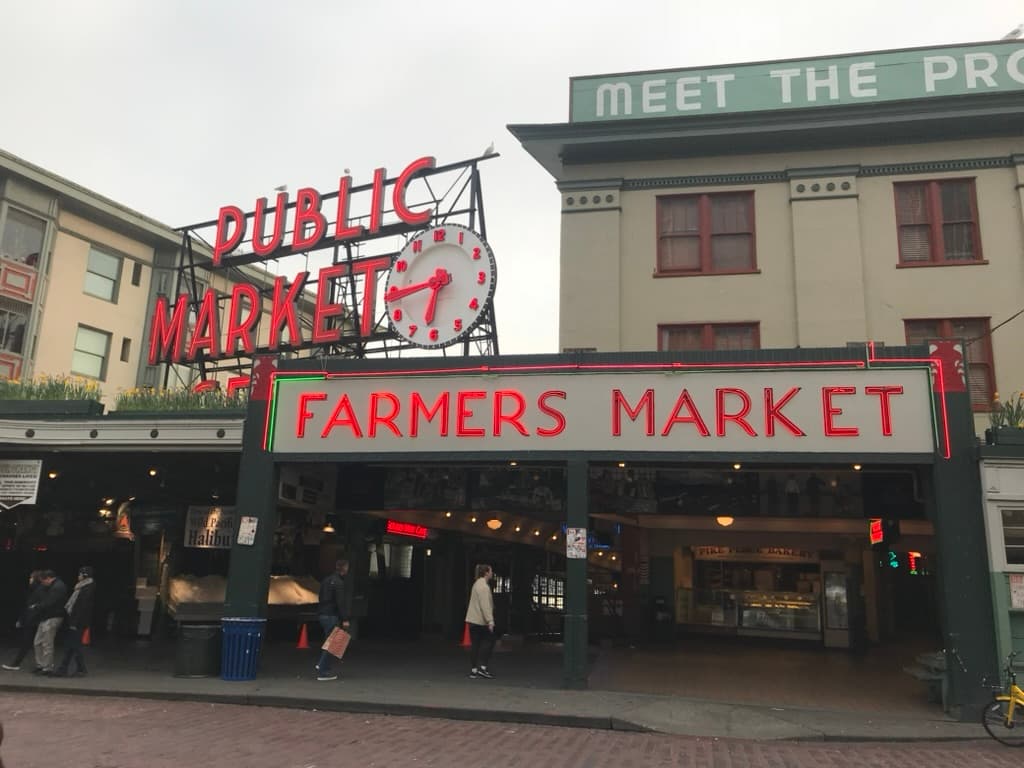
The library sits close enough to Pike Place Market, Seattle Art Museum, and the waterfront that it fits easily into a downtown walking day. Pioneer Square, with its own cluster of early 20th-century architecture, is a short walk south and makes a useful contrast if you want to see what downtown Seattle looked like before buildings like this one arrived. Many visitors pair a library visit with a walk through the Pike Place Market a few blocks northwest, or combine it with the Seattle Art Museum, which sits just a few minutes away on 1st Avenue.
Practical tips
- Enter from 4th Avenue for the most direct route up toward the Books Spiral and upper floors
- Budget 45 minutes to an hour if you want to see the red corridor, the Spiral, and the tenth-floor reading room without rushing
- Wear comfortable shoes. Even with escalators, the ramp involves a fair amount of walking
- It's a working library, so keep noise down, especially near the reading areas
- Free public restrooms are available inside, useful if you're doing a longer downtown walking day
FAQ
Do I need a library card to visit?
No. The building is open to the public for free, and you only need a card to borrow materials.
How long does a visit take?
Most people spend somewhere between thirty minutes and an hour, depending on how much of the Books Spiral and upper floors they want to explore.
Is it accessible?
Yes, elevators run alongside the escalators and ramp system, so the building is navigable without using the Spiral itself.
Is photography allowed?
General photography for personal use is fine in the public areas, as it is in most public libraries, though you should be considerate of other patrons and quiet study areas.
Seattle Central Library isn't trying to be a tourist attraction, which is part of what makes it worth visiting. It's a functioning piece of civic infrastructure that happens to also be one of the more radical pieces of public architecture built in the United States this century, and you can walk through nearly all of it without paying a cent.
Reviews
Sign in and mark this place visited to leave a review.
No reviews yet.
Free Trip Planner
Plan your United States trip with our free planner
Build a day-by-day itinerary with AI suggestions, hand-picked places, and friends. Free forever — no credit card.