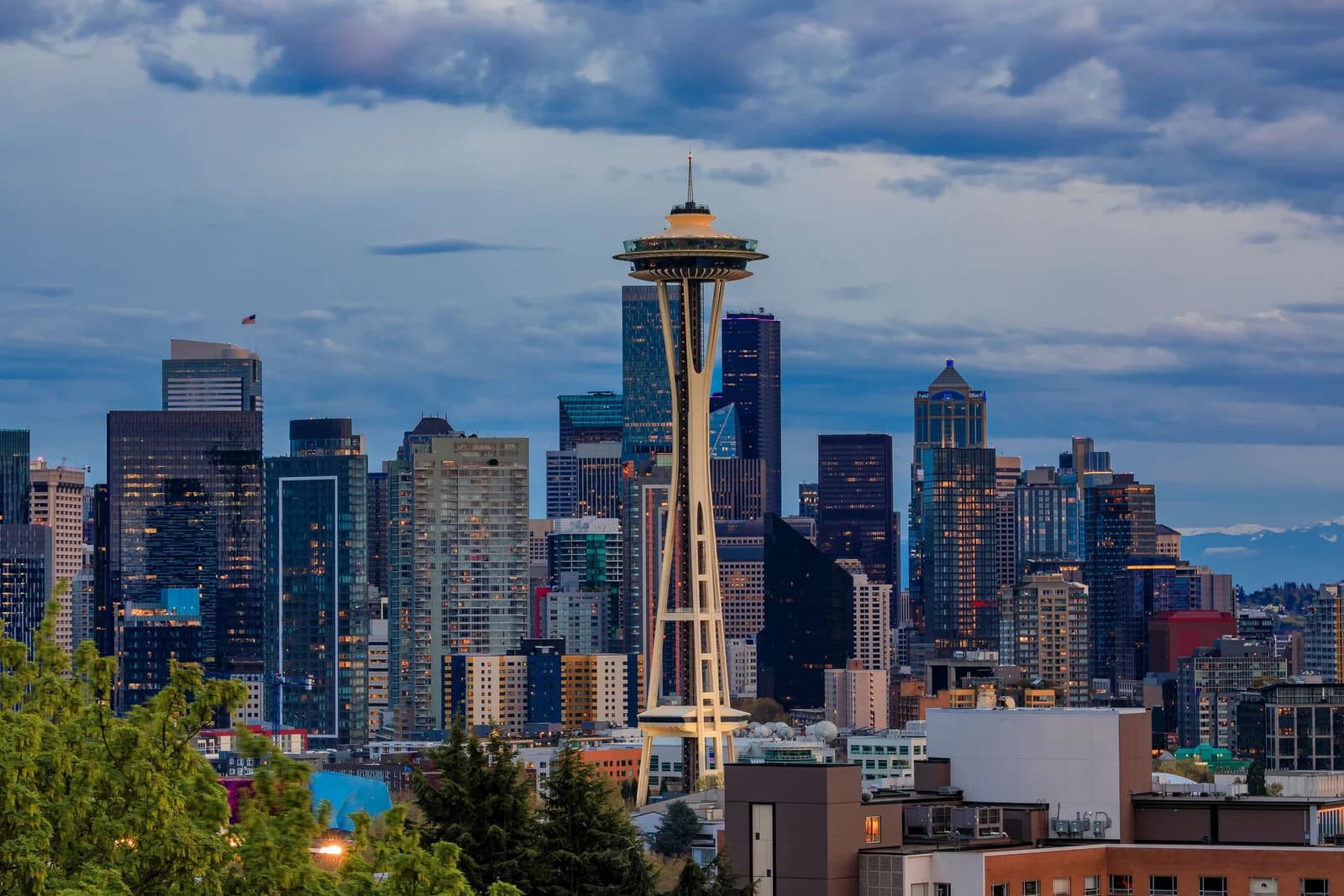
The Space Needle has been shorthand for Seattle since before most of the city's current skyline existed. Built for the 1962 World's Fair in a construction push of a little over a year, it still anchors Seattle Center the way it did when the fair opened, and it remains the single most reliable establishing shot for anything set in this city. At 400 Broad St, a short walk or monorail ride from downtown, it sits at the center of a campus that was built around it rather than the other way around.
What you're actually visiting is an observation deck 520 feet up, reached by elevator in under a minute, with a second level below it that revolves slowly on a glass floor. That rotating floor is new, relatively speaking. It replaced the old revolving restaurant in a 2018 renovation that also opened up the outer edge of the upper deck with glass benches you can lean back against and look straight down through.
Why the Space Needle matters
Few structures built for a six-month fair end up defining a city for sixty years afterward. The 1962 World's Fair, officially the Century 21 Exposition, was Seattle's attempt to put itself on the map as a city of the future, and the Needle was its physical argument. It worked. The tower outlasted the fair, outlasted the Cold War optimism that funded it, and became the thing Seattle points to when it needs a symbol. Monorail included, the fairgrounds around it are now Seattle Center, home to the Pacific Science Center, Climate Pledge Arena, and the Museum of Pop Culture, but the Needle is still the landmark the whole complex orients around.
Quick facts
- Observation deck elevation: 520 feet
- Built for the 1962 World's Fair (Century 21 Exposition), constructed in a little over a year
- Two public levels: an open-air observation deck with glass benches, and a rotating glass floor below it
- Rotating floor and glass bench feature added in a 2018 renovation, replacing the former revolving restaurant
- Located at 400 Broad St, within Seattle Center
- Reachable by the Seattle Center Monorail from downtown's Westlake Center
Getting there
The easiest approach from downtown Seattle is the monorail from Westlake Center, a ride that takes about two minutes and drops you almost directly beneath the tower. If you'd rather walk, it's roughly a fifteen to twenty minute walk from Pike Place Market through Belltown. Seattle Center itself has paid parking lots, though on event days at the arena or during festivals on the grounds, those fill fast and street parking nearby gets competitive. If you're coming by rideshare, expect drop-off traffic to back up around Broad St and Thomas St during peak hours.
The layout and experience
The visit starts at ground level with a ticketed entry and elevator ride that climbs the tower's central column in under a minute, which is a strange sensation given how slow the building looks from outside. At the top, you step onto the open-air observation deck, the one with the leaning glass benches. These are the Needle's most photographed feature post-renovation. You sit on the inward side of a bench and the outward side is glass, so the net effect is a bit like perching on the edge of the building with nothing but a pane between you and 520 feet of open air. It's not for everyone, but it's also not as nerve-wracking as it sounds once you're actually seated.
One level down is the rotating floor, a slow turn that completes a full rotation over roughly 45 minutes, giving you a changing view without having to move. This is the level that used to house the revolving restaurant before the 2018 renovation stripped that concept out in favor of the glass floor and open sightlines. You can see straight down through it in sections, which disorients some visitors more than the open-air deck above does.
Main highlights
On a clear day, the payoff is the full set: Mount Rainier to the southeast, the Olympic Mountains across the Sound to the west, the Cascades to the east, and Elliott Bay and downtown's skyline laid out below. It's one of the only spots in the city where all of that lines up in a single sweep without buildings blocking the view, since you're above nearly everything around you.
The glass benches are worth seeking out specifically if you're after photos, since they put you and the skyline in the same frame without a railing in the way. The rotating floor is better suited to just standing still and letting the city move past you, which sounds gimmicky until you're actually doing it.
Best time to visit
Seattle's weather is the deciding factor here, more than crowds or season. On the many days that are not clear, you're buying a ticket to look at cloud, and it's worth checking a forecast before committing to a timed entry rather than gambling on a sunny slot. Late summer and early fall tend to offer the best odds for a clear view of Rainier and the Olympics, though nothing here is guaranteed given how quickly marine layer can roll in off the Sound. Sunset is popular for obvious reasons, and the tower stays lit and visible from across the city well after dark, which is part of why it photographs so well at night from Kerry Park or other hillside viewpoints.
Combining with nearby attractions
Because the Needle sits inside Seattle Center, you don't need to go far to fill out a half day. The Museum of Pop Culture, with its Frank Gehry-designed building, is a short walk away, as is the Pacific Science Center and its planetarium. Chihuly Garden and Glass, showcasing Dale Chihuly's glass sculpture work, sits right at the base of the tower and pairs naturally with a Needle visit since many tickets are sold as a combined package. If you want to extend further, the monorail back to Westlake Center puts you within walking distance of Pike Place Market and downtown's retail core.
Practical tips
- Check the weather before locking in a timed ticket. Cloud cover is common enough in Seattle that a clear-day slot is worth planning around rather than assuming.
- If you want photos with the mountains in frame, go early in the day before afternoon haze or cloud typically builds.
- The glass benches on the open-air deck can feel exposed. If heights unsettle you, the rotating floor level below offers views without the same sensation.
- Pair your visit with Chihuly Garden and Glass at the base of the tower, since combined tickets are commonly available and the two sit steps apart.
- Seattle Center hosts festivals and events throughout the year that can affect parking and crowd levels, so it's worth checking what else is happening on the grounds that day.
FAQ
Is the Space Needle still a revolving restaurant?
No. The restaurant concept was removed in the 2018 renovation. The lower level now has a rotating glass floor instead, with no dining service tied to the rotation.
How high is the observation deck?
The main observation deck sits at 520 feet.
What was the Space Needle originally built for?
It was built for the 1962 World's Fair, Seattle's Century 21 Exposition, constructed in a little over a year.
Can you see Mount Rainier from the top?
On a clear day, yes, along with the Olympic Mountains, the Cascades, and Elliott Bay. Seattle's frequent cloud cover means this view isn't guaranteed on any given visit.
Is the Space Needle within walking distance of downtown Seattle?
Yes, it's about a fifteen to twenty minute walk from Pike Place Market, or a two-minute ride on the Seattle Center Monorail from Westlake Center.
Reviews
Sign in and mark this place visited to leave a review.
No reviews yet.
Free Trip Planner
Plan your United States trip with our free planner
Build a day-by-day itinerary with AI suggestions, hand-picked places, and friends. Free forever — no credit card.