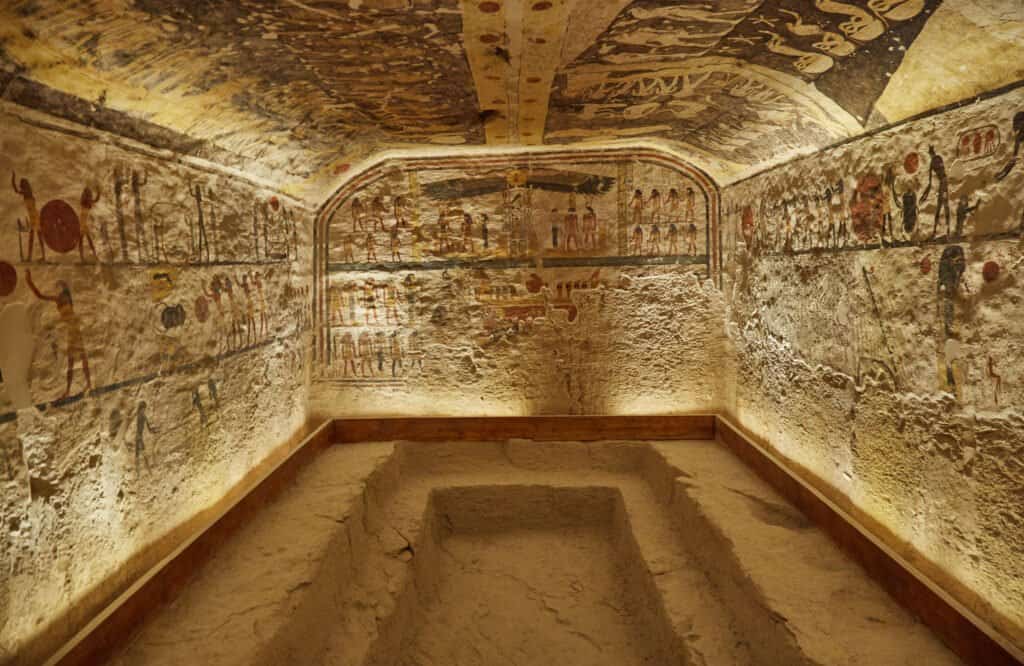
Tomb of Merenptah
Valley of the Kings West Bank, Thebes, Luxor Egypt Posted by bazartravelsAdmin
Inside the Tomb of Merenptah, Valley of the Kings
The Tomb of Merenptah sits near the entrance of the Valley of the Kings on the West Bank at Luxor, and it rewards visitors who take it seriously. Most people walk past it chasing the more famous names nearby, which is their loss. Merenptah was the thirteenth son of Ramesses II and ruled Egypt for roughly a decade beginning around 1213 BCE. His tomb, designated KV8 by Egyptologists, is one of the deepest and most dramatically descending corridors in the entire valley, and it contains some of the finest painted relief work you will find anywhere in the necropolis.
It is also the tomb that yielded the Merenptah Stele, the earliest known inscription to mention Israel by name. That single detail has made it one of the most historically significant burial sites in the ancient world, well beyond its considerable artistic merit.
Why the Tomb of Merenptah Matters
KV8 was discovered and first documented by Howard Carter in 1903, nearly two decades before his more famous work in the valley. The tomb had been open since antiquity and was reused as a Christian chapel at some point, which explains certain modifications to the walls near the entrance corridor. Despite centuries of interference, the painted decoration survives in remarkable condition through much of the lower chambers.
The sarcophagus of Merenptah is still in place. That alone makes this tomb unusual. Most royal sarcophagi were removed long ago, relocated to museums or simply lost. The outermost granite sarcophagus lid rests in the burial chamber, and seeing it in situ, in the actual room it was carved to occupy, is a genuinely different experience from encountering it behind glass in Cairo.
Quick Facts
Tomb designation: KV8, Valley of the Kings, West Bank, Luxor
Pharaoh: Merenptah, 19th Dynasty, reigned approximately 1213 to 1203 BCE
Documented by Howard Carter in 1903
Total corridor length descends roughly 160 meters into the hillside
The original sarcophagus lid remains in the burial chamber
Entry requires a standard Valley of the Kings admission ticket, which covers three tombs per visit
KV8 is one of the tombs included in the standard ticket rotation, though availability can shift seasonally
Getting There
The Valley of the Kings is on the West Bank of the Nile, directly across from central Luxor. From the East Bank, most visitors cross by the local ferry from the dock near Luxor Temple, then take a taxi, microbus, or hired bike toward the valley. The crossing itself takes only a few minutes. From the ferry landing to the valley entrance is roughly 8 to 10 kilometers depending on your route, and taxis negotiate the fare on the spot.
Once inside the valley complex, KV8 is positioned relatively close to the main visitor path, not far from the tomb of Ramesses II (KV7) and near the entrance area. You will not need to walk far into the valley to find it, which makes it a practical first stop before the heat of the day builds.
The Layout and Experience
The tomb descends through a long series of corridors and antechambers before reaching the burial hall. The slope is consistent and steep enough that you feel the descent clearly as you move deeper. Wooden walkways and handrails have been installed for visitor access, and the lighting is artificial throughout, so your eyes need a moment to adjust each time you enter a new chamber.
The walls in the upper corridors carry texts from the Amduat and the Book of Gates, painted in the characteristic style of the Ramesside period: bold outlines, registers of gods and demons, and the solar barque making its nightly journey through the underworld. The color, considering the age, is striking. Ochres, blues, and greens hold up in the deeper sections where humidity and foot traffic have done less damage.
The burial chamber itself is large. The ceiling carries astronomical imagery, and the granite sarcophagus lid dominates the floor. Take a moment to walk around it rather than just glancing from the doorway. The scale of the object, carved to hold a man who ruled one of the most powerful empires on earth, lands differently when you are standing beside it in the room where it was placed over three thousand years ago.
Main Highlights
The descending corridor sequence, one of the longest in the valley at around 160 meters
Book of Gates scenes in the second and third corridors, well-preserved and detailed
The in-situ granite sarcophagus lid in the burial chamber
Astronomical ceiling in the burial hall
Evidence of the tomb's later reuse as a Coptic Christian chapel near the entrance
Best Time to Visit
The valley opens early in the morning, and that is when you want to be there. By mid-morning, tour groups arrive in volume and the corridors of any popular tomb become crowded and warm. KV8 tends to draw fewer visitors than KV62 (Tutankhamun) or the tomb of Ramesses VI, so you often have more room to look carefully at the walls. Even so, arriving before 8am gives you a quieter experience.
Summer temperatures in Luxor are extreme, sometimes exceeding 40 degrees Celsius above ground. Inside the tombs it is cooler, but the walk between sites in full sun is punishing. Visiting between October and April is significantly more comfortable. Ramadan can affect ferry and transport schedules on the West Bank, worth checking if your trip overlaps.
Photography Tips
Photography inside KV8 is permitted with a standard camera, but flash photography is restricted to protect the painted surfaces. Natural light does not reach the lower chambers at all, so if you want usable images, a camera that handles low light well will serve you better than a phone. The sarcophagus chamber is wide enough that you can get a full-length shot of the lid with a moderate wide angle. The corridor walls photograph best straight on, in the sections where the artificial lighting hits the painted plaster at a shallow angle and brings out the texture.
Tripods are generally not permitted inside the valley tombs without a special permit, which must be arranged in advance through official channels.
Combining with Nearby Attractions
The West Bank is dense with sites, and a single day is genuinely not enough to do it justice. The Valley of the Queens lies to the south, where KV5 (the tomb of the sons of Ramesses II) and the Tomb of Nefertari are located, the latter requiring a separate premium ticket. The mortuary temple of Hatshepsut at Deir el-Bahri is roughly 20 minutes by taxi from the valley and is architecturally unlike anything else in Egypt.
If you want to put Merenptah in context, the Luxor Museum on the East Bank holds several objects from the 19th Dynasty period, and the Egyptian Museum in Cairo displays the actual Merenptah Stele, the inscription that made this pharaoh known to biblical archaeologists worldwide. Seeing the stele after visiting the tomb gives the trip a satisfying arc.
Practical Tips
Buy your Valley of the Kings ticket at the main gate, not from touts outside the complex
The standard ticket covers three tombs; KV8 counts as one of them, so plan your other two choices before you enter
Wear closed shoes with grip, the walkways inside are smooth and the descent is steep
Bring water and drink it before you enter, consuming food and drink inside the tombs is not permitted
The electric tram from the gate to the tomb area is included in the ticket and worth using in the heat
Guides can be hired at the entrance and are worth considering for KV8 specifically, the wall texts are dense and a knowledgeable guide makes the imagery readable
Leave your rolling suitcase at your hotel, the paths are uneven and you will want both hands free
FAQ
Is the Tomb of Merenptah included in the standard Valley of the Kings ticket?
It is typically included in the general admission ticket, which allows entry to three tombs. Availability in the standard rotation can occasionally change, so confirm at the gate when you arrive.
How long does a visit take?
Most visitors spend between 20 and 40 minutes inside KV8. If you read the wall texts carefully or visit with a guide, allow closer to an hour.
Is it accessible for visitors with limited mobility?
The tomb descends steeply over a long distance. Wooden ramps and handrails are in place, but the gradient is significant. Visitors with limited mobility should assess the entrance corridor before committing to the full descent.
Where is the Merenptah Stele now?
The stele was found in Merenptah's mortuary temple on the West Bank, not in KV8 itself. It is now housed in the Egyptian Museum in Cairo, where it is one of the most viewed objects in the collection.
Can I visit without a guided tour?
Yes. The valley is easy to navigate independently, and the tombs are labeled clearly. That said, the religious texts covering the walls of KV8 are complex, and many visitors find that even a short guided explanation transforms what they see from decoration into narrative.
---METADATA--- { "meta_title": "Tomb of Merenptah (KV8): Valley of the Kings Guide", "meta_description": "Visit the Tomb of Merenptah (KV8) in Luxor's Valley of the Kings. Ancient sarcophagus, vivid painted reliefs, and deep history on Egypt's West Bank.", "image_queries": [ "Valley of the Kings entrance path with limestone cliffs Luxor Egypt daytime wide shot", "KV8 Merenptah tomb burial chamber granite sarcophagus lid interior low light", "painted corridor wall relief Book of Gates Ramesside period tomb Egypt close detail", "West Bank Luxor Nile ferry crossing with cliffs and desert landscape in background" ], "tags": [ "ancient egypt", "archaeology", "historic site", "cultural heritage", "solo travel", "guided tours" ] }
Opening hours
Reviews
Sign in and mark this place visited to leave a review.
No reviews yet.
Free Trip Planner
Plan your Egypt trip with our free planner
Build a day-by-day itinerary with AI suggestions, hand-picked places, and friends. Free forever — no credit card.