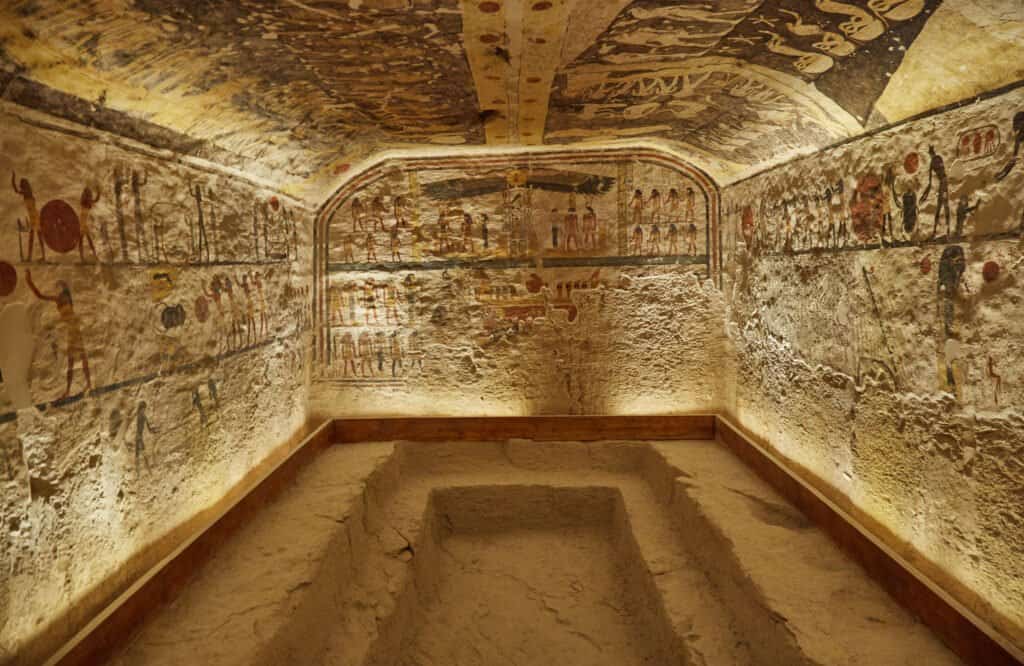
Tomb of Ay
Western Valley, Luxor Egypt Posted by bazartravelsAdmin
Tomb of Ay
The Tomb of Ay sits in the Western Valley near Luxor, one of Egypt's least crowded burial sites and a fascinating counterpoint to the famous royal tombs across the river. Built for Ay, who served as vizier and briefly ruled Egypt during the 18th Dynasty, the tomb offers a quieter, more intimate look at New Kingdom burial practices. Unlike the Valley of the Kings main sites, you can often explore this tomb with few other visitors, making it an exceptional choice if you want to linger and absorb the painted walls without the crowds.
Why this place matters
Ay occupied a unique position in Egyptian history. He rose from non-royal origins to become one of the most powerful men in the kingdom, serving Tutankhamun as vizier before ascending to the throne himself around 1323 BCE. His reign lasted only four years, but his influence shaped the final years of the 18th Dynasty. The tomb he built for himself reflects both his high status and the artistic traditions of his era, featuring painted reliefs that offer insights into royal funerary beliefs and daily life imagery.
The Western Valley itself deserves attention as a distinct burial ground. While most New Kingdom royals were buried in the Valley of the Kings proper, the Western Valley hosted only a handful of tombs. This isolation, combined with its smaller visitor numbers, makes it an essential stop for anyone serious about understanding Luxor's archaeological landscape.
Quick facts
- Location: Western Valley, about 2 kilometers from the Valley of the Kings main entrance
- Owner: Ay, 18th Dynasty pharaoh (ruled approximately 1323-1319 BCE)
- Painted reliefs and hieroglyphic inscriptions throughout
- Access requires separate ticket from the Valley of the Kings main sites
- Minimal shade and steep descent required to reach the burial chamber
Getting there
The Western Valley is accessible from Luxor's West Bank, the same area where the Valley of the Kings and other major sites cluster. If you are staying on Luxor's East Bank, you will cross the Nile by ferry or organized tour. Once on the West Bank, you can reach the Western Valley by private taxi, rental car, or as part of a guided tour package.
From the Valley of the Kings main entrance, the Western Valley lies about 2 kilometers away. Most visitors hire a private driver or join a tour that combines multiple sites in one day. The road is unpaved in sections but passable year-round. If you are driving independently, ask your hotel or rental agency for directions, as signage is minimal.
The tomb entrance sits at the end of a short path from the parking area. You will need to descend a steep flight of stairs carved into the rock face to reach the inner chambers. Bring sturdy shoes with good grip, as the stairs can be slippery, especially after any rare rainfall.
The layout and experience
The tomb follows the standard New Kingdom royal design: an open courtyard leads to a sloped corridor that descends into the rock. As you move deeper, the passage narrows and angles downward, drawing you progressively into the mountain. This architectural progression was intentional, symbolizing the journey of the deceased into the underworld and toward rebirth.
The walls throughout are decorated with painted reliefs. Unlike some damaged tombs, Ay's burial chamber retains substantial color and detail. You will see hieroglyphic texts, religious scenes, and imagery depicting Ay's transition to the afterlife. The pigments, primarily ochres and blues, have held up remarkably well given their age of more than 3,300 years.
The burial chamber itself is modest compared to what you might expect from a pharaoh's tomb. This reflects both Ay's relatively short reign and the practical constraints of tomb construction in his era. The sarcophagus, once housed here, is now in a museum. The empty chamber itself, however, creates an unexpectedly moving space. The painted ceiling and walls create an immersive visual environment that conveys the religious vision of the New Kingdom.
Main highlights
The painted reliefs are the primary draw. Look for scenes showing Ay in various ritual poses, often accompanied by divine figures and sacred texts. One notable image shows Ay with his wife, a rare intimate domestic detail in royal tomb art. The hieroglyphic inscriptions include the Book of the Dead passages designed to guide the pharaoh through the afterlife.
The astronomical ceiling is worth studying closely. Ancient Egyptians mapped stars and constellations directly onto burial chamber ceilings. The Tomb of Ay preserves this tradition, with visible star patterns and celestial symbolism that connected the deceased pharaoh to the cosmos.
Because of the small visitor numbers, you have time to examine details that rush would obscure. Bring binoculars to see ceiling details more clearly without straining your neck.
History and background
Ay's rise to power was unusual for ancient Egypt. Born into a non-royal family, he married into the royal household and gained prominence during the reign of Akhenaten, the heretic pharaoh who tried to overturn centuries of Egyptian religious tradition. When Akhenaten's successor Tutankhamun took the throne as a child, Ay served as his chief advisor and vizier, wielding the actual power of governance.
After Tutankhamun's unexpected death around 1323 BCE, Ay, then in his sixties, assumed the throne himself. His brief reign focused on restoring traditional religious practices and consolidating power. He died after only four years, and the throne passed to Horemheb, a military general who worked to erase memories of Ay's rule, including attempts to deface his tomb.
The Western Valley was chosen as Ay's burial site, possibly to distinguish his tomb from the main Valley of the Kings where Tutankhamun was buried. The valley had hosted Amenhotep III's tomb centuries earlier, lending it prestige despite its isolation. Ay's tomb represents the end of an era. Within a generation, the New Kingdom's power began to decline, and no pharaohs were buried in the Western Valley after Ay.
Tickets and entry
The Tomb of Ay requires a separate ticket from the Valley of the Kings main ticket. You cannot visit it with a standard Valley of the Kings pass. Tickets are purchased at the Valley of the Kings entrance gate. Ask the ticket seller specifically for access to the Western Valley sites. A few tombs are open there, so clarify which you wish to visit.
The ticket is relatively inexpensive compared to main Valley sites. Timed entry is not enforced the way it is for some other tombs, and opening hours align with the Valley of the Kings (typically 6 am to 5 pm, depending on the season).
Best time to visit
October through April offers the most comfortable conditions. Temperatures are warm but not extreme, and you avoid the intense summer heat that makes outdoor walking difficult. Mornings are ideal. Arrive by 8 or 9 am to explore with minimal crowds and while the light is still soft.
The tomb receives fewer visitors than the main Valley sites year-round, but it is quietest in the shoulder seasons of October-November and March-April. Summer months see fewer tourists overall, but the heat becomes a serious consideration. The descent into the tomb provides some shade, but the approach and exit are fully exposed.
Avoid afternoons if possible. The sun beats down on the exposed courtyard and stairs, and any shade provided by the surrounding cliffs diminishes as the day progresses.
Photography tips
Photography is generally permitted. Bring a wide-angle lens if you have one, as the corridor and chamber spaces are relatively tight and you may want to capture the full decorated walls. A telephoto lens helps capture ceiling details without tilting your head back uncomfortably.
The painted walls photograph best with soft, diffused light. Midday direct sunlight can create harsh shadows that obscure detail. Early morning or late afternoon light is more flattering to the colors and makes the hieroglyphic inscriptions more legible in photographs.
Bring a tripod if you want sharp images in the dimmer interior chambers. Flash is typically prohibited to protect the ancient pigments, so a tripod and slower shutter speed are necessary for interior shots without flash.
Facilities and preparation
The Western Valley has minimal facilities. There are no refreshment stands, bathrooms, or shaded rest areas at the tomb site itself. Bring plenty of water, at least one to two liters per person. A hat or headscarf provides essential sun protection for the approach and exit.
Wear comfortable walking shoes with good ankle support. The descent involves a steep staircase with variable footing. The stairs are not polished or worn smooth, so grip matters.
Sunscreen and sunglasses are essential. The rock reflects intense heat and glare, especially in spring and fall when the sun angle is higher.
If you have mobility issues, the steep stairs and confined passages make this tomb challenging to access. There is no elevator or alternative route into the burial chamber. Assess your comfort with steep descents before committing to a visit.
Combining with nearby attractions
The West Bank of Luxor is exceptionally rich in archaeological sites. Most visitors pair the Tomb of Ay with the main Valley of the Kings sites, the Temple of Hatshepsut, the Colossi of Memnon, and the Valley of the Queens. These can be visited in a single long day with an organized tour or private driver.
If you are spending multiple days on the West Bank, you can afford to move more slowly. Visiting the Tomb of Ay in the morning, resting during the afternoon heat, and then exploring the Temple of Hatshepsut or other sites in late afternoon creates a more sustainable pace.
The Western Valley itself contains one or two other tombs beyond Ay's, though they are less accessible and less well-preserved. A knowledgeable guide can point them out and explain their significance. Most guides combine the Western Valley with the main Valley of the Kings in a half-day tour.
Sample visit plan
Start on the West Bank early. Cross the Nile by ferry or arrange transport before sunrise if possible, aiming to be at the Valley of the Kings ticket gate by 6 or 6:30 am. Purchase your Western Valley ticket along with any other sites you plan to visit that day.
Head directly to the Western Valley while it is still cool. Plan to spend 45 minutes to an hour at the Tomb of Ay, depending on how carefully you examine the painted walls and hieroglyphics. The steep descent and ascent take 10 to 15 minutes combined. Allow extra time if you are photographing or taking detailed notes.
After exiting, rest in a shaded area or return to your vehicle for water and a snack. By mid-morning, head to the Temple of Hatshepsut or the Valley of the Kings main sites. These are best visited in the late afternoon when temperatures cool slightly, so use the middle of the day for a meal and rest.
Practical tips
- Hire a knowledgeable guide if you want detailed information about Ay's reign and funerary beliefs. Many guides specialize in the West Bank and can provide context that enriches your understanding.
- Bring a flashlight or headlamp. The interior chambers are dim, and a light helps you see painted details more clearly.
- Visit early in your Luxor trip so you can rest afterward if the heat or exertion leaves you fatigued.
- Ask your hotel or guide about the current condition of the stairs. Occasional rockfalls or maintenance can temporarily affect access.
- Carry a small notebook. The hieroglyphic inscriptions and scenes reward close study, and jotting notes or sketches helps you process what you are seeing.
FAQ
Is the Tomb of Ay worth visiting if I only have one day in Luxor? If you have a full day on the West Bank, yes. It is less crowded than Valley of the Kings sites and offers a more intimate royal tomb experience. If you have only a few hours, prioritize the main Valley sites and Temple of Hatshepsut instead.
Can I visit the Tomb of Ay without a guide? Yes, you can explore independently with just a ticket. However, a guide adds significantly to your understanding of Ay's historical role and the religious symbolism in the tomb's decoration. Consider hiring a guide for at least this site even if you explore others independently.
How physically demanding is the descent? The stairs are steep and the passage is narrow, but the distance is relatively short. Most people of reasonable fitness can manage it. The main challenges are the slope and the need to duck in places. If you have difficulty with stairs, this tomb may not be accessible for you.
What should I bring to the tomb? Water, a hat, sunscreen, sturdy shoes, and a light. A camera, binoculars, and a notebook are helpful but optional. There is nowhere to buy supplies near the tomb.
Is the Tomb of Ay air-conditioned? No. It is a natural rock chamber with no climate control. It stays cooler than the surface during the day, but it is not refrigerated.
Opening hours
Reviews
Sign in and mark this place visited to leave a review.
No reviews yet.
Free Trip Planner
Plan your Egypt trip with our free planner
Build a day-by-day itinerary with AI suggestions, hand-picked places, and friends. Free forever — no credit card.