
A Second Phone Number for Travel: App Number, Local SIM or eSIM
By
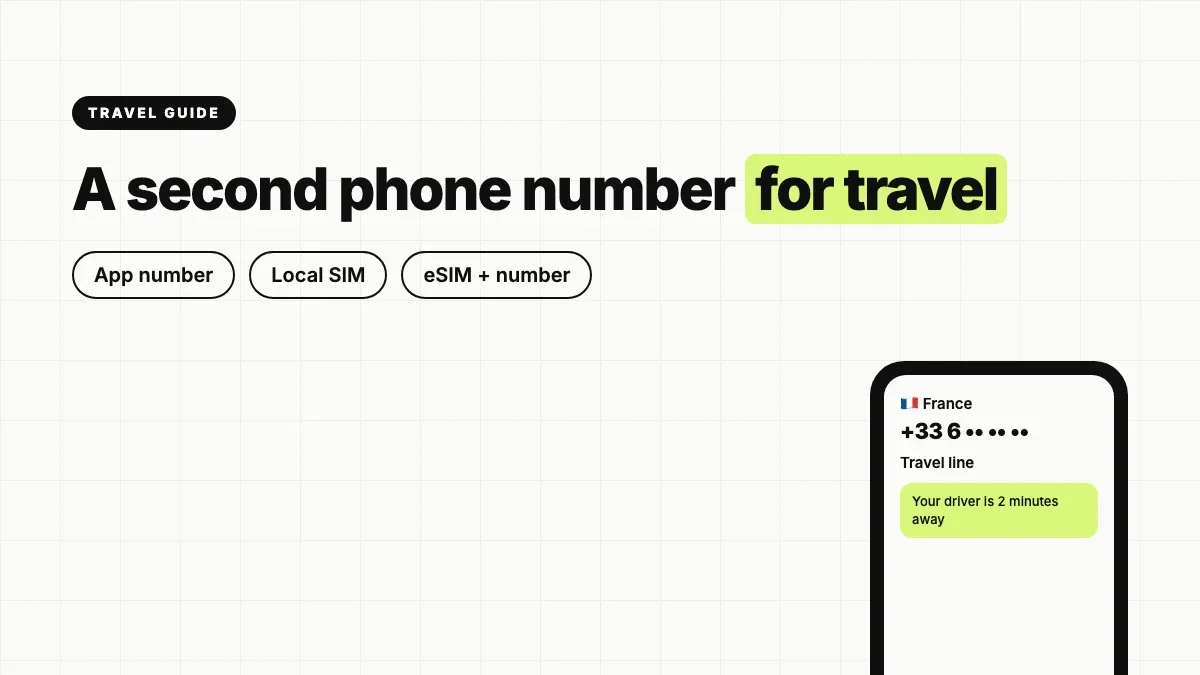
A trip usually needs your phone number before you have left the airport. The driver booked through your hotel texts to say which exit he is parked at. The front desk calls because your flight landed late and they want to know whether to hold the room. Halfway through the week, your bank sends a code to approve a card payment, and it goes to your home number, wherever that SIM happens to be.
Those jobs don’t all belong on one line. Most travelers end up with some mix of three tools: a number inside an app, a local SIM bought on arrival, or an eSIM that carries its own phone number. Each one handles some jobs well and fumbles the others.
What a travel number has to handle
On a typical trip, your phone needs to:
take calls from people who won’t use your messaging app, like a hotel front desk or a driver on a basic phone
receive texts from local businesses, such as booking confirmations and pickup details
get you online for maps, ride apps and translation
keep receiving codes from your bank and other accounts at home
be easy to hand out to strangers and easy to drop when the trip ends
No single number does all five without a compromise somewhere. Most recent phones support dual SIM, either a physical SIM plus an eSIM or two eSIMs, so the real question is which number does which job.
Option one: a number inside an app
App numbers such as Google Voice, TextNow, Burner and Hushed are VoIP numbers: calls and texts travel over the internet rather than over a mobile network. You can set one up before the trip, and it works anywhere with Wi-Fi.
The catch is how other companies treat those numbers. Many services run a line-type lookup on any number you enter, which tells them whether it is mobile, landline or VoIP. Fraud teams often block VoIP because those numbers are cheap, disposable and rented in bulk, and Google Voice and TextNow numbers in particular are often rejected by banks and some apps. On the road, that shows up as a booking platform or ride app that refuses to send a code to the number you just gave it.
Google Voice also requires a Google account and verification against an existing US non-VoIP number, so it mainly suits travelers who already have a US mobile line. And an app number only rings when the app is online. Land without data or airport Wi-Fi, and the driver’s message sits unread.
Fine for a rental host or a tour desk, then. A poor fit for anything that has to verify you.
Option two: a local SIM from the counter at arrivals
A local SIM gives you a real mobile number in the country you are visiting, in a format local businesses and drivers recognize. Because it is a mobile line, it shows up as mobile in a line-type lookup rather than VoIP.
The trade-off is time and paperwork. Many countries, Spain and Germany among them, require ID for any SIM, so expect to hand over your passport and wait while the clerk enters your details. Where registration is mandatory, using an unregistered SIM can itself be an offense, so this is not a step to work around. The US and the UK have no SIM registration law for prepaid SIMs.
Then there is the hardware. If your home line is a physical SIM and your phone has a single slot, the local card pushes it out, and your bank codes stop arriving the moment you swap.
Option three: an eSIM that comes with a number
First check whether a travel eSIM includes a number at all. In technical terms, an eSIM with a number has both an IMSI, which is the subscription, and an MSISDN, which is the phone number itself. A data-only eSIM has no MSISDN, so nobody can call it or text it. Great for maps, useless when the hotel wants to reach you.
An eSIM with a number puts calls in both directions, SMS and mobile data on one eSIM. The number runs on a mobile network rather than inside an app, so it is not an app-based VoIP number. Regional plans can usually be installed before you fly, so the line works while the driver is still circling the pickup lane. Some country plans, the UK for example, are installed after arrival instead, so check the plan before you pack.
Where the number comes from depends on the plan. Cypher eSIM, one of several providers in this category, lists the number’s country on the plan card before you pay: European plans carry a French +33 number, and some destinations have local numbers. If local businesses will be calling you, that card is worth a look before you buy an eSIM with a phone number for the trip.
Two more things. These plans are time-boxed: the number lasts as long as the plan, so it is a tool for the trip, not a number to keep for years. And no provider can promise that a specific bank or app will accept a specific number. The same provider says it bought and tested its own number before selling it: calls connected both ways, and SMS and verification codes arrived. A reasonable sign, but if one app matters for your trip, test it the day you install.
What to keep on the home line
Your bank, airline account and email recovery settings all point to your home number. Leave them there. A travel number expires with its plan, and an account that sends codes to an expired number is hard to get back into.
The usual setup: keep the home line active for bank codes and calls, and put data and a second number on a travel eSIM. Choose the travel line for mobile data and turn off data roaming on the home line, so it sits in the background receiving texts. Ask your carrier before you leave how it handles calls and texts abroad.
WhatsApp deserves a thought too. It registers with an SMS or voice code, and if you lose access to the number, re-verifying the account later requires that number. Keep WhatsApp on your home number and give the travel number to people who call or text the old-fashioned way.
As a rough rule: a short city break spent on hotel Wi-Fi may need only your home line and an app number. A long stay in one country suits a local SIM in the second slot. A trip across several countries, or a late arrival with a driver already waiting, is where an eSIM with a number earns its place.
FAQ
Can I keep my home number working while I use a travel eSIM? Yes, if your phone supports dual SIM, and most recent phones do. Keep the home line on for calls and texts, and set the travel eSIM as your data line.
Should I give my bank the travel number? No. A travel number ends with its plan, and no provider can promise that a specific bank will accept a specific number. Keep bank codes on your home line.
Can I install the eSIM before I fly? Often, yes, especially for regional plans. Some country plans, such as the UK, are installed after arrival, so check the instructions for your destination first.