
How to Plan a Road Trip: A Step-by-Step Guide for Your First (or Best) Trip Yet
By
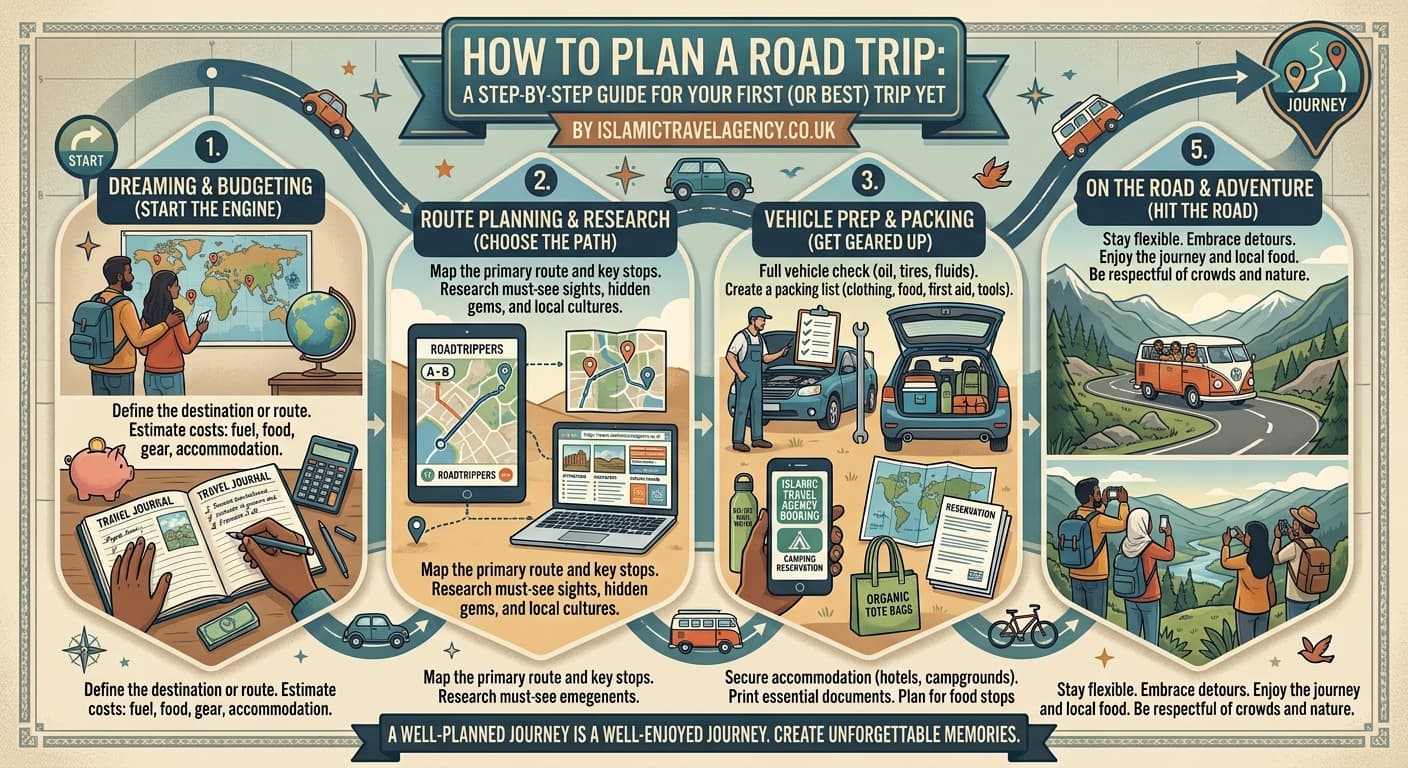
How to Plan a Road Trip: A Step-by-Step Guide for Your First (or Best) Trip Yet
There’s a particular kind of freedom that only a road trip delivers. No boarding gates, no baggage carousels, no rushing to make a connection — just an open road, a playlist you actually like, and the ability to stop wherever a view or a roadside diner catches your eye. But that freedom has a secret: the best road trips are the ones that were quietly, carefully planned before anyone turned the key. Spontaneity feels effortless precisely because the groundwork was already laid.
The good news is that the skills you build planning a road trip carry over to every other kind of travel you’ll ever do. Whether you’re mapping a coastal drive along the Amalfi Coast or comparing Umrah Packages from UK for a once-in-a-lifetime pilgrimage, the fundamentals are the same: know your route, set an honest budget, prepare your logistics early, and leave enough breathing room for the trip to surprise you. Master trip planning once and you’ve got a template for a lifetime of better journeys. So let’s break the road-trip version down, step by step.
Every great road trip starts with a single, deceptively simple question: where do you actually want to go? Resist the urge to cram in everything. A common first-timer mistake is treating a route like a checklist — five countries in seven days, or eight national parks in a long weekend — and then spending the whole trip staring at the road instead of enjoying it.
Start by picking one or two “anchor” destinations you genuinely care about, then build a loop or a line between them. Use a mapping tool to sketch the route and get a realistic sense of driving time. A useful rule of thumb: no more than four to five hours of driving on a full travel day, and less if you want time to actually explore. If you’re planning your route with a free trip planner, drop pins on the places that excite you and let the shape of the journey reveal itself. You’ll quickly see which detours are worth it and which ones are just adding hours to your seat time.
Think about the character of your drive, too. Coastal highways, mountain passes, and desert straightaways each offer a completely different experience. The road itself is part of the destination.
Step 2: Set a Realistic Budget
Nothing ends the magic of a road trip faster than running out of money halfway through. Before you go, break your budget into clear categories: fuel, accommodation, food, activities, and a cushion for the unexpected. Fuel is easy to underestimate — calculate your total distance, divide by your vehicle’s fuel economy, and multiply by current prices, then add ten percent for detours and traffic.
Timing matters more than most people realise, and this is where big-trip thinking pays off. The best rates on accommodation and vehicle hire go to travellers who commit early, before peak-season demand pushes prices up. It’s the same logic that leads pilgrims researching Umrah Packages 2027 to lock in dates and pricing more than a year in advance — early planning consistently beats last-minute scrambling, whether you’re booking a mountain cabin or a flight halfway across the world. Set price alerts, book refundable options where you can, and always know your daily spending ceiling before you set off.
Step 3: Get Your Vehicle Ready
Your car is the single most important piece of equipment on a road trip, so it deserves attention long before departure day. If you’re driving your own vehicle, book a service check: oil, brakes, tyres (including the spare), coolant, wipers, and lights. A breakdown in the middle of nowhere can turn a dream trip into an expensive ordeal.
If you’re renting, choose your vehicle for the trip you’re actually taking. A compact car is cheap and efficient for city-to-city cruising, while an SUV earns its higher cost on rough terrain or when you’re hauling gear and passengers. Read the rental agreement carefully — mileage limits, insurance excess, cross-border restrictions, and deposit requirements can all catch you off guard. Look for options with transparent terms so there are no surprises when you return the keys. Whichever vehicle you choose, spend ten minutes learning where the essentials are: hazard lights, spare tyre, jack, and the fuel cap release.
Step 4: Build a Flexible Itinerary (and Leave Empty Days)
Here’s the counterintuitive secret of the best road trips: the itinerary should have gaps in it. Over-scheduling is the enemy of a good drive. When every hour is accounted for, a flat tyre, a long lunch, or a town you fall in love with becomes a stressful disruption instead of a happy accident.
Plan your must-see stops and your overnight stays, but leave whole afternoons — even whole days — deliberately empty. These are the hours where the trip becomes yours: the unplanned hike, the beach you weren’t expecting, the local festival you stumble into. A loose itinerary is not a lazy one; it’s a confident one. Book your first night and your key reservations in advance, then let the middle of the trip breathe. You’ll come home with better stories.
Step 5: Pack Smart — The Road Trip Essentials
Packing for a road trip is different from packing for a flight — you have space, but that’s exactly the trap. Just because it fits doesn’t mean you need it. Build your packing list around a few core categories:
Navigation and documents: driving licence, insurance papers, ID, printed backup of key bookings, and offline maps downloaded in advance.
Emergency kit: first-aid supplies, jumper cables, a torch, a basic tool kit, water, and a warm blanket.
Comfort: refillable water bottles, snacks, sunglasses, chargers, and a phone mount so you’re not fumbling for directions.
Clothing: layers you can mix and match, plus one outfit for weather you’re not expecting.
Keep the items you’ll need on the go — snacks, chargers, sunglasses — within arm’s reach rather than buried in the boot. Small logistics like these are what separate a smooth day from a frustrating one.
Step 6: Stay Safe and Prepared
A little preparation buys a lot of peace of mind. Share your route and rough schedule with someone back home, and check in at your overnight stops. Download offline maps for any stretch where signal might vanish — mountains, deserts, and rural border regions are notorious for dead zones.
Know the basics before you cross into a new region: local driving laws, speed limits, whether you drive on the left or right, and what documents you’re required to carry. Keep emergency numbers saved and written down somewhere that doesn’t depend on a charged phone. And never underestimate rest. Driver fatigue is one of the most common and most avoidable road-trip hazards, so swap drivers regularly, take a proper break every couple of hours, and stop for the night before you’re truly exhausted.
Step 7: Use the Right Apps and Tools
Technology can quietly do a lot of the heavy lifting. A good navigation app with live traffic and offline capability is non-negotiable. Add a fuel-price finder to save money at the pump, an accommodation app for booking on the move, and a notes or planning app to keep your reservations and confirmation numbers in one place.
Just don’t let the tools run the trip. Screens are there to support the journey, not replace the experience of looking out the window. The best travellers use technology to remove friction, then put the phone down and enjoy where they are.
The Road Is Yours
Planning a road trip well isn’t about controlling every variable — it’s about handling the boring logistics in advance so the spontaneous, memorable parts have room to happen. Choose a route you love, budget honestly, prepare your vehicle, and then trust yourself enough to leave space for the unexpected.
Whether this is your very first road trip or your latest attempt at your best one yet, the same truth holds: great journeys are planned by people who care about the details and stay flexible about the rest. Fill the tank, cue the playlist, and go. The road is waiting.