
Antigua Street Market
Antigua Guatemala Posted by Brandon B.Admin
Antigua Street Market: Where the City Actually Shops
The Antigua Street Market is one of those places that tells you more about a city in an hour than a week of sightseeing can. Spread across several blocks in Antigua Guatemala, the market draws locals, vendors from surrounding Maya villages, and travelers who've heard enough about the town's cobblestone streets and colonial churches to want something less polished. This is where the food is real, the prices are negotiated, and the mornings smell like wood smoke and fresh tortillas.
Antigua itself sits at roughly 1,500 meters above sea level, surrounded by three volcanoes, and the market reflects the highland culture that thrives in those conditions. You'll find produce that doesn't exist in most supermarkets, textiles woven in villages an hour away, and street food that local families have been making the same way for generations.
Why the Antigua Street Market Matters
Markets like this one are increasingly rare even in Central America. Supermarket chains and tourist-facing craft shops have pushed out the working markets in a lot of regional towns, but Antigua's street market has held its ground partly because the surrounding indigenous communities depend on it. Vendors travel in from San Antonio Aguas Calientes, Santa Catarina Palopó, and other villages in the Sacatepéquez department to sell here. For many of them, this is the primary outlet for their goods.
The market also functions as a social institution. Women in traditional huipiles gather not just to sell but to talk, to pass information, to catch up on what's happening in neighboring villages. If you spend time here without rushing, you start to notice that dynamic.
Quick Facts
- Location: Central Antigua, near the Mercado Municipal on Alameda Santa Lucía
- Best days: Every day, but Saturday and Sunday see the highest vendor turnout
- Peak hours: Early morning through early afternoon, with activity winding down by mid-afternoon
- Language: Spanish is fine, though many vendors also speak Kaqchikel
- Payment: Cash only for nearly all vendors; bring small bills in quetzales
- Price tier: Budget to very budget, depending on what you're buying
- Accessibility: Uneven cobblestone surfaces throughout; limited for mobility aids
Getting There
The market clusters around the Mercado Municipal on Alameda Santa Lucía, which runs along the western edge of Antigua's central grid. From Parque Central, the main plaza, it's about a 10-minute walk heading west. You'll know you're getting close when the foot traffic thickens and the sidewalks start filling with carts and awnings.
If you're arriving by chicken bus from Guatemala City or from one of the lake towns, the main bus terminal drops you nearby on Alameda Santa Lucía itself. Tuk-tuks are everywhere in Antigua and will get you there from most hotels for a very small fare.
The Layout and Experience
The market isn't a single building. It spills out from the covered Mercado Municipal into the surrounding streets, and depending on the day, it can extend several blocks in multiple directions. The covered section tends to hold butchers, produce stalls, and prepared food vendors. The outer streets are where you find textiles, handicrafts, and the women selling loose herbs, dried chiles, and enormous bags of cacao.
Navigating it takes a few minutes to calibrate. The covered market interior is dimly lit and densely packed, with narrow aisles between stalls. Outside, the street vendors lay goods on plastic sheets or fold-out tables along the curb. The whole area has the organized chaos of a place that's been running this way for a long time and doesn't need to explain itself to anyone.
Noise is constant. There's the low hum of conversation, vendors calling out, the slap of tortillas being shaped by hand, and the occasional burst of a radio. Smells shift every few steps: raw meat, then ripe mango, then copal incense burning at a small shrine near one of the entrances.
Main Highlights
Street Food
This is genuinely one of the best reasons to come. Look for tostadas topped with black bean paste and pickled cabbage, tamales wrapped in banana leaves, and atol, a thick corn-based warm drink that's been a morning staple in this part of Guatemala for centuries. If you see a woman with a large clay pot and a line forming, get in the line. Chuchitos, smaller tamales filled with chicken and a red tomato sauce, are everywhere and usually cost almost nothing per piece.
Textiles
The huipiles and table runners sold here are often made by the vendors themselves or by family members in their home villages. The quality varies, so take time to look closely at the weaving. Hand-woven pieces have a slight irregularity that machine-made imitations lack. If you're buying seriously, ask where the piece was made. Most vendors are direct about this.
Produce and Specialty Ingredients
The highland produce section is worth exploring even if you're not cooking. Vendors sell several varieties of squash, dried beans in colors that don't appear in ordinary markets, fresh chilacayote, and flowers used in both cooking and ceremony. The spice section, where vendors sell dried herbs in small bundles, is a good place to pick up achiote, dried peppers, and locally grown cinnamon.
History and Background
Antigua, originally known as Santiago de los Caballeros de Guatemala, was established as a colonial capital in 1543. Market trade in the area predates that founding, rooted in the Kaqchikel Maya trading networks that connected the highland communities long before Spanish colonization. The current Mercado Municipal building has been through several versions over the decades, but the street market itself has continued in some form regardless of what's been built or rebuilt around it.
The 1976 earthquake that devastated much of Guatemala's western highlands disrupted the market significantly, as it did most of Antigua's infrastructure, but vendors returned as the city rebuilt. Today the market is considered an informal cultural heritage site by many in the local community, even if it doesn't carry official protected status.
Best Time to Visit
Saturday mornings are the fullest, with vendors arriving early and the widest selection of goods on offer. If you want a more manageable experience, a weekday morning between around 7am and 10am gives you the freshest food stalls without the weekend crowds. By early afternoon most days, the prepared food vendors start packing up and the energy drops noticeably.
During Semana Santa, the week leading up to Easter, Antigua transforms entirely and the market expands significantly. Vendors come from across the country and the streets around the market become part of the larger festival landscape. It's spectacular but extremely crowded.
Photography Tips
Always ask before photographing people, especially women vendors in traditional dress. Many will say yes, some will decline, and a few will ask for a small payment in exchange, which is a reasonable request. Photographing the food stalls and produce sections is generally fine without asking. The best light is in the morning, especially in the open-air sections where natural light reaches the goods laid out on tables.
The covered market interior is challenging for photography due to mixed artificial light, but the textures and close quarters can produce interesting results if you're shooting with a wide aperture.
Combining with Nearby Attractions
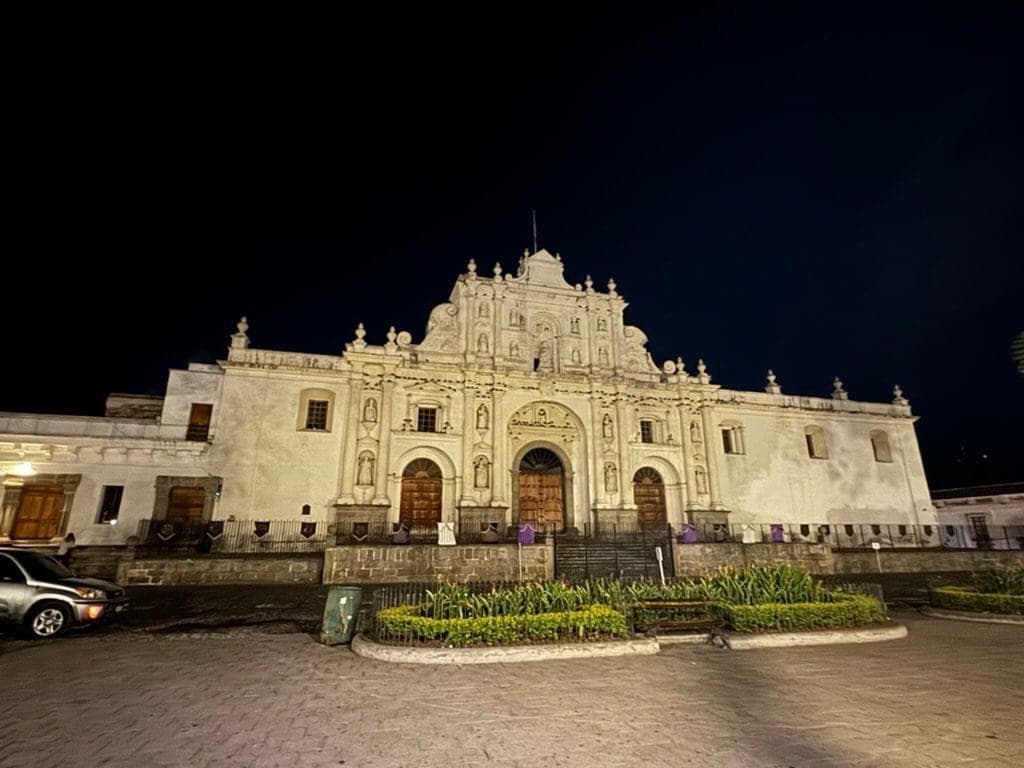
The market sits close enough to several of Antigua's other major sites that you can easily build a morning around it. From Alameda Santa Lucía, you're roughly 10 minutes on foot from Parque Central and the Catedral de Santiago, which dates to 1543 and remains partly in ruins from the 1773 earthquake. The Iglesia y Convento de La Merced, with its distinctive yellow facade, is a short walk northeast. If you want coffee after the market, Antigua's specialty coffee scene is dense and several well-regarded cafés operate within a few blocks.
Practical Tips
- Bring small bills. Vendors often can't break large notes and it slows everything down.
- Go early for food. Prepared food stalls are at their best before 9am and some sell out by late morning.
- Wear closed-toe shoes. The ground is uneven cobblestone and gets wet near produce stalls.
- Don't flash valuables. The market is generally safe but it's dense and busy, which creates opportunities for pickpockets.
- Bargaining is normal for crafts and textiles, but not expected for food. Don't haggle over a 5-quetzal tostada.
- Bring a bag. You will almost certainly buy more than you planned.
- If you're buying textiles as gifts, compare a few stalls before committing. Prices and quality vary more than they appear to at first glance.
FAQ
Is the Antigua Street Market safe for tourists?
Generally yes, especially in the morning hours when it's most active and populated. The usual precautions apply: keep your phone in a pocket rather than your hand, leave expensive jewelry at the hotel, and stay aware of your surroundings in the more crowded interior sections.
Can I eat at the market without worrying about getting sick?
Hot, freshly prepared food from busy stalls is typically lower risk than raw produce that may have been handled repeatedly. Stick to cooked items if you have a sensitive stomach, and watch which stalls locals are lining up at. A busy stall with fast turnover tends to be a reliable indicator.
Do vendors speak English?
Most don't, and that's part of the experience. Basic Spanish goes a long way, and numbers in Spanish are enough to negotiate most transactions. Vendors are generally patient with travelers who are clearly trying.
Is there a formal entrance or fee to enter?
No. The street market is public space, and the covered Mercado Municipal is open to anyone. There's no ticket or entrance fee.
What's the difference between this market and the craft markets aimed at tourists?
The Antigua Street Market is primarily a working market where locals shop for food and household goods. The craft and souvenir markets, like those near Parque Central, cater mainly to tourists and price accordingly. You'll find some overlap in textiles, but the atmosphere and the pricing are noticeably different.
Reviews
Sign in and mark this place visited to leave a review.
No reviews yet.
Free Trip Planner
Plan your Antigua trip with our free planner
Build a day-by-day itinerary with AI suggestions, hand-picked places, and friends. Free forever — no credit card.
Related reading

Things to see near Antigua Street Market


Places to eat or drink near Antigua Street Market

Mesón Panza Verde

Por Qué No? Cafe

Mellow coffee

Hot Chiplin Bar and Restaurant
More places in Antigua

MUNAG – Museo Nacional de Arte de Guatemala

Centro Cultural La Azotea
Cathedral de Santiago Antigua
