
 Posted by Brandon B.Admin
Casa Popenoe: Antigua's Best-Preserved Colonial House
If you want to understand what life actually looked like for a wealthy colonial family in 17th-century Guatemala, Casa Popenoe on 6ta Calle Oriente is the place to go. Most visitors to Antigua walk past dozens of crumbling facades without ever stepping inside one. This house lets you step inside a fully restored one, and the difference is remarkable.
The residence dates to 1636 and stands as one of the finest examples of domestic colonial architecture surviving in the Americas. It's not a museum in the sterile sense. The rooms are furnished, the garden is alive, and the whole property feels like someone might still live there. Someone did, until relatively recently.
Why Casa Popenoe Matters
Antigua is full of ruins, and ruins are beautiful. But they can make it hard to picture the city as it functioned at its peak, when it was the capital of the Captaincy General of Guatemala and one of the most important cities in the Spanish colonial world. Casa Popenoe fills that gap.
The house was rescued from near-total collapse in the 1930s by an American couple, Dr. Wilson Popenoe and his wife Dorothy. Wilson Popenoe was an agricultural scientist working in Central America at the time. The two of them spent years sourcing period-appropriate furniture, ceramics, paintings, and textiles from across Guatemala and beyond. What they assembled wasn't a recreation from scratch. It was a careful act of restoration guided by historical research, and the result holds up.
The collection inside includes colonial-era portraits, religious artwork, locally made pottery, and furniture that reflects the blend of Spanish and indigenous craft traditions that defined Guatemalan material culture in that period. A few pieces are genuinely rare.
Quick Facts
- Address: 6ta. Calle Oriente No. 16, Antigua Guatemala
- Original construction: 1636
- Restoration began: 1930s by Dr. Wilson Popenoe and Dorothy Popenoe
- Now managed by Universidad del Valle de Guatemala
- Entry is ticketed; guided tours are typically included
- Photography policies vary by area of the house, so ask on arrival
- Closed on certain days of the week; confirm hours before visiting
Getting There
The house sits on 6ta Calle Oriente, a short walk east of Antigua's central park, the Parque Central. From the park, you're looking at about five minutes on foot heading east. The street itself is one of the more intact colonial corridors in the city, lined with thick whitewashed walls and the occasional bougainvillea spilling over a gate.
There is no dedicated parking lot. If you're arriving by car or tuk-tuk, the easiest approach is to drop off near the intersection with 1a Avenida Sur and walk the remaining block. Tuk-tuks from anywhere in Antigua's center will know the address.
The Layout and Experience
The property follows the classic colonial house plan: a large entrance corridor leads into a main courtyard, which is surrounded by the principal rooms of the house. A second, more private courtyard sits behind the first, and beyond that lies the garden, which is one of the most quietly impressive parts of the whole visit.
The garden alone is worth the entry fee. It's planted with species that would have been cultivated in colonial Antigua, including medicinal herbs, fruit trees, and flowering plants that create a kind of living document of domestic horticulture from that era. The stone fountain at the center and the low corridors framing the space have a stillness that's hard to find elsewhere in the city.
Inside, the rooms are arranged around the main courtyard. You'll move through a sala, a dining room, a bedroom, a chapel, and several service areas. Each is furnished and labeled. The chapel is small but striking, with original painted details and a carved wooden altar. The kitchen gives a surprisingly clear picture of how food was prepared at scale for a household of that size and status.
Guided tours run through the history of the house, the Popenoe restoration project, and the significance of specific pieces in the collection. The guides tend to speak Spanish and English, though it's worth confirming availability when you buy your ticket.
Main Highlights
- The rear garden, planted with colonial-era species and centered on a stone fountain
- The private chapel with original painted decoration and carved altar
- Colonial portraits and religious paintings collected by the Popenoes
- The kitchen, which is one of the most complete colonial domestic kitchens you'll find on display anywhere in Guatemala
- The rooftop terrace, which offers views over Antigua's roofscape toward Volcán Agua
- Locally made ceramics and textiles that document indigenous craft traditions from the colonial period
History and Background
The original house was built in 1636, just over a century after the Spanish founded the city then known as Santiago de los Caballeros. The city went on to become the administrative and religious center of a territory stretching from Chiapas to Costa Rica. At its height in the 18th century, Antigua had a population that some historians estimate at around 60,000 people, making it one of the larger cities in the Western Hemisphere at the time.
The 1773 earthquakes, known as the Terremotos de Santa Marta, destroyed much of the city and prompted the colonial government to relocate the capital to present-day Guatemala City. Many residents left. Properties like the one that would become Casa Popenoe fell into disrepair over the following century and a half.
When Wilson and Dorothy Popenoe acquired the property in the 1930s, they found it in serious structural trouble. The restoration they undertook was meticulous. Dorothy Popenoe in particular was deeply involved in the research and sourcing side of the project, and her contribution to the finished house is substantial. She died before the restoration was complete, and the house became in part a tribute to her work. The property was later donated to Universidad del Valle de Guatemala, which continues to maintain it.
Best Time to Visit
Antigua's dry season runs roughly from November through April, which is when the city sees the most visitors. Casa Popenoe tends to be quieter than the major ruins and churches even during peak season, so crowds are rarely a problem here. Mornings are the most pleasant time to visit, before the midday heat settles into the courtyard stone.
Semana Santa, the week before Easter, transforms Antigua entirely. The city fills with processions and visitors from across Guatemala and abroad. If you're in town during that period, the house takes on a different kind of significance, since the colonial Catholic traditions on display in the chapel and throughout the collection connect directly to what you'll see happening in the streets.
Photography Tips
The rear garden photographs beautifully in the morning, when the light comes over the back wall and catches the fountain. The rooftop terrace is the obvious spot for a wide shot of Antigua with Volcán Agua behind it. Late afternoon tends to produce warmer light up there, though the sun can be directly in your lens depending on the season.
Inside the rooms, light levels are low and flash is typically restricted. A wide-aperture lens will serve you better than trying to boost ISO on a phone camera. The chapel in particular deserves a slow look even if you're not shooting, since the painted details are easy to miss in dim light.
Combining with Nearby Attractions
Casa Popenoe sits within easy walking distance of several of Antigua's most visited sites. The Iglesia y Convento de La Merced is a few blocks north, recognizable by its ornate yellow facade. The ruins of the Convento de Santa Clara are a short walk south. Both are worth an hour each.
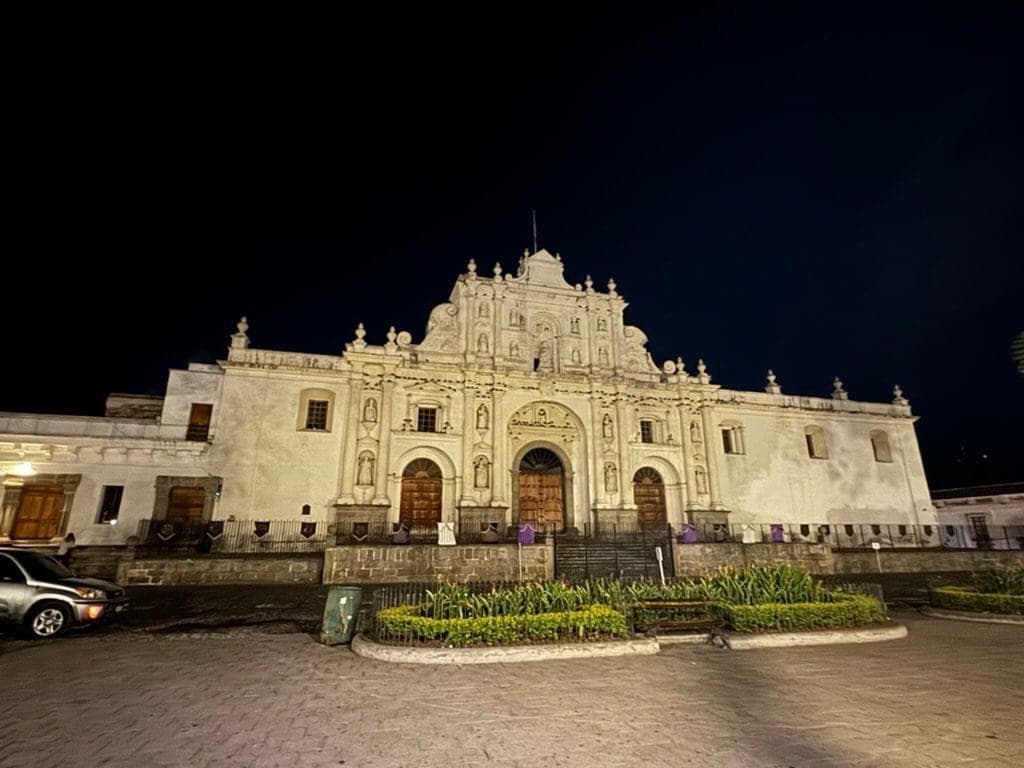
If you're building a full day in this part of the city, the Parque Central is five minutes west and anchors the whole historic center. The Palacio de los Capitanes Generales and the Cathedral ruins both face the park. A morning that starts at Casa Popenoe and moves west through the center covers a lot of colonial history without feeling rushed.
Practical Tips
- Confirm opening days and hours before you go, as they can vary and the house is sometimes closed for private events
- Wear comfortable shoes; the stone floors and courtyard surfaces are uneven in places
- The guided tour is worth taking even if your Spanish is limited, since many guides are bilingual
- The house is not fully accessible for visitors with mobility limitations due to its colonial-era layout and stone steps
- Bring cash for the entry fee; card payment is not always available at smaller historic sites in Antigua
- Allow at least an hour, more if you want to linger in the garden or on the rooftop
FAQ
Is Casa Popenoe suitable for children?
It works well for older children who have some patience for guided tours. Younger kids may find the indoor rooms less engaging, but the garden tends to hold attention well.
Do I need to book in advance?
Most days you can walk in and buy a ticket at the door. It's worth calling ahead if you're visiting with a larger group or during a major festival period like Semana Santa.
Is the tour only in Spanish?
English-language tours are typically available, but it's worth confirming when you arrive or contacting the house in advance if your group needs a specific language.
How does Casa Popenoe compare to the other colonial houses in Antigua?
Most of Antigua's colonial domestic architecture is either privately owned or in ruin. Casa Popenoe is genuinely unusual in being fully restored, furnished, and open to the public, which puts it in a category of its own in the city.
Reviews
Sign in and mark this place visited to leave a review.
No reviews yet.
Free Trip Planner
Plan your Antigua trip with our free planner
Build a day-by-day itinerary with AI suggestions, hand-picked places, and friends. Free forever — no credit card.
Related reading

Things to see near Casa Popenoe


Places to eat or drink near Casa Popenoe

Mesón Panza Verde

Por Qué No? Cafe

Mellow coffee

Hot Chiplin Bar and Restaurant
More places in Antigua

MUNAG – Museo Nacional de Arte de Guatemala

Centro Cultural La Azotea
Cathedral de Santiago Antigua
