Ghent City Center
Ghent Belgium Posted by Brandon B.
Overview
Ghent City Center is the living core of Belgium's medieval Flanders region, a walkable neighborhood where canals lined with guild houses reflect centuries of commerce and craft. Unlike Brussels or Antwerp, Ghent feels less polished and more lived in, with locals cycling past cafes, students claiming corners of cobblestone squares, and water lapping against stone facades that date to the 1300s. The center sits roughly between the Sint-Baafskathedraal to the south and Sint-Jacobs Church to the north, spanning about 20 minutes on foot end to end. You'll find the major attractions, restaurants, and street life concentrated in a zone that's genuinely navigable without feeling rushed or overwhelmed.
Why this place matters
Ghent was one of the richest cities in medieval Europe, built on the cloth trade and the grain trade flowing through its waterways. That wealth left behind architecture that shaped the Renaissance and Gothic movements. The Graslei waterfront, where merchant ships once unloaded goods, still stands as one of the most photogenic streetscapes in Europe, with gabled facades in shades of cream, rust, and ochre rising directly from the water.
The city's cultural weight comes from the Van Eyck brothers, who painted the Ghent Altarpiece in 1432, one of the most influential works in Western art. But Ghent also matters today because it hasn't calcified into a museum town. Street art covers certain walls, independent shops cluster in unexpected corners, and the university presence keeps the atmosphere young and slightly rough around the edges.
Quick facts
- Population: approximately 250,000 in the city proper, much smaller and more manageable than Brussels
- Best explored on foot or by bicycle; the center itself is largely car-free
- Main waterfront: the Graslei and Sint-Michielsbrug (Saint Michael's Bridge) offers the most famous vantage point
- Three major churches anchor the layout: Sint-Baafskathedraal, Sint-Niklaaskerk, and Sint-Jacobs Church
- Vegetarian and vegan dining is unusually prominent for a Flemish city
- No single admission fee for the center itself; attractions charge individually
Getting there
Ghent-Sint-Pieters train station sits about 1.5 kilometers south of the city center. Trains from Brussels arrive every 10 to 20 minutes and take roughly 30 minutes. From the station, you can walk into the center in about 20 minutes, following signs toward the Citadelpark and then the Graslei, or catch a tram or bus for a quicker ride. The city center itself has no car traffic, so if you're driving, you'll need to park at one of the peripheral garages and walk or cycle in from there.
If you're coming from the airport in Brussels, train is the practical choice. Rent a bicycle once you arrive if you're staying more than a day; bike shops cluster near the station and major hotels often offer rentals.
The layout and experience
The center radiates from three key plazas. Sint-Veerleplein sits at the water's edge, where the Graslei's guild houses face the camera-ready view across the Leie River. Walking north from there, you'll reach Graffiti Street (Werregarstraatje), a narrow lane covered in street art that locals use as a shortcut but tourists treat as an open-air gallery.
The main square, Graffiti Street connects to Sint-Niklaaskerk, the oldest of the three major churches and a good landmark for reorienting yourself. From the church, Veldstraat runs east as the primary shopping street, lined with chains and independent boutiques. Heading south from Sint-Niklaaskerk, you'll find Sint-Baafskathedraal, which houses the Ghent Altarpiece inside.
The western quadrant, around Citadelpark and the Design Museum, feels quieter and more residential. The eastern bank of the Leie has narrower lanes, smaller plazas, and fewer tourists. If you wander there, you'll pass working studios, repair shops, and bars that cater to locals rather than visitors.
Water shapes the experience throughout. Three rivers converge here (the Leie, Scheldt, and Maas), creating a network of canals that you'll cross dozens of times. Most bridges are low arches or simple stone spans; nothing is grand, but the constant interplay of water and architecture makes walking feel contemplative rather than transactional.
Main highlights
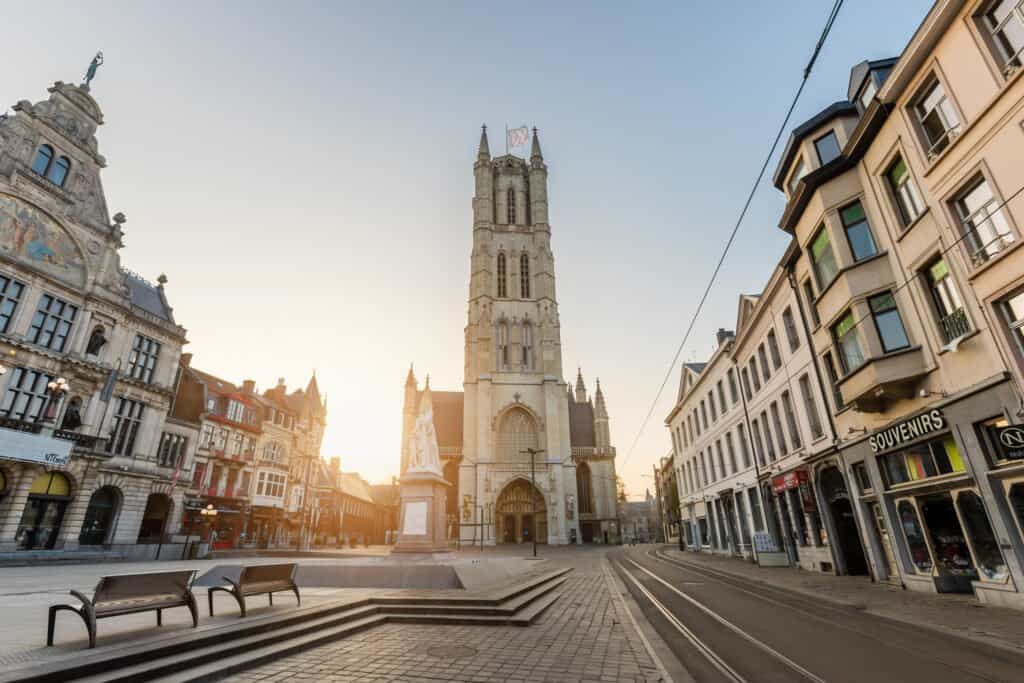
Sint-Baafskathedraal is the essential stop if you're only visiting once. The cathedral is modest from the street, but inside hangs the Ghent Altarpiece, a 15-panel oil painting completed by Jan and Hubert Van Eyck in 1432. The altarpiece is often called the "Adoration of the Mystic Lamb." Its lower panels depict a procession of pilgrims approaching a sacrificial lamb in a lush meadow, rendered with a precision and luminosity that startled contemporaries. The painting sits in a dedicated chapel; you'll need to buy a separate ticket to see it, but most guides recommend spending at least 20 minutes with it. The cathedral itself, built starting in the 1200s, has soaring ceilings and side chapels that reward wandering.
The Graslei waterfront is where most first-time visitors orient themselves. The row of guild houses rises three to four stories, each with a distinct gable shape and color. A guild house was both an office and a residence, built by wealthy merchants to display status. Walk the length of the Graslei in late afternoon light, when the facades glow. Cross Sint-Michielsbrug (the bridge at the north end) to see the full composition reflected in the water. From the bridge, looking back toward the Graslei and the cathedral spire beyond, you're seeing the image that appears in nearly every postcard of Ghent.
Sint-Niklaaskerk, the black-stone church at the heart of the center, is Ghent's oldest parish church, begun in the 1200s. It's smaller and less decorated than Sint-Baafskathedraal but worth entering for its proportions and the quiet it offers during busy afternoons. The church often hosts chamber concerts and organ recitals; if you hear one advertised, it's worth timing your visit around it.
The Design Museum, housed in a 18th-century mansion called Sint-Jacobs, displays decorative arts from the medieval period through contemporary work. The collection is modest compared to major museums in Antwerp or Brussels, but the building itself is the draw. Walking through period rooms, you'll see how wealthy Ghent merchants lived. The courtyard garden is a peaceful spot that many visitors miss.
Saint Bavo's Square (Sint-Baafsplein) wraps around the cathedral and opens into a plaza where locals sit with coffee and students sprawl on the steps. It's not a manicured square; it's a working neighborhood living room. The surrounding cafes and restaurants are mid-range and casual, not tourist traps.
History and background
Ghent emerged as a power in the 1100s when it gained the right to mint coins and control the grain trade flowing down the Scheldt. By the 1300s, cloth manufacturing made it one of the wealthiest cities in Europe, rivaling Venice and Florence. The guild houses you see today were built by weavers, dyers, and grain merchants who reinvested their wealth into stone, glass, and paint.
The Van Eyck brothers, Jan and Hubert, worked in Ghent in the early 1400s. Jan is considered the father of oil painting in the Northern Renaissance, and the Ghent Altarpiece exemplifies why. The brothers moved between courts and cities, but their work defined the Flemish school and influenced Italian Renaissance painters who saw their innovations. The altarpiece stayed in Ghent except during periods of war and political upheaval, when it was moved for safekeeping.
The city's fortunes declined after the 1500s as trade routes shifted and Spain consolidated power over Flanders. By the 1700s, Ghent was smaller and less prosperous than it had been. The 19th-century industrial revolution brought textile mills and coal-powered factories, which transformed the outskirts but left the medieval center largely intact. That accident of history preserved what you see today.
Tickets and entry
The city center itself is free to walk through. Individual attractions charge separate admission.
Sint-Baafskathedraal charges for entry to see the Ghent Altarpiece in the dedicated chapel, with discounted rates for students, seniors, and children under 12. Entry to the cathedral itself is often free or a nominal amount. The altarpiece viewing is timed, so if you visit during peak summer season, you may need to book ahead or arrive early.
The Design Museum charges general admission with discounts for students and seniors. Family tickets are available if you're traveling with children.
Walking tours of the city center are offered by several companies; these typically run 90 minutes to two hours and cost a mid-range fee. They're worth considering if you want context on the architecture and history without relying on a guidebook.
Best time to visit
Late March through May is ideal. The weather is mild, the tourist season hasn't peaked, and the light in the afternoon brings out the color in the guild house facades. September through October offers similar conditions with slightly fewer crowds.
December transforms the center with a Christmas market that sprawls across Sint-Baafsplein and the Graslei. The market runs for several weeks and draws locals as well as visitors. The atmosphere is festive but not frenzied, and the winter light reflecting off the water at dusk is exceptional.
July and August see the heaviest tourist traffic. The center doesn't feel overwhelmed the way Venice or Amsterdam might, but you'll share the Graslei with crowds and wait longer at restaurants. If you're visiting then, arrive at major attractions early in the morning or plan to explore quieter neighborhoods like the eastern bank.
Rainy weather is common year-round. The city's appeal doesn't diminish in the rain, but pack a waterproof jacket and expect to duck into cafes and museums more frequently.
Photography tips
Sint-Michielsbrug offers the single most recognizable angle. Stand on the bridge at late afternoon or early evening when the light hits the guild house facades from the side. Shoot from the center of the bridge looking south toward the cathedral spire for the postcard composition. If you want to avoid crowds, arrive before 9 AM or after 5 PM.
The Graslei itself offers endless variations depending on where you stand and what angle you shoot. Get low to include water reflections. Move along the waterfront to frame individual guild houses against the sky. The narrower lanes on the eastern bank have less dramatic light but more intimate compositions if you're interested in texture and detail.
Graffiti Street is worth a photo walk on its own, especially in the morning when the light enters from the west and colors pop. The art changes seasonally, so even repeat visitors will find new details.
Inside Sint-Baafskathedraal, natural light from high windows illuminates the Ghent Altarpiece in the afternoon. Photography is often restricted, so check with staff before raising a camera. The chapel itself, with its vaulted ceiling and stained glass, is photogenic even if you can't photograph the altarpiece directly.
Facilities and preparation
Restrooms are available in the cathedral, museums, and most cafes and restaurants. Public facilities are limited, so use a cafe if you need one. Many places require a small purchase, though it's never onerous.
The city center is mostly flat and paved, but the cobblestones can be uneven. Wear comfortable walking shoes with good support. Cyclists outnumber cars, so stay alert at street crossings and don't assume a lane is pedestrian-only.
Most restaurants and shops accept cards, but a few smaller cafes and street vendors prefer cash. ATMs are common throughout the center.
The center has good cell coverage. WiFi is available in most cafes and hotels. If you're planning a full day, download a map offline, as relying on GPS in narrow lanes can be disorienting.
How it compares to similar places
Ghent sits between Bruges and Antwerp in character. Bruges, 30 kilometers south, is older and more meticulously preserved, almost too perfect, with tourist infrastructure that can feel overwhelming in summer. Antwerp, 60 kilometers north, is larger and grittier, with more contemporary art and fashion, but less cohesive medieval character. Ghent holds the balance: medieval architecture and history without the theme-park polish of Bruges, but more compact and walkable than Antwerp. The university presence also distinguishes it. You'll see students everywhere, which keeps the food scene experimental and the nightlife less formulaic.
Combining with nearby attractions
Sint-Baafskathedraal's Ghent Altarpiece is the primary reason many people visit Belgium. If you're making a day trip from Brussels, you can see the altarpiece, walk the Graslei, and have lunch in two to three hours. If you're staying overnight, add the Design Museum and explore the quieter eastern neighborhoods.
Citadelpark, just south of the center, holds the Museum of Fine Arts and the Contemporary Art Museum. Both are worth a visit if you're interested in Flemish painting or modern work. The park itself is a pleasant green space that contrasts with the dense stone of the medieval center.
Bruges is a straightforward 30-minute train ride south. Many travelers combine Ghent and Bruges as a two-day itinerary, spending one day in each city. The towns have different feels, so both reward a full day if you have the time.
Sample visit plan
If you have four hours: Arrive at Sint-Pieters train station, take a tram or walk to Sint-Baafskathedraal, buy a ticket to see the Ghent Altarpiece. Spend 20 to 30 minutes with the painting. Walk to the Graslei, cross Sint-Michielsbrug, and walk back along the western bank. Eat lunch at a cafe near Sint-Baafsplein. If time remains, wander Graffiti Street or browse shops on Veldstraat.
If you have a full day: Start as above, but add the Design Museum in the afternoon. Take a walking tour if you want deeper historical context. Spend the evening eating dinner at a restaurant on the eastern bank, away from the main tourist zones. Walk back toward Sint-Michielsbrug at dusk to see the light change on the facades.
If you have two days: Spend the first day as described above. On the second day, explore the quieter neighborhoods on the eastern bank, visit Citadelpark and the art museums, rent a bicycle and ride to the surrounding villages, or take a day trip to Bruges.
Practical tips
- Arrive at Sint-Baafskathedraal early if you want to see the Ghent Altarpiece without a long wait. Timed entry slots fill quickly in summer.
- Rent a bicycle if you're staying more than a day. It's the local way to move around and extends your range beyond the center.
- Eat vegetarian. Ghent has a large vegetarian population and restaurants accommodate it well, often with more creativity than meat-focused options elsewhere.
- Duck into small museums and galleries that aren't in guidebooks. The Design Museum is on most itineraries, but smaller collections in converted guild houses offer quieter, more personal encounters with art and craft.
- Visit the Graslei at different times of day. Morning light is soft, afternoon light is dramatic, and evening light is intimate. Each offers something different.
- Learn the bridge names if you're staying more than a day. Locals navigate by bridges (Sint-Michielsbrug, Sint-Michielsbrug, Graffitibrug) rather than street names, and it helps you reorient quickly.
FAQ
How long should I spend in Ghent City Center? A minimum of four hours allows you to see Sint-Baafskathedraal, the Ghent Altarpiece, walk the Graslei, and eat lunch. A full day (six to eight hours) lets you add a museum and explore quieter neighborhoods. Two days is ideal if you're traveling without time pressure.
Is Ghent City Center accessible for people with mobility limitations? The center is mostly flat, but cobblestones are uneven and can be difficult for wheelchairs or walkers. The main attractions (cathedral, major bridges) are accessible, though some side streets and smaller museums may have stairs. Contact specific venues ahead of time to confirm accessibility.
Can I see the Ghent Altarpiece for free? No, there's a separate charge to view the altarpiece in its chapel. Entry to the cathedral itself may be free or minimal, but the altarpiece viewing requires a ticket.
What's the best way to get around the city center? Walking. The center is small enough to cross in 20 minutes, and you'll miss details if you move too fast. If you need to cover distance quickly, rent a bicycle. Trams and buses are available but unnecessary for the center itself.
Is Ghent City Center worth visiting if I've already been to Bruges? Yes. Bruges is more polished and touristy. Ghent feels more lived in and has a younger, less commercialized atmosphere. The Ghent Altarpiece alone justifies a visit, and the city's character is distinct enough to warrant both if you have time.
Reviews
Sign in and mark this place visited to leave a review.
No reviews yet.
Free Trip Planner
Plan your Belgium trip with our free planner
Build a day-by-day itinerary with AI suggestions, hand-picked places, and friends. Free forever — no credit card.
Related reading
Things to see near Ghent City Center

Museum Voor Schone Kunsten

STAM Ghent City Museum
St. Bavo’s Cathedral (Sint-Baafskathedraal)