
Easy Company and Battle of the Bulge Sites in Bastogne: A Mapped Guide
By
Explore on the map
14 places from the destinations in this story. Tap a pin to open the listing.
Bastogne is a small town in the Belgian Ardennes with an outsized place in the history of the Second World War. For a week in December 1944 the 101st Airborne Division held it while surrounded by German forces, and when the commander, Brigadier General Anthony McAuliffe, received a written demand to surrender, he answered with one word: Nuts. The siege, the relief by Patton's Third Army, and the fighting in the woods north of town became the closing episodes of Band of Brothers — which is why most people arrive here looking for Easy Company.
This is a guide to the Battle of the Bulge sites you can actually visit, in the order that makes sense on the ground. Every location below is on the map at the top of this page, so you can see which stops cluster in the town centre and which need a car. The short version: the museums are in town, the ground Easy Company fought over is three kilometres north around Bois Jacques and Foy, and the cemeteries are north again at Recogne — or an hour's drive south in Luxembourg.
Top World War II sites in Bastogne and the surrounding area
You can see the town centre on foot in half a day. Doing the whole thing properly — including the forest, the villages north of town, and the Luxembourg American Cemetery — takes two days, or one very long one with a car.
If you only have a few hours, prioritise in this order: the Bastogne War Museum for the context, Bois Jacques for the foxholes, and the Mardasson for the view and the scale of it. If you have come specifically for Band of Brothers, the two unmissable stops are Bois Jacques and Foy, and they are a ten-minute drive from the square.
A practical note before you go: several of these sites are in working farmland and forest, with no ticket office, no fence and no interpretation board. Wear boots, stay on paths and verges, and treat the ground as what it is.
Bastogne War Museum

The Bastogne War Museum sits beside the Mardasson Memorial and is the right first stop, because it does the thing the battlefield itself cannot: it explains how the Ardennes offensive came about and what it was like to be caught in it. The museum tells the story through four characters — a schoolboy, a schoolteacher, a Belgian resistance member and a German soldier — whose accounts you follow on an audio guide through a sequence of reconstructed scenes.
That framing divides visitors. If you want orders of battle and divisional markings you may find it thin; if you want to understand why a Belgian family hid in a cellar for a fortnight, it is extremely effective. Either way, allow two hours, and go before you walk the ground rather than after — the forest means considerably more once you know what was happening in it.
Mardasson Memorial

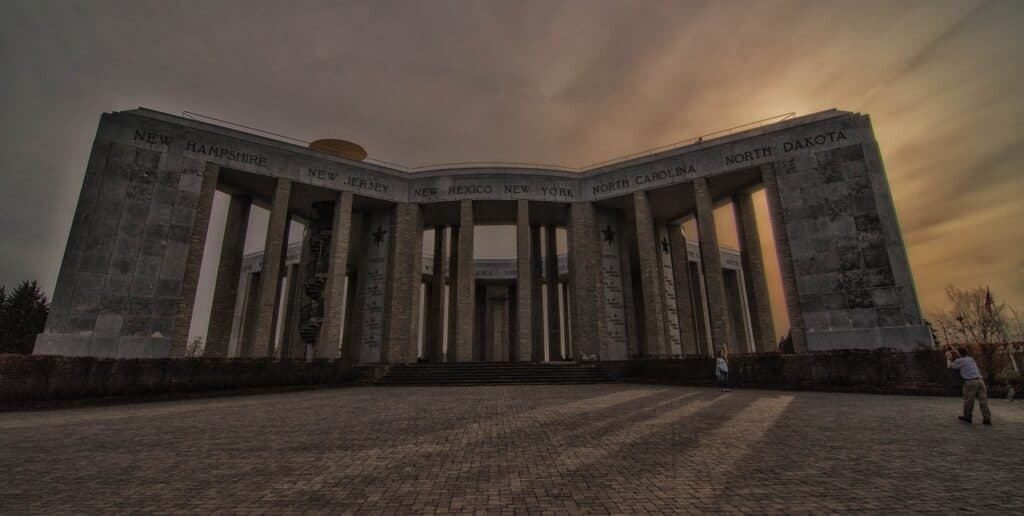
The Mardasson Memorial is the five-pointed star on the hill east of town, raised by Belgium to honour the American soldiers killed, wounded or missing in the Battle of the Bulge. The names of all forty-eight US states of the time are carved around the top, and a staircase takes you onto the roof for a view across the plateau the fighting was fought over — which is, on a clear day, the single best way to grasp the geography of the battle.
Go down into the crypt as well. It holds three altars — Catholic, Protestant and Jewish — decorated with mosaics by Fernand Léger. Almost nobody visiting for the Band of Brothers locations expects to find a major piece of twentieth-century French art under a war memorial in the Ardennes, and it is worth the ten minutes.
Nearby, look for the last of the Liberty Road milestones: a numbered stone marking the end of the Voie de la Liberté, which counts every kilometre from Utah Beach in Normandy to Bastogne.
Bastogne Barracks

The significance of Bastogne Barracks is simple and easy to miss: this is where McAuliffe said it. The cellar of this building was the command post of the 101st Airborne during the siege, and it is the room where the written German surrender demand was received on 22 December 1944 and answered with "Nuts!" — a reply the German envoys reportedly needed to have explained to them.
The site is run by the Belgian Army's War Heritage Institute and is normally seen on a guided tour, which also takes in a restoration workshop holding a serious collection of armoured vehicles. Check opening times before you travel: this is a working military site, not a commercial museum, and the tour schedule is limited and seasonal.
101st Airborne Museum (Le Mess)

The 101st Airborne Museum occupies a building that served as an officers' mess during the war, in the town centre a short walk from the square. The displays are built around uniformed mannequins and original equipment arranged into tableaux — a medical station, a command post, a street scene — with a heavy emphasis on the ordinary kit of the men who were here.
The part people remember is in the cellar: an air-raid simulation that puts you in a reconstructed shelter during a bombing, in the dark, with the sound turned up. It is brief and it is effective, and it is not recommended for small children or anyone who would rather not be startled.
General McAuliffe Square

Place McAuliffe is the centre of Bastogne and the place everyone ends up, usually several times a day — it is also where the restaurants are. In the middle stands a bust of McAuliffe himself, and beside it a Sherman tank of the 11th Armored Division, knocked out in the winter fighting and left unrestored. Walk round it and look at the holes; most visitors photograph the tank without registering what they are looking at.
The square is also where you will see the town's commercial relationship with its own history at its most cheerful — a bar named Le Nuts, nut-themed souvenirs, and a steady trade in unit patches. Make of that what you like. The town has lived with this for eighty years and is entitled to make a living from it.
Bois Jacques

If you came for one thing, this is it. Bois Jacques is the stretch of forest north-east of Bastogne where Easy Company dug in through the coldest part of the winter, under artillery that burst in the treetops and sent splinters down onto men in open holes. The foxholes are still there. Not reconstructions — the actual depressions, in pairs, running along the treeline.
Eight decades of leaf fall has rounded them off, so give your eyes a minute. Once you have seen the first, you will see dozens. Stand at the edge of the trees and look north across the open fields: that is the ground the company crossed to take Foy, and the distance tells you more about the attack than any documentary.
It is a flat, short walk from the roadside and it is free. Go early or late for the quiet; this is not a place that rewards arriving with a tour bus. Leave everything where it is — removing material from the ground here is both illegal and grubby.
Foy and the Easy Company Memorial

Foy is a working village of a few hundred people two kilometres north of Bois Jacques, and it was the objective of the assault on 13 January 1945 that forms one of the most-watched sequences in Band of Brothers. There is no visitor centre, and that is rather the point: you stand at the southern edge, look back at the treeline the company came out of, and the whole action is laid out in a single view.
The Easy Company Memorial stands between the two, a modest stone marking the unit's part in the fighting here. In the village itself, a wall still carries bullet impacts from the January fighting, associated locally with Sergeant Darrell "Shifty" Powers — treat the attribution as lore rather than documented fact, but the marks are real and at eye level.
Please remember that people live and farm here. Park on the verge rather than in gateways, and stay out of yards and outbuildings.
Bastogne Historical Walk

The Bastogne Historical Walk is a waymarked route through the town and out to the perimeter, taking in the places where the defence was organised and the line was held. It is the cheapest way to see Bastogne properly and the one most visitors skip in favour of driving between museums.
The markers to look for are the tank turrets set into the ground around the town — each one fixed at a point on the defensive perimeter, with the unit that held it. There is another on the Route de Neufchâteau to the south-west. Seen together they make the essential thing clear: the line was a ring, Bastogne sat inside it, and every road out was a road the Germans wanted.
Luxembourg American Cemetery and Memorial

An hour's drive south of Bastogne, just outside Luxembourg City, the Luxembourg American Cemetery holds 5,073 American war dead, most of them killed in the Ardennes. The graves are laid out in sweeping arcs across close-cut lawn, and among them — at his own request to be buried with his men — is General George S. Patton, whose Third Army broke the encirclement of Bastogne.
It is immaculately kept, free to enter, and quiet in a way that the museums are not. If you are driving back toward Luxembourg Airport it is barely a detour, and it is the stop most people say afterwards they were glad they made.
Closer to Bastogne, the German Military Cemetery at Recogne holds nearly 7,000 German dead under low grey crosses, and beside it is the site of the temporary American cemetery where the US dead were first buried before repatriation. Seeing both in the same afternoon is a markedly different experience from seeing either alone.
Memorial Renée Lemaire and the 10th Armored Division Aid Station

On an ordinary street in the town centre, a plaque marks the 10th Armored Division aid station that was struck by a German bomb on Christmas Eve 1944. Around thirty wounded men were killed. So was Renée Lemaire, a 30-year-old Belgian civilian nurse who had volunteered to help the American medics and who had been working in that building for days without rest.
She is remembered in Bastogne as the Angel of Bastogne, and most visitors arrive knowing her through Band of Brothers, where the medic Eugene Roe's scenes with a Belgian nurse are drawn from her. The plaque is small, easy to walk past, and placed exactly where it happened — which is the reason to seek it out rather than settle for the screen version.
Beyond the town: where the siege was broken
Two stops that most itineraries miss, and both are arguably more decisive than anything in the town centre.
Bunker Assenois, south-west of Bastogne, is where Lieutenant Charles Boggess drove his Sherman through the German line on 26 December 1944 and opened the corridor that ended the siege. Patton's Third Army had been pushing north for five days. This unremarkable stretch of road is where it actually succeeded, and on most days you will have it to yourself.
East of the Mardasson, the Monument Emile Cady is one of the small roadside memorials the Ardennes is full of — local, specific, and unexplained to anyone who has not looked it up. It is a useful corrective to a trip spent only on famous sites: the battle was fought across farmland and village lanes, and most of the ground where men died carries nothing but a stone and a name.
Planning your visit
Getting there. Bastogne has no railway station. Most visitors drive — it is about ninety minutes from Brussels and an hour from Luxembourg City, which has the nearest airport. A car is effectively required if you want Bois Jacques, Foy and Recogne as well as the town.
How long. One full day covers the town centre museums, the Mardasson and the forest. Two days lets you add the cemeteries, the perimeter turrets and Assenois without rushing.
When to go. Summer is easiest for the forest paths. December is the anniversary, with commemorations around the town and a genuine sense of occasion — and it is also cold, wet and dark by four, which is rather the point if you want to understand what the winter of 1944 was like.
Tours. Several local guides run half- and full-day Battle of the Bulge tours covering the Easy Company sites. If you are not driving, this is the practical way to reach Bois Jacques and Foy.