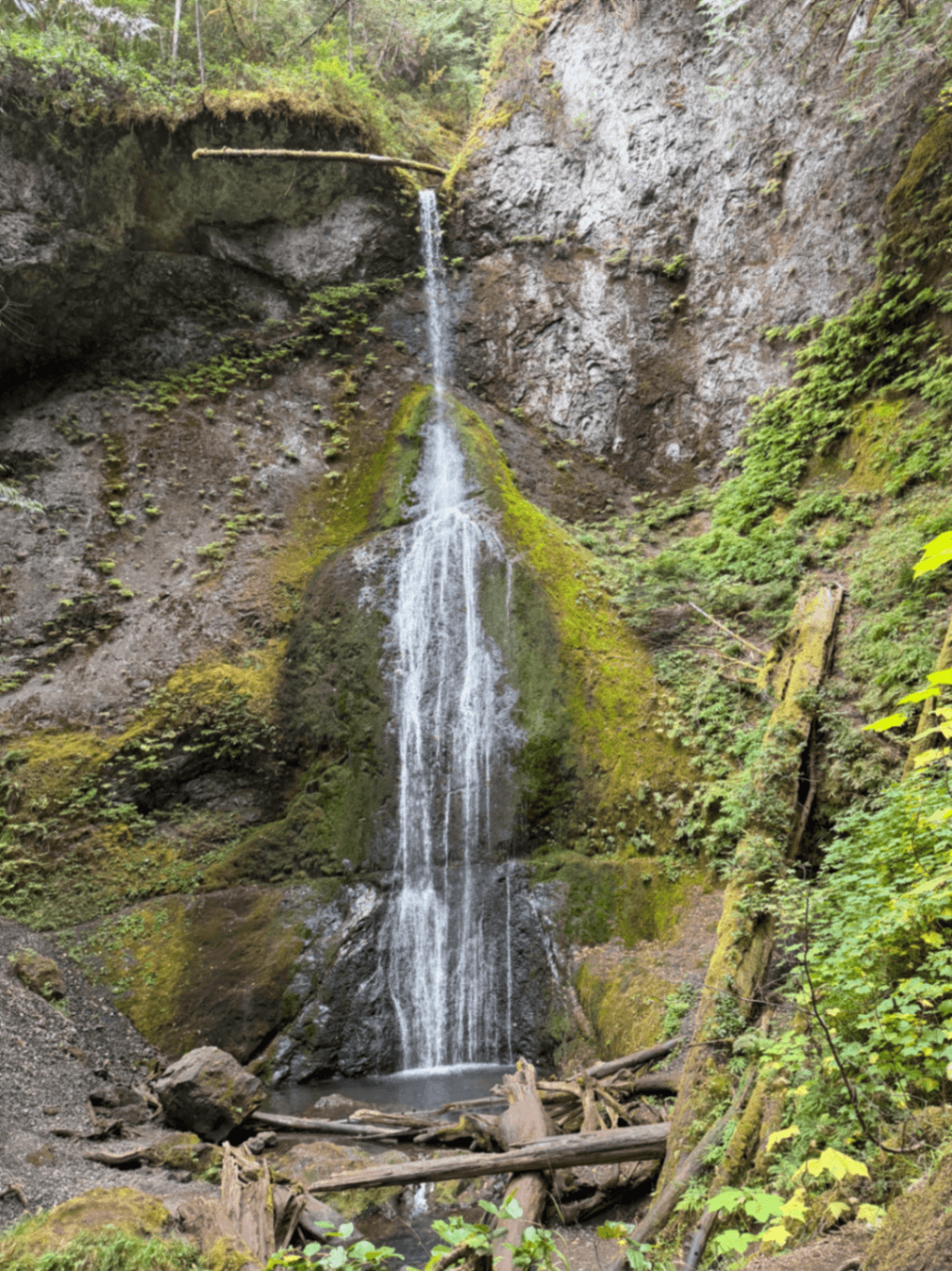
The Hoh Rain Forest sits at the end of a long, slow road in Jefferson County, deep inside Olympic National Park, and it gets between twelve and fourteen feet of rain a year. That number sounds abstract until you're standing under it. Sitka spruce and western hemlock climb past 250 feet overhead, bigleaf maples sag under the weight of club moss draped over every branch, and the forest floor is scattered with nurse logs, fallen trees that rotted slowly enough for a straight row of new saplings to take root along the top of each one. This is the temperate rain forest that most people picture when they think of Olympic National Park, and it earns that reputation within the first quarter mile of trail.
Unlike a tropical rain forest, the Hoh stays cool and green year-round because of the moisture pulled off the Pacific and dropped on the western slopes of the Olympic Mountains before it ever reaches drier ground inland. The result is a valley where light filters down in a dim, greenish wash even at noon. That's not a trick of the camera. It's the actual quality of light here, and it's part of why photographs of this place rarely do it justice.
Why the Hoh Rain Forest matters
Few places in the continental United States let you walk through old growth forest this intact. Logging reshaped most of the lowland Pacific Northwest over the past century and a half, but the Hoh valley's protection as part of Olympic National Park kept this stretch largely untouched. The moss itself is the headline feature, but the deeper story is the layering: nurse logs feeding new growth, maples thick with epiphytic moss that draws moisture straight from the air, and a canopy tall enough that the valley floor stays shaded and damp through most of the year. It's a working example of an ecosystem that's become rare everywhere else.
Quick facts
- Location: 18113 Upper Hoh Rd, Forks, WA 98331, inside Olympic National Park
- Annual rainfall: roughly twelve to fourteen feet
- Hall of Mosses loop: about eight tenths of a mile, flat
- Spruce Nature Trail: a little over a mile, flat, ends at the Hoh River gravel bars
- Hoh River Trail: more than seventeen miles one-way to Glacier Meadows at the base of Mount Olympus
- Both short loops start at the Hoh Rain Forest Visitor Center
Getting there
The Upper Hoh Road runs about nineteen miles off U.S. Route 101, and it's a slow drive, winding and often shared with logging trucks and cyclists. There's no shortcut and no way to rush it. Give yourself more time than the mileage suggests, especially if you're coming from Forks or from the coastal side of the park. Cell service drops out well before you reach the visitor center, so download any maps or park information ahead of time.
The layout and experience
Everything radiates out from the visitor center, where both the Hall of Mosses and the Spruce Nature Trail begin. The Hall of Mosses is the one almost everyone walks first, and for good reason. It's short, flat, and concentrates the hanging moss and the biggest maples into a loop you can do in under an hour. It's also, unsurprisingly, the busiest trail in the park during peak season.
The Spruce Nature Trail gets quieter fast. It runs a little over a mile down toward the Hoh River, and where the trees open up at the gravel bars you get your first real look at the valley walls and the braided river channels below. If the Hall of Mosses feels crowded, this is the better bet for something closer to solitude without adding real distance.
For those who want to go further, the Hoh River Trail keeps going past both loops, eventually climbing more than seventeen miles to Glacier Meadows, the main approach route for climbers attempting Mount Olympus. You don't need to go anywhere near that far to get the point of the place. The first two miles beyond the visitor center stay flat and the crowds thin out noticeably once people realize the loop trails are the shorter option.
Main highlights
- The moss-draped maple grove along the Hall of Mosses loop
- Nurse logs with visible rows of young trees growing from their tops
- River gravel bars at the end of the Spruce Nature Trail, with open views of the valley walls
- Old growth Sitka spruce and western hemlock exceeding 250 feet in height
- The first few miles of the Hoh River Trail, quieter than either loop and still flat
Best time to visit
Come early. This is the single most useful piece of advice for the Hoh. The parking lot at the visitor center fills by mid-morning through the summer months, and because the road in is long with few places to turn around, arriving late can mean sitting in a line of cars waiting for someone else to leave. An early start also tends to mean better light for photos and fewer people on the Hall of Mosses loop.
Rain is a near-constant possibility here regardless of season, which is sort of the whole point. Many visitors find the forest at its most atmospheric when it's actually raining, with mist low in the canopy and the moss glistening. Winter brings fewer crowds but also a higher chance of road closures or fallen debris after storms, so check conditions before making the long drive out.
Facilities and preparation
Bring real rain gear rather than an umbrella. The trees are tall enough and the understory thick enough that an umbrella is mostly useless, and a steady rain jacket with a hood will serve you far better. Waterproof or at least water-resistant footwear is worth it too, since the trails can turn muddy even outside of active rainfall. Dress in layers, since the temperature under the canopy tends to run cooler than the parking lot suggests. The visitor center has restrooms and some interpretive displays, but don't expect much beyond the basics this deep into the park.
Combining with nearby attractions
The Hoh sits within Olympic National Park, which also includes the Pacific coastline to the west and the high country around Hurricane Ridge to the north. Most visitors treat the Hoh as a half-day stop on a longer loop through the park, pairing it with the beaches near Ruby Beach or Kalaloch, or with a night in Forks, the nearest town with services. Because the Upper Hoh Road is a dead end, you'll backtrack to 101 either way, so plan your route accordingly rather than trying to push on to another part of the park directly from the forest.
Practical tips
- Arrive early, ideally before mid-morning, to avoid a full parking lot
- Pack a rain jacket rather than relying on an umbrella
- Expect dim, greenish light even at midday, which is normal and part of the environment
- Do the Hall of Mosses first if you only have time for one trail, then add the Spruce Nature Trail if you want quieter walking
- Download offline maps before you lose cell service on the way in
- Check road conditions ahead of a winter visit, since storms can affect the Upper Hoh Road
FAQ
How long does it take to see the Hoh Rain Forest?
You can cover the Hall of Mosses loop in under an hour, and adding the Spruce Nature Trail brings a visit to around two to three hours including stops for photos. If you want to walk further into the Hoh River Trail, plan for a half day or more depending on how far you go.
Is the Hoh Rain Forest hike difficult?
No. Both the Hall of Mosses and the Spruce Nature Trail are flat and short, suitable for most fitness levels and families with kids. The terrain only gets more demanding well beyond the loops, on the longer stretches of the Hoh River Trail toward Glacier Meadows.
Do I need a permit to hike in the Hoh Rain Forest?
Day hiking on the Hall of Mosses, Spruce Nature Trail, and the lower Hoh River Trail doesn't require a special permit beyond standard park entry. Overnight backpacking further up the Hoh River Trail toward Glacier Meadows requires a wilderness permit through the park.
When does it rain the most in the Hoh Rain Forest?
The wettest months tend to fall in late fall and winter, though rain is possible at any time of year given the twelve to fourteen feet that falls annually. Summer is comparatively drier and is when most visitors come, which is also why the parking lot fills so early in that season.
What's the best trail if I only have a little time?
The Hall of Mosses is the obvious choice. At around eight tenths of a mile and flat the whole way, it packs in the densest moss and the biggest maples in the shortest possible walk, which is exactly why it draws the most people.
Reviews
Sign in and mark this place visited to leave a review.
No reviews yet.
Free Trip Planner
Plan your Olympic National Park trip with our free planner
Build a day-by-day itinerary with AI suggestions, hand-picked places, and friends. Free forever — no credit card.