Path of Gods
Sentiero degli Dei, Positano SA, ItalyOverview
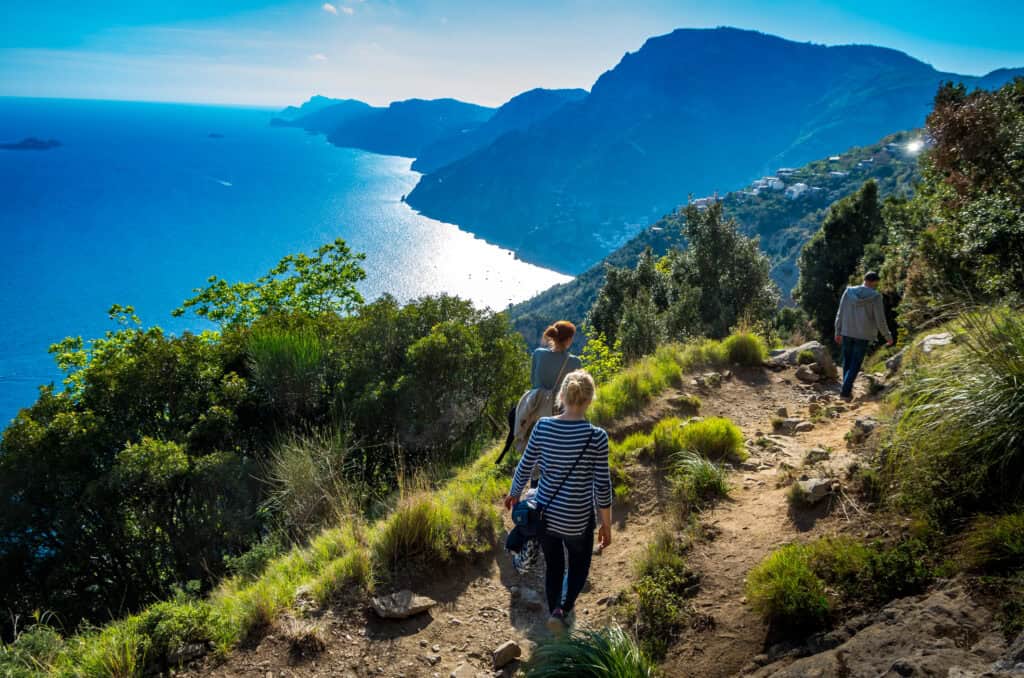
The Path of Gods unfolds across the cliffs between Praiano and Positano on the Amalfi Coast, and the first thing that hits you is the sheer drop. The trail runs so close to the edge that you can see straight down to the water, the Mediterranean spreading out in that impossible blue that photographs never quite capture. By mid-morning in summer, you'll share the path with dozens of other hikers, but in May or September, long stretches belong to just you and the sound of waves on the rocks below.
This is a day hike, not a scramble or a technical climb. You can cover the full route in about three hours at an easy pace, though most people linger. The path itself is well-maintained stone steps and packed earth, occasionally narrow enough that you'll brush against the cliff face on one side while being very aware of the drop on the other. It's exhilarating rather than dangerous if you're steady on your feet and not afraid of heights.
Why this place matters
The Sentiero degli Dei has become iconic because it does something few coastal walks manage: it delivers both the physical thrill of walking a high cliff path and genuine solitude, even if only in patches. Local hikers have used this route for centuries as a practical connection between villages. For modern visitors, it's become the defining walk of the Amalfi Coast precisely because you can't replicate the experience from a boat or a car window.
Quick facts
- Length: approximately 7.5 kilometers (4.7 miles) for the full route between Praiano and Positano
- Elevation gain: roughly 500 meters (1,640 feet) total, though most is concentrated at the start and end
- Estimated time: 2.5 to 3.5 hours depending on pace and stops
- Difficulty: moderate; steep sections at both ends, flat middle stretch along the ridge
- No entrance fee; the path is public and free to walk
- Best seasons: May to June and September to October
- Surface: stone steps, compacted earth, occasional loose gravel
Getting there
Most hikers start from Praiano, which is easier to reach than Positano if you're using public transport. SITA buses run regularly along the coastal road between Salerno and Positano, and Praiano is a natural stop. If you're driving, parking in Praiano can be tight in summer, but there are small lots near the town center and paid parking garages if you arrive after 10 a.m.
From Praiano, the trailhead is signposted and sits above the town center. You'll climb steeply uphill for the first 30 to 45 minutes through terraced lemon groves and past a few houses before reaching the ridge proper. This initial section is the hardest part of the walk.
If you prefer to end downhill, reverse the route and start from Positano, though this means climbing steeply at the end when you're tired. Most people find starting from Praiano and finishing in Positano more pleasant. From Positano, you can catch a bus back to Praiano or onward to Salerno, or walk down into the town for a meal before heading back.
The layout and experience
The walk falls into three distinct sections. The opening climb is relentless but brief, gaining elevation through switchbacks and stone steps cut into the hillside. Lemon trees give way to Mediterranean scrub, and the town below shrinks fast.
Once you reach the ridge at roughly 400 meters elevation, the character changes completely. The path levels out and runs along the cliff edge, occasionally dipping into small valleys where you might find a stone shelter or a lone house. This is the iconic stretch: you can see across to Capri on clear days, and the path itself narrows enough in places that you're acutely aware of the exposure. The ridge section is long and mostly flat, which is where most people spend most of their time.
The final descent into Positano is steep and technical, with more stone steps than the start. Your knees will feel it. The path winds down through terraced gardens and eventually emerges onto a small road that feeds into Positano's main piazza area.
Main highlights
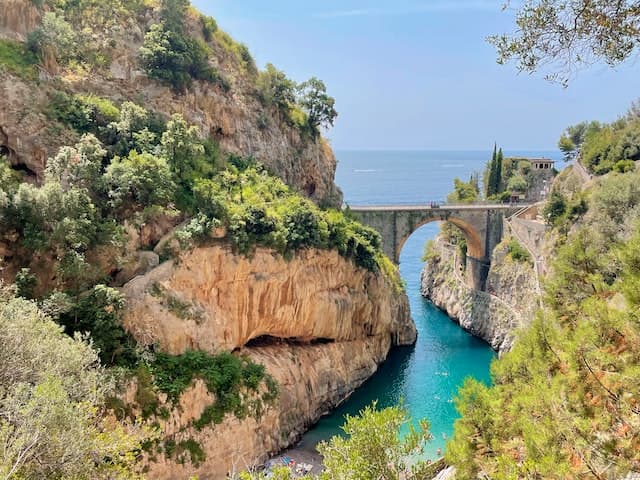
The Fiordo di Furore viewpoint sits roughly halfway along the ridge. A small stone marker indicates the spot where you can look down into a hidden fjord, one of the few dramatic geological features breaking the otherwise consistent cliff line. The water inside is a distinct shade of blue, protected from the open sea by narrow rock walls. On a clear day, this single view justifies the hike.
Several abandoned or semi-abandoned houses dot the ridge. Most date from the 19th or early 20th century, when people lived up here to tend the terraced lemon groves rather than commuting from the towns below. Some have been restored as basic shelters; others are slowly being reclaimed by the landscape. These structures are genuine, not reconstructions, and offer a reminder of how this region was lived in before tourism.
The vegetation itself is worth noticing. You'll pass through maquis shrubland with rosemary, thyme, and wild herbs that smell intense in the heat. Wildflowers appear in spring, particularly bright yellow broom and purple wisteria. In autumn, the light changes the color of the water and the surrounding hills, making the entire walk feel different even if you've done it before.
Best time to visit
May and September are ideal. In May, wildflowers are at their peak, the weather is warm but not oppressive, and the summer crowds haven't fully arrived. September brings the same comfortable temperatures with the added bonus of that particular quality of late-summer light on the Mediterranean. June through August will be hot, crowded, and occasionally uncomfortable if you're walking in the direct sun. The path has no shade for most of its length.
Winter is passable but not recommended. Storm damage can close sections of the path, and the steps become slippery. Spring and autumn offer the best combination of weather and solitude.
Photography tips
The light is most dramatic in late afternoon, when the sun moves behind you and illuminates the cliffs across the water. If you start late in the day, you'll have this light for the crucial middle section, though you'll need to descend into Positano as dusk approaches.
For wide shots, the Fiordo di Furore is the natural focal point, but the best photographs often come from turning around and shooting back along the ridge toward Praiano, with the path itself leading the eye into the frame. Bring a polarizing filter if you have one; it cuts the glare off the water and makes the blue deeper and more convincing.
The narrow sections of path with the drop visible on both sides make for dramatic personal photos, but step carefully. The path is narrow enough that you need to pay attention to your footing, not just your composition.
Facilities and preparation
Bring more water than you think you'll need. There are no reliable water sources on the trail itself, and the sun reflects off the white limestone cliffs, intensifying the heat. A liter per person is a minimum; 1.5 to 2 liters is safer.
Wear proper hiking boots or trail shoes with good grip. The stone steps are polished smooth by thousands of feet, and the loose gravel sections are deceptive. Flip-flops or casual sneakers will leave your feet tired and your ankles at risk. Sunscreen and a hat are essential; the trail offers almost no shade.
A light snack like nuts, fruit, or a sandwich is enough. The path itself has no facilities or shops, though you can eat in Praiano before you start or in Positano after you finish. Some hikers pack a picnic and eat at one of the viewpoints, which is pleasant if you go early enough to avoid the crowds.
The path can be muddy or slippery after rain, so check the weather forecast. Storms can roll in quickly off the water in late afternoon, particularly in shoulder seasons.
Combining with nearby attractions
Positano itself, where the trail ends, is worth a few hours if you haven't explored it. The town clings to the cliffs in a way that feels almost impossible from an engineering standpoint, and the main beach is genuinely pleasant despite being crowded in summer. You can swim, eat fresh seafood, and wander the narrow streets without it feeling like obligation.
Praiano, your starting point, is smaller and less touristy than Positano. The town has a proper fishing fleet and a few restaurants where locals actually eat. The Spiaggia della Marina beach here is less crowded than Positano's main beach, and the water is just as blue.
If you're staying in the Amalfi area, the coastal drive itself between Salerno and Positano is worth doing at least once. The road was built into the cliff face in the 1850s and offers constantly shifting views of the water and the villages below.
Sample visit plan
Arrive in Praiano by mid-morning. Park or exit the bus, grab a coffee at one of the cafes near the main piazza, and locate the trailhead. Start walking by 10:30 or 11 a.m. at the latest to ensure you reach the ridge section with the sun still on it and plenty of daylight remaining.
Walk the ridge slowly. Stop at the Fiordo di Furore viewpoint for at least 15 minutes. Photograph, rest, drink water. Continue to Positano, taking breaks as needed. You should reach the top of the descent into Positano by early to mid-afternoon.
Descend into Positano and head directly to a restaurant or cafe by the water. Eat lunch or an early dinner. Spend an hour or two wandering the town before catching a bus back to your base or, if you're staying in Positano, simply walking to your hotel.
Practical tips
- Start early to avoid the afternoon crowds and to ensure you descend into Positano before dusk
- If you're hiking alone, let someone know your rough timeline
- The path is well-marked with red and white blazes, but bring a phone with offline maps downloaded as a backup
- Check the weather before you go; afternoon storms can make the descent into Positano uncomfortable
- If you find the crowds overwhelming, consider hiking on a weekday or in shoulder season rather than weekends in high summer
- Bring a small first-aid kit with blister treatment; the stone steps are tough on feet
- Trekking poles can help with the descent into Positano if you have knee issues, though many people hike without them
FAQ
Can you hike just part of the Path of Gods? Yes. Many people hike from Praiano to the Fiordo di Furore viewpoint and back, which takes about 90 minutes total and avoids the steeper sections at either end. This is a legitimate option if you're short on time or want an easier route.
Is the Path of Gods difficult for people who are afraid of heights? It depends on your tolerance. The exposure is real, but the path itself is wide enough and well-maintained. If you're very uncomfortable with heights, the ridge section will feel intense, but you won't be in danger if you stay on the marked trail and don't stray toward the edge.
Can you do the hike in both directions in a day? Technically yes, but it's not recommended. The walk takes three hours one way, plus time for breaks and meals. A round trip would be exhausting and leave you hiking in darkness. Pick a direction and stick with it.
Do you need a guide? No. The path is well-marked and popular enough that you'll see other hikers. Guided tours exist, but they add cost and remove the flexibility to set your own pace.
What should you do if the weather turns bad on the ridge? The ridge offers no shelter. If a storm is approaching, descend immediately toward either Praiano or Positano. The path becomes slippery and the exposure feels more dangerous in rain. Don't wait it out.
Reviews
Sign in and mark this place visited to leave a review.
No reviews yet.
Free Trip Planner
Plan your Provincia di Salerno trip with our free planner
Build a day-by-day itinerary with AI suggestions, hand-picked places, and friends. Free forever — no credit card.