Posted by Brandon B.Admin
Overview
Vienna's Rathaus, officially known as the Vienna City Hall, stands on Friedrich-Schmidt-Platz in the heart of the city's first district. This Gothic Revival building dominates the square with its distinctive silhouette and red-and-white striped tower, visible from several blocks away. Built between 1872 and 1883, the Rathaus serves as the seat of Vienna's mayor and city council, making it both a functioning government building and one of Austria's most recognizable landmarks.
The building's architectural presence defines this part of Vienna. Whether you're walking through the Innere Stadt or exploring the cultural institutions nearby, the Rathaus announces itself immediately. Its neo-Gothic design was revolutionary for Vienna at the time, breaking from the classical traditions that dominated earlier Habsburg-era buildings.
Why this place matters
The Rathaus represents a pivotal moment in Vienna's urban development and political history. When construction began in 1872, Vienna was expanding rapidly and the city needed a new administrative center that reflected its growing importance and modern aspirations. The building became a symbol of municipal pride and democratic governance during the Austro-Hungarian Empire.
Architecturally, the Rathaus introduced Vienna to full-scale Gothic Revival design. Architect Friedrich von Schmidt drew inspiration from medieval town halls across Europe, but the Vienna version is distinctly grander and more elaborate. The tower rises 105 meters and has become inseparable from the city's skyline.
Today, the building hosts events that shape Vienna's cultural calendar, from classical concerts to Christmas markets. The square in front fills with thousands of Viennese and visitors throughout the year, making this one of the city's primary gathering spaces.
Quick facts
- Completed in 1883 after 11 years of construction
- Tower height: 105 meters
- Architect: Friedrich von Schmidt
- Active government building (not a museum)
- Free access to the ground floor and courtyard during business hours
- Guided tours of the interior available on select days
- Friedrich-Schmidt-Platz hosts seasonal markets and outdoor events year-round
Getting there
The Rathaus sits directly on Friedrich-Schmidt-Platz, which is easy to reach by public transport. The U-Bahn (metro) line U2 stops at Rathaus, putting you at the building's doorstep. If you're arriving by tram, lines 1 and 2 run along the square's perimeter.
Walking from other districts is straightforward. From St. Stephen's Cathedral, the journey takes roughly 15 minutes heading north through the Innere Stadt. If you're staying near the MuseumsQuartier, it's about 10 minutes west on foot. The building's tower is visible from several streets away, so you can navigate visually if needed.
Parking near the Rathaus is limited and paid. Street parking fills quickly, especially during market season. Your best option is a nearby car park, though public transport is more practical for most visitors.
The layout and experience
The Rathaus occupies an entire city block. The main facade faces Friedrich-Schmidt-Platz, where you'll encounter the building's full Gothic Revival splendor: pointed arch windows, ornate stonework, and the soaring tower topped with a copper roof.
The ground floor and courtyard are accessible to the public most days when no official events are happening. You can walk through the main entrance and explore the interior courtyard, which is surprisingly quiet compared to the bustling square outside. The courtyard features arcaded passages and gives you a sense of the building's massive scale. Soft light filters through the arches, and acoustics in the space are notably good, which is why it hosts musical performances during certain events.
The upper floors, including the ornate council chambers and mayor's office, are only accessible by guided tour. These tours typically include the historic assembly hall with its elaborate ceiling frescoes and period furnishings. Tours are conducted in German and English on rotating days, usually in the afternoon.
The tower itself is not open to the general public, though it remains Vienna's most photographed architectural detail.
Main highlights
The tower is the obvious focal point. Its Gothic spire and decorative elements are best appreciated from the square, particularly in late afternoon when the sun hits the stone. The gilt statue of the "Genius of Vienna" crowns the peak, visible through binoculars or a camera lens from ground level.
The main facade's detail work rewards close inspection. Carved figures, reliefs, and heraldic symbols cover the stonework. If you look carefully at the arched windows and doorways, you'll see the precision of 1870s stone masonry, which differs noticeably from earlier classical buildings in Vienna.
The interior courtyard provides relief from the busy square and is worth spending 10 to 15 minutes exploring. The symmetry of the arcades and the quiet atmosphere create an almost meditative space in the middle of central Vienna.
If you join a guided tour, the assembly hall is the highlight. The proportions of the room, the painted ceiling, and the original furniture convey the gravity Vienna's leaders intended to project. The tour also shows you rooms and corridors that aren't visible from outside, giving you a sense of how the building actually functions as an office.
History and background
Vienna's previous city hall, located on Wipplingerstrasse, had become inadequate by the mid-19th century. The city's population was growing rapidly, and municipal administration needed more space. The Austro-Hungarian government approved a new civic center, and an architectural competition was held in 1869.
Friedrich von Schmidt won with his neo-Gothic design. This was a deliberate choice by Vienna's leadership to distinguish the new city hall from the classical and baroque buildings that dominated the older districts. Gothic Revival was experiencing a resurgence across Europe at the time, and Vienna wanted to signal its modernity and ambition.
Construction took 11 years and was completed in 1883. The building's inauguration was a major civic event, attended by Emperor Franz Joseph I. During its first decades, the Rathaus became synonymous with Vienna's identity as a modern, forward-thinking capital.
The building suffered damage during World War II bombing campaigns. The roof caught fire and the interior was extensively damaged. Reconstruction began immediately after the war and took several years. Much of what you see today is carefully restored to match the original design, though some sections incorporate modern materials and techniques.
The Rathaus remains the working seat of Vienna's mayor and city government. This functional role means it's not a museum and operates under the constraints of an active government building. This authenticity, however, is part of what makes it compelling to visit.
Tickets and entry
General access to the ground floor and courtyard is free. You can enter during standard business hours, typically 8 am to 6 pm on weekdays, though hours may shift depending on official events or ceremonies.
Guided tours of the upper floors require advance booking and a small fee. Tours usually run 45 to 60 minutes and are conducted in German and English on set days, most often Tuesday through Thursday afternoons. Check the Vienna city government website for current tour schedules and booking information, as these change seasonally.
Occasionally the Rathaus closes for official state events or ceremonies. If you're planning a visit on a specific day, it's worth confirming availability beforehand, especially if you're hoping to join a guided tour.
Best time to visit
Friedrich-Schmidt-Platz transforms dramatically with the seasons. December brings a large Christmas market that fills the square with wooden stalls, mulled wine, and decorations. The Rathaus tower is lit at night and serves as the market's backdrop, creating one of Vienna's most iconic winter scenes. If you visit in December, arrive early to avoid the heaviest crowds, and expect the square to be packed from mid-morning onward.
Spring and early autumn offer the most comfortable weather for exploring the exterior and courtyard. The square is busy but not overwhelming, and daylight lasts long enough for photography without rushing.
Summer can be crowded with tourists, especially July and August. The square hosts outdoor dining and events, but the sheer volume of visitors may make a leisurely visit difficult. If you go in summer, come early in the morning before tour groups arrive.
If you're interested in a guided tour, weekday afternoons in late spring or September tend to have smaller group sizes than peak season.
Photography tips
The tower is best photographed from the square itself, ideally in the late afternoon when the sun is lower and casts shadows that define the architectural details. Early morning light is softer and works well if you want to capture the full facade without harsh contrast.
For detail shots of the stonework and carved figures, get closer to the main entrance and use a telephoto lens if you have one. The arched windows and heraldic symbols photograph well in side lighting.
The courtyard interior is beautiful in midday light when sun fills the arcades, but you'll need a wider lens to capture the symmetry. Late afternoon creates more dramatic shadows within the arches.
If you visit during the Christmas market, shoot from the edges of the square to include both the market stalls and the lit tower in the background. The golden hour, roughly an hour before sunset, provides ideal color and contrast.
The building's scale is difficult to convey in photographs from close range. Step back to a distance of 30 to 50 meters to show the full facade and tower in context. This also gives you a clearer view of the decorative upper sections.
Facilities and preparation
Public restrooms are available in the Rathaus building itself, accessible via the ground floor. Several cafes and restaurants surround the square if you need refreshment. The area is well-served by Vienna's food and beverage infrastructure, so finding coffee, lunch, or a drink is never difficult.
The square is fully paved and accessible to those with mobility constraints. The ground floor of the Rathaus is also accessible, though guided tours of the upper floors involve stairs that may not be suitable for everyone. Contact the Rathaus directly if you have specific accessibility questions before booking a tour.
The area can be windy, especially around the base of the tower. In winter, bring extra layers. In summer, sun exposure is intense on the open square, so sunscreen and a hat are practical.
Combining with nearby attractions
The Rathaus sits within Vienna's cultural district. The MuseumsQuartier is directly south, housing some of Austria's finest art museums. You can walk from the Rathaus to the Leopold Museum or Albertina in under 15 minutes.
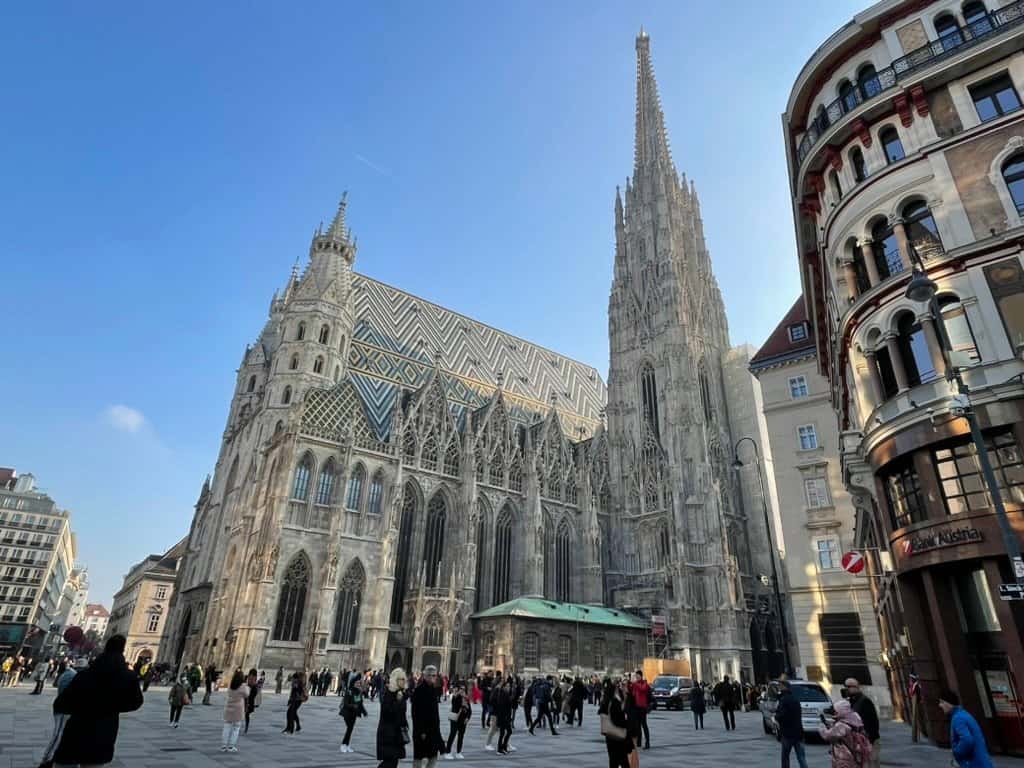
St. Stephen's Cathedral is roughly 15 minutes south on foot. Combining a visit to both buildings gives you a contrast between Vienna's medieval roots and its 19th-century modernization.
The Burgtheater, Vienna's national theater, is just east of the Rathaus on Universitaetsring. Even if you don't attend a performance, the building's neoclassical architecture is worth seeing, and you can tour the interior on select days.
The Ringstrasse, Vienna's grand circular boulevard, passes directly past the Rathaus. Walking the Ring on foot or by tram gives you a comprehensive view of Vienna's major landmarks in sequence. The Rathaus is effectively the northwest anchor of this route.
Sample visit plan
A basic visit to the Rathaus and square takes 30 to 45 minutes. Arrive mid-morning, walk the perimeter of the building to observe the exterior from different angles, then spend 15 minutes in the courtyard. If you have time, grab coffee at one of the cafes on the square and people-watch.
If you want to join a guided tour, allocate an additional 60 to 90 minutes. Book the tour in advance. Arrive 15 minutes early to confirm your booking and get oriented. After the tour, take another walk around the exterior to see details you may have noticed during the indoor portions.
A full morning combining the Rathaus, a stroll on the nearby Ringstrasse, and a visit to one museum would fill 4 to 5 hours comfortably. Start at the Rathaus, walk the Ring southward toward the Hofburg Palace, then visit the Leopold Museum or another institution in the MuseumsQuartier before lunch.
Practical tips
- Confirm the Rathaus is open before you go, as official events occasionally close the building to visitors
- Book guided tours in advance through the Vienna city government website, especially in peak season
- Visit the square early morning or late afternoon to avoid the largest crowds
- The U-Bahn U2 station is directly beneath the square; exit at Rathaus for the most direct access
- Bring a camera with a wide lens to capture the tower and full facade in one frame
- The Christmas market (typically late November through December) fills the square but offers a unique atmosphere if you don't mind crowds
- Street names in the area can be confusing; use a map or navigation app to orient yourself within the Innere Stadt
- Allow extra time in winter; the square can be slippery after snow or rain
How it compares to similar places
Vienna has other important civic buildings, but none command the visual presence of the Rathaus. The Hofburg Palace is older and larger, but it's a royal residence rather than a city hall. The Burgtheater is similarly monumental and Gothic Revival in style, but it's dedicated to a single cultural purpose.
If you're visiting other European cities, the Rathaus invites comparison to similar buildings in places like Bruges, Brussels, or Munich. Vienna's version is notably larger and more ornate than most, reflecting the city's status as a major imperial capital. The Gothic Revival style was chosen deliberately to set it apart from Vienna's earlier classical architecture.
What distinguishes the Rathaus is that it remains a working government building. You're not visiting a museum or a heritage site frozen in time. This active civic function gives it a different character than similar landmarks that have been converted to other uses.
FAQ
Can you go inside the Rathaus? Yes, the ground floor and courtyard are freely accessible during business hours. The upper floors and council chambers require a guided tour booked in advance, which involves a fee.
Is the tower open to visitors? No, the tower is not open to the public. You can only view it from ground level on the square.
How long should I spend at the Rathaus? A basic exterior visit takes 30 to 45 minutes. If you join a guided tour, add 60 to 90 minutes. Many visitors combine it with nearby attractions and spend a full morning or afternoon in the area.
When is the best time to photograph the Rathaus? Late afternoon provides the most dramatic lighting on the tower and main facade. The Christmas market season (December) offers a unique backdrop, but crowds are substantial.
What's the easiest way to get to the Rathaus? The U-Bahn line U2 stops directly at Rathaus station. Trams 1 and 2 also run past the square. From central Vienna, it's a 10 to 20 minute journey by public transport depending on your starting point.
Opening hours
Reviews
Sign in and mark this place visited to leave a review.
No reviews yet.
Free Trip Planner
Plan your Austria trip with our free planner
Build a day-by-day itinerary with AI suggestions, hand-picked places, and friends. Free forever — no credit card.