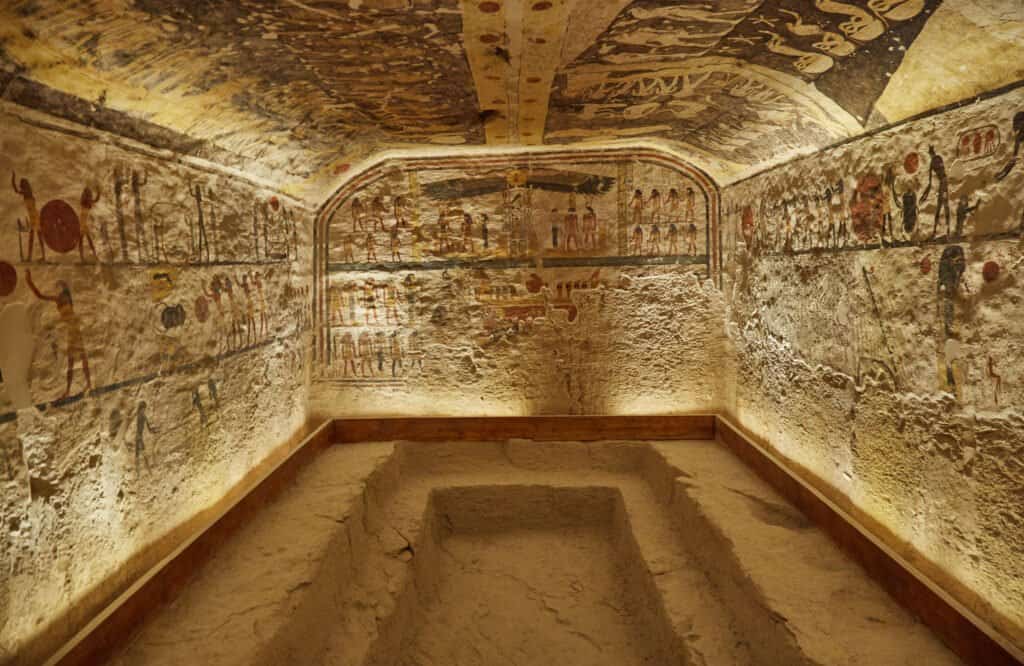
Tomb of Ramses VI
Valley of the Kings West Bank, Luxor Egypt Posted by Brandon B.Admin
Inside the Tomb of Ramses VI in the Valley of the Kings
The Tomb of Ramses VI sits near the center of the Valley of the Kings on Luxor's West Bank, and it is one of the most visually overwhelming burial chambers you will find anywhere in Egypt. The ceiling alone is worth the trip. Covered in astronomical texts and painted depictions of the sky goddess Nut swallowing and rebirthing the sun, it turns what could be a dark corridor into something closer to a planetarium built three thousand years ago. If you only enter one tomb during your visit to the valley, this is a strong candidate.
The tomb was originally cut for Ramses V, who died before it was fully decorated. His nephew Ramses VI, who ruled in the 12th century BCE, took it over, enlarged it, and had it completed with some of the most elaborate religious texts in the entire necropolis. That layered history gives the site an unusual density, both architecturally and spiritually.
Why the Tomb of Ramses VI Stands Apart
Most tombs in the valley impress through sheer scale or through the fame of their occupant. This one earns its reputation differently. The walls are essentially a library of the Egyptian afterlife. You will see excerpts from the Book of Gates, the Book of Caverns, and the Amduat, all painted in vivid yellows, blues, and ochres that have survived remarkably well given the tomb's age.
There is also a historical footnote that makes this tomb unusual in a completely different way. Excavations conducted in the early 20th century confirmed that the rubble piled at the entrance during the construction of Ramses VI's tomb inadvertently buried and concealed the entrance to Tutankhamun's tomb directly below it. That accident of ancient construction is a large part of why KV62, the most famous tomb in the valley, survived intact for so long. Standing at the entrance to Ramses VI's tomb and knowing that puts the whole site in a strange, layered perspective.
Quick Facts
- Location: Valley of the Kings, West Bank, Luxor, Upper Egypt
- Tomb designation: KV9 (King's Valley tomb number 9)
- Original owner: Begun for Ramses V, completed and used by Ramses VI
- Dynasty: 20th Dynasty, New Kingdom period
- Approximate period: 12th century BCE
- Ticket type: Requires both the general Valley of the Kings admission and a separate individual tomb ticket for KV9
- Photography: A separate photography permit is required inside the valley
- Accessibility: Long descending corridor with steps; not accessible for wheelchairs
Getting There
The Valley of the Kings is on the West Bank of the Nile, roughly a 10-minute drive from the Luxor ferry landing at the West Bank dock near the village of Al-Gezira. Most visitors cross the Nile by local ferry or tourist boat from Luxor's corniche and then hire a taxi or a tuk-tuk for the remaining distance to the valley entrance. The road climbs into the limestone hills past the Colossi of Memnon, which you will pass on the main road and are worth a quick stop.
Organized tours from Luxor almost always include transportation directly to the valley gates. If you are going independently, agree on a price with your driver before you set off. The valley has a small visitor center at the entrance where you buy tickets before boarding the electric tram that shuttles passengers to the tomb area, roughly a 5-minute ride up into the hills.
The Layout and Experience
KV9 is a long, relatively straight tomb compared to some of the more maze-like chambers in the valley. You descend through a series of corridors and antechambers, each one decorated floor to ceiling. The passageways tend to feel narrow once a tour group is moving through, so arriving early or timing your visit between large group arrivals makes a genuine difference.
The burial chamber at the far end is where the ceiling painting reaches its peak. The double image of Nut, stretched across the arched ceiling in two registers, is the kind of thing you want to spend time with rather than glancing at on the way through. Bring a small torch or use your phone light if you want to see the details in the lower wall registers, as the artificial lighting inside, while adequate for general viewing, tends to flatten some of the finer painted lines.
The sarcophagus of Ramses VI remains in the burial chamber. It is broken, which happened in antiquity when tomb robbers worked through the site, but enough of it survives to give you a sense of the original form. The lid lies nearby.
History and Background
Ramses VI ruled Egypt during a period when the New Kingdom was beginning its long decline. The 20th Dynasty was managing increasing instability, and the scale of royal tomb construction was shrinking across the valley compared to earlier dynasties. Despite that, KV9 is one of the larger and more elaborately decorated tombs of its era, suggesting that Ramses VI invested heavily in his afterlife provisions.
The tomb was known in antiquity. Greek and Roman visitors left graffiti on the walls, and more than a thousand ancient inscriptions have been documented inside. Some of those graffiti date to the Ptolemaic and Roman periods, meaning travelers were visiting this exact chamber while the Roman Empire was still functioning. That long continuum of human attention is easy to forget when you are standing inside, but it is worth thinking about.
Modern archaeological work on KV9 has been ongoing, and the tomb has benefited from conservation efforts aimed at stabilizing the painted surfaces, which are vulnerable to the humidity introduced by large numbers of visitors.
Tickets and Entry
Entry to the Valley of the Kings uses a tiered system. A standard admission ticket covers entry to the valley and access to three tombs chosen from a rotating selection. KV9 is not always included in the standard three and often requires a separate add-on ticket purchased at the main ticket office before you enter. Check when you arrive at the booth, because the ticketing structure has changed in recent years and the options at the desk will reflect current policy.
The photography permit is sold separately and covers use of a personal camera or phone throughout the valley. Without it, photography inside the tombs is not permitted, and the staff do check.
Best Time to Visit
The valley sits in a natural bowl in the limestone hills and gets extremely hot between late morning and mid-afternoon, particularly from May through September. Most days in summer, the heat inside the tombs is actually a relief compared to the open air outside, but the walk between tombs can be brutal. Arriving when the gates open, typically around 6am, gives you cooler temperatures and thinner crowds before the first tour buses arrive.
Winter months, roughly November through February, are far more comfortable and are considered peak season. Expect larger crowds during this period, especially around public holidays. Spring and autumn offer a reasonable middle ground.
Photography Tips
The ceiling in the burial chamber is the obvious subject, but it is also the hardest to photograph well. The curved surface combined with artificial light means most phone cameras will struggle with exposure. If you have a camera with manual settings, bracket your exposures. A wide-angle lens captures more of the full ceiling register in a single frame.
The corridor walls offer slightly easier shooting conditions, especially in sections where the lighting is positioned at an angle to the painted surface, which brings out the relief carving underneath the paint. Avoid using flash, both because it is generally not permitted and because it washes out the color completely.
Combining with Nearby Attractions
The Valley of the Kings sits within a cluster of West Bank sites that work well together in a single day if you start early. The Temple of Hatshepsut at Deir el-Bahari is about a 10-minute drive from the valley and is one of the most architecturally distinctive monuments in all of Egypt. The Medinet Habu temple complex is further south and tends to get fewer visitors than it deserves. The Colossi of Memnon, two massive seated statues that stand alone in an open field near the main road, are easy to stop at on your way in or out.
If you are combining multiple West Bank sites in one visit, plan for the Valley of the Kings first, before the heat peaks and before the tour groups settle in.
Practical Tips
- Buy your KV9 add-on ticket at the main booth before boarding the tram, not at the tomb entrance
- Bring water and drink it before entering the valley area, not just at the entrance
- Wear shoes you can walk in on uneven stone surfaces
- A small flashlight helps with lower wall details that the installed lighting misses
- If you are visiting with a guide, ask them to point out the graffiti left by ancient visitors, easy to miss if you don't know where to look
- The electric tram fills up quickly after large tour buses arrive, so plan your exit timing accordingly
- Hat and sunscreen matter more here than almost anywhere else in Luxor, given the open limestone terrain between tombs
FAQ
Is KV9 included in the standard Valley of the Kings ticket?
Not always. The standard ticket typically covers three tombs from a set list, and KV9 often requires a separate purchase. Confirm at the ticket office on the day of your visit, as the included tombs can change.
How long should I spend inside the tomb?
Most visitors move through in 20 to 30 minutes, but if you want to actually read the wall texts and study the ceiling carefully, an hour is not excessive. The experience rewards patience more than speed.
Is the tomb suitable for children?
The descending corridors are manageable for older children and teenagers who are comfortable in enclosed spaces. The content, Egyptian funerary imagery, tends to fascinate rather than frighten most kids. Very young children and anyone with mobility limitations may find the steps difficult.
Can I visit Tutankhamun's tomb on the same day?
Yes, and many visitors do exactly that. KV62 requires its own separate ticket, and the entrance is close to KV9. Standing at the entrance to Ramses VI's tomb and then walking a short distance down to Tutankhamun's gives the whole sequence a satisfying context.
Opening hours
Reviews
Sign in and mark this place visited to leave a review.
No reviews yet.
Free Trip Planner
Plan your Egypt trip with our free planner
Build a day-by-day itinerary with AI suggestions, hand-picked places, and friends. Free forever — no credit card.