Bibliotheca Alexandrina
El Shatby, Alexandria 30100 Egypt Posted by bazartravelsAdmin
Overview
Bibliotheca Alexandrina sits on the Mediterranean coast in Alexandria, Egypt, built where the ancient Library of Alexandria once stood. This modern library and cultural complex opened in 2002 as a symbol of Egypt's commitment to scholarship and dialogue between civilizations. It houses millions of books, manuscripts, and digital resources across multiple floors, but it functions as far more than a repository. The building itself is a landmark: a tilted disc of white limestone and glass that appears to rise from the waterfront like a half-buried sun.
If you're visiting Alexandria, this is where locals and travelers go to understand the city's intellectual heritage. The complex draws students, researchers, casual browsers, and visitors with no specific agenda. You can spend an hour here or an entire day.
Why this place matters
The original Library of Alexandria, founded around 300 BCE, was one of the ancient world's greatest repositories of knowledge. It burned and was lost to time. For nearly 2,000 years, that loss was permanent. The Bibliotheca Alexandrina reclaims that history without trying to recreate it. Instead, it's a living answer to the question of what a library could be in the 21st century.
The library was built through a partnership between the Egyptian government and UNESCO. It sits in El Shatby, where archaeologists believe part of the ancient library once occupied the same ground. The symbolism is deliberate: not nostalgia, but continuity.
Quick facts
- Opened: 2002
- Location: El Shatby, Alexandria, on the Mediterranean coast
- Main building design: A tilted disc designed by Norwegian architects Snøhetta
- Collections: Over 2 million books, plus manuscripts, periodicals, and digital resources
- Multiple museums and exhibition spaces within the complex
- Public library open to visitors with free general admission to most areas
- Research library requires membership for full access
Getting there
Bibliotheca Alexandrina occupies a beachfront site in El Shatby, roughly 2 kilometers east of Alexandria's central downtown. If you're staying in the city center, a taxi or rideshare will take 15 to 20 minutes depending on traffic. The library sits directly on the corniche, the waterfront promenade, so it's visible from the road.
Public buses run along the coast, though routes and schedules shift seasonally. Ask your hotel staff for the current bus number if you prefer public transport. Most visitors find a taxi more straightforward.
If you're driving yourself, parking is available on-site. The entrance is well signposted from the corniche road.
The layout and experience
The building's most striking feature is its design. The main reading room occupies a massive circular space beneath a sloped roof of glass and limestone. Natural light floods in from above and from the Mediterranean side, creating an effect that shifts throughout the day. The floor slopes gently, mimicking a beach or a ramp, which is why locals sometimes call it "the tilted building."
The library is organized vertically. Upper levels hold the general collections and research facilities. Lower levels contain museums, manuscript repositories, and exhibition halls. The basement connects to archaeological excavations where remnants of the ancient library were uncovered.
You don't need to register or check in to walk through most of the public areas. The main reading room is open to anyone. You can browse the stacks, sit at tables overlooking the sea, or simply observe the architecture. If you want to borrow books, you'll need to register, but this is straightforward for international visitors and typically involves a small fee or deposit.
Expect crowds on weekends and during school holidays. Weekday mornings tend to be quieter.
Main highlights
The main reading room is the centerpiece. It's a genuinely impressive space, and the combination of scale, light, and the view of the Mediterranean makes it worth the visit alone. Students and researchers work here at long tables. The acoustic design is thoughtful; despite the size, the space feels focused rather than cavernous.
The Manuscript Museum holds rare texts and historical documents. Holdings include medieval Islamic manuscripts, Coptic texts, and materials related to Egyptian history. Displays rotate, so what you see depends on when you visit.
The Antiquities Museum occupies the lower levels and includes artifacts recovered during the library's excavation. These pieces connect the modern library to its ancient predecessor, though the collection is modest compared to the Egyptian Museum in Cairo.
The Children's Library is a dedicated floor designed for younger readers. It's well-designed and colorful, and even if you don't have children with you, it's worth a quick look for the architectural approach to learning spaces.
Temporary exhibitions change regularly. These might focus on photography, contemporary art, historical documentation, or cultural topics. Check what's on during your visit.
History and background
The ancient Library of Alexandria was established under Ptolemy II in the 3rd century BCE. It was the intellectual capital of the Mediterranean world, housing hundreds of thousands of scrolls and papyri. Scholars came from across the known world. The library's loss through fire and political upheaval remains one of history's great cultural catastrophes.
For centuries, Alexandria remained a shadow of its former self. The modern city developed away from the waterfront where the ancient library stood. In the 1980s, Egyptian intellectuals and UNESCO began envisioning a new library that would honor the past while serving the present.
The project took over a decade to complete. Construction began in 1995. The Norwegian architecture firm Snøhetta won an international competition for the design. The building was completed in 2002 and formally inaugurated by Egyptian President Hosni Mubarak, along with UNESCO Director-General Koichiro Matsuura.
The name itself, Bibliotheca Alexandrina, deliberately echoes the ancient institution. It signals continuity without pretending to be a replica.
Tickets and entry
General admission to the public areas of Bibliotheca Alexandrina is free. You can walk in, explore the main reading room, visit the ground level, and browse exhibitions without paying.
Some specialized areas, like the Antiquities Museum or special exhibitions, may charge a modest entrance fee. Ticket booths are located inside the main building. Prices are inexpensive by international standards.
If you want to use the research library facilities or borrow books, you'll need to register. Registration is open to international visitors and involves a small fee or deposit. Staff can explain the process when you arrive.
Guided tours are available but tend to be arranged in advance for groups. Individual visitors can usually walk through on their own or ask a staff member to point out key areas.
Best time to visit
Alexandria's climate is mild year-round, but summers are hot and can feel crowded with tourists. October through April offers more comfortable temperatures and fewer crowds.
Weekday mornings are quieter than afternoons and weekends. If you prefer a peaceful experience, aim for a Tuesday or Wednesday before noon.
The library's hours extend into early evening most days, so you can visit after exploring other parts of Alexandria without rushing.
Photography tips
The building's exterior is photogenic from almost any angle, especially in late afternoon light when the tilted roof creates dramatic shadows. The waterfront side, facing the Mediterranean, is the most iconic view.
Interior photography is generally permitted in the main reading room and public areas. The interplay of natural light on the curved ceiling and the view of the sea beyond create strong compositions. Avoid using flash, which disturbs readers and researchers.
The lower levels and museum spaces have varying policies. Ask staff if you're uncertain.
Facilities and preparation
The building is modern and well-maintained. Bathrooms are clean and clearly marked. There's a café inside serving coffee, tea, and light snacks, though it's basic compared to commercial cafés elsewhere in the city.
Bring water, especially in summer. The large windows and high ceilings create a pleasant environment, but the Mediterranean sun is strong on the waterfront side.
The main reading room and public areas are accessible to visitors with mobility challenges. Elevators connect the floors. Specific accessibility questions should be directed to staff upon arrival.
There's no dress code, but this is a library and cultural institution. Casual clothing is fine, but extremely informal attire may draw attention.
Combining with nearby attractions
Bibliotheca Alexandrina is a short walk from the Citadel of Qaitbay, a 15th-century fortress built on the site of an ancient lighthouse. The waterfront promenade connects them. Most visitors combine the two in a half-day itinerary.
The Royal Jewelry Museum and the Palace of Montaza are also within 30 minutes by taxi. The city's downtown district, with its 19th-century colonial architecture and markets, is 10 to 15 minutes away.
Sample visit plan
Arrive mid-morning on a weekday. Spend 45 minutes exploring the main reading room and upper levels. Descend to the lower floors and spend 30 to 45 minutes in the Manuscript Museum or Antiquities Museum, depending on your interest. Have coffee at the café. Take a walk around the exterior of the building to see the architecture from different angles. If you have energy, walk along the corniche toward the Citadel of Qaitbay. Total time: 2 to 3 hours.
Practical tips
- Arrive before 1 PM if you prefer quieter spaces
- Bring a light layer; the main reading room can feel cool despite large windows
- The café is convenient but overpriced; consider eating elsewhere first or after
- Staff speak English, Arabic, and often French
- Check the website or ask at the desk about current exhibitions
- The waterfront can be windy; bring a scarf if you're sensitive to wind
- Leave at least 90 minutes to avoid feeling rushed
FAQ
Can I borrow books without a library card? No, but registration is quick and inexpensive. Bring your passport.
Is there a gift shop? Yes, a small one near the main entrance sells books, postcards, and souvenirs related to the library and ancient Alexandria.
How long does a typical visit take? Most visitors spend 1.5 to 2 hours. Researchers and serious book browsers can spend much longer.
Is it worth visiting if I'm not interested in books? Yes. The architecture, the Mediterranean views, and the museum sections make it worthwhile even for casual visitors. Think of it as a cultural landmark first and a library second.
Can I bring my luggage if I'm arriving from the train station? Yes, but there's no dedicated luggage storage. You can carry bags through the public areas. Ask staff if you need assistance.
Opening hours
Reviews
Sign in and mark this place visited to leave a review.
No reviews yet.
Free Trip Planner
Plan your Alexandria trip with our free planner
Build a day-by-day itinerary with AI suggestions, hand-picked places, and friends. Free forever — no credit card.
Things to see near Bibliotheca Alexandrina

Catacombs of Kom el Shoqafa

Pompey’s Pillar
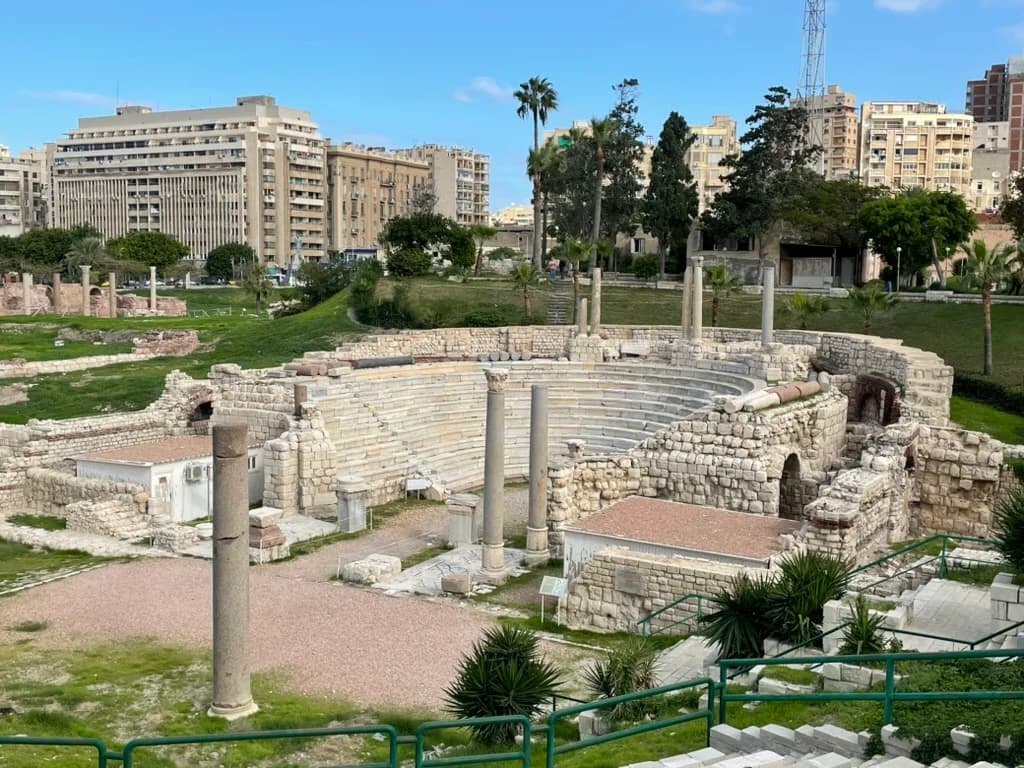
Ancient Roman Amphitheater