
Le Domus Romane di Palazzo Valentini
Foro Traiano, 85, 00186 Roma RM, ItalyOverview
Push through the heavy wooden doors at street level on Via IV Novembre and you descend into the dark. Your eyes adjust. Then the projectors hum to life and the ruins beneath Palazzo Valentini materialize around you in blue light. These are the remains of two Roman houses from the 2nd century AD, buried under the palazzo's foundations for centuries until archaeologists uncovered them in the 1990s. The site uses projection mapping and digital reconstruction to show you what these domus looked like when they were lived in, when servants moved through kitchens and owners entertained guests in columned courtyards. It's archaeological theater, and it works.
Le Domus Romane di Palazzo Valentini sits in the Forum of Trajan, one of Rome's most important imperial spaces. The museum itself occupies the basement of a 16th-century palazzo, but the real draw is what lies beneath. You're not just looking at stone fragments behind glass. You're walking through actual rooms, seeing mosaics in place, touching walls that survived two thousand years.
Why this place matters
Most Roman houses in the city are either completely gone or exist as scattered archaeological sites. These two domus are rare because they're intact enough to walk through, and because the museum's digital layer lets you see them as functioning homes rather than abstract rubble.
The houses belonged to wealthy Romans. One has evidence of a bakery operation on the ground floor, suggesting the owner was involved in commerce as well as living above his business. The other shows the layout of a typical upper-class residence: atrium, tablinum, cubicula, triclinium. If you want to understand how Romans actually lived, this beats a textbook by several centuries.
Quick facts
- Two Roman domus from the 2nd century AD, preserved in situ beneath Palazzo Valentini
- Discovered during restoration work in the 1990s
- Underground location at Foro Traiano 85, near the Forum of Trajan
- Entry requires descending roughly 12 meters below street level
- Visits are by guided tour only, available in Italian and English
- Tour duration is approximately 90 minutes
- Open Tuesday through Sunday; closed Mondays
- Capacity per tour is limited to 25 people
Getting there
The entrance is on Via IV Novembre, a few steps from Piazza Venezia. If you're coming from the Colosseum, head northwest for about 12 minutes on foot. By Metro, take Line B to Cavour station, then walk south for roughly 8 minutes. Tram 8 runs near Piazza Venezia if you're coming from Trastevere.
Parking in this part of Rome is scarce and expensive. A taxi or rideshare from your accommodation will likely save you time and frustration.
The layout and experience
You meet your guide in the palazzo's courtyard. After a brief introduction, you descend a modern staircase into the basement. The air cools noticeably. Once your group gathers in the first chamber, the lights dim and the projection mapping begins.
The experience unfolds room by room. In each space, digital overlays show you the walls, furniture, and decorative elements that once filled it. You see the atrium with its impluvium (rainwater basin) illuminated in amber light. The guide explains how the roof was designed to funnel rain into the pool, which provided water for the household. In the triclinium, you watch a digital reconstruction of a Roman dinner party, complete with period-accurate furniture and diners reclining on couches.
The most striking moments come when the projections fade and you're left looking at the actual archaeological remains: a mosaic floor in black and white stone, a section of wall still bearing traces of fresco paint, the stone lip of a doorway worn smooth by centuries of feet.
The second domus includes a small museum space with artifacts found during excavation. Pottery, glass vessels, coins, and bronze objects fill display cases. These concrete pieces anchor the digital reconstruction in material reality.
Main highlights
The atrium of the first house is the most visually impressive space. The digital reconstruction shows you how light would have poured in from the compluvium (the opening in the roof), and how the impluvium collected it. The scale of the room becomes clear only when you see the full reconstruction.
The floor mosaics are worth studying closely. One features a geometric pattern of interlocking squares. Another shows a more elaborate design. These weren't mass-produced or generic. The owner commissioned them, and they signal wealth and taste.
The bakery space in the second house offers a window into the working side of Roman life. The oven is still there, darkened by heat from two millennia ago. The guide will explain the economics of running a bakery in the Roman Empire and why a wealthy family might have operated one.
History and background
These houses were built during the reign of Hadrian, around the 2nd century AD. At that time, the Forum of Trajan was already several centuries old, built by the emperor Trajan in the early 100s. By the time these domus were constructed, the forum's political importance had faded, but the neighborhood remained desirable for wealthy residents.
The houses were eventually buried under debris and fill as the city changed. A 16th-century palazzo was built on top of the site. Nobody knew what lay beneath until the 1990s, when restoration work on the palazzo revealed the Roman walls. Archaeologists conducted a careful excavation and decided to preserve the remains in place rather than relocate them to a museum.
The museum itself opened to the public in 2007 after years of planning and technical work to create the projection-mapping system. The decision to use digital reconstruction was controversial at first. Some archaeologists argued it was too speculative, too theatrical. Others saw it as the only practical way to help visitors understand three-dimensional space from fragmentary remains. Today it's considered a successful model for archaeological site interpretation.
Tickets and entry
Entry is by guided tour only. You cannot wander through on your own. Tours run multiple times daily, with the last tour typically departing in late afternoon. Book in advance, especially during high season (April through October). Walk-ups are possible but risky if you have limited time.
Admission is in the mid-range tier for Rome attractions. Children under 6 typically enter free. Reductions are available for EU citizens aged 18 to 25, and for students with valid ID. Group discounts apply for parties of 10 or more.
Tours are conducted in Italian and English. Some tours may accommodate other languages if you book ahead and have a sufficiently large group.
Best time to visit
Early morning tours are less crowded. If you can book the first tour of the day, you'll have more room to move and better sightlines for photography.
Summer (July and August) brings peak tourist numbers. Autumn (September through October) and spring (April through May) offer more comfortable temperatures and smaller groups.
Winter mornings can be chilly underground, but the site is climate-controlled and never oppressively hot or cold. It's a good rainy-day option if weather turns poor.
Photography tips
Photography is allowed. The blue and amber projections create striking visual contrasts. Bring a camera that performs reasonably in low light. A smartphone with night mode will work, but a dedicated camera with a faster lens will give you cleaner images.
The guide will pause at key points to allow photos. Don't expect to shoot continuously. Flash is typically not permitted, as it interferes with the projection system and can be disorienting for other visitors.
The most photogenic moment is often the atrium with its full digital reconstruction, when the projections show the impluvium and the colonnade intact. Ask your guide when this scene appears so you're ready.
Facilities and preparation
The site is underground and involves a descent of roughly 12 meters on a modern staircase. There are no elevators. If you have mobility issues or cannot navigate stairs, contact the museum before visiting to discuss options.
The temperature underground is stable year-round, around 15 to 18 degrees Celsius (59 to 64 Fahrenheit). Bring a light jacket or sweater, even in summer. The stone radiates cold, and you'll be standing still for extended periods.
Restrooms are available on the ground floor of the palazzo. There is no cafe or shop on-site, so plan your drinks and snacks before entering.
Tours last approximately 90 minutes. Wear comfortable shoes with good grip. The floors are stone and can be slippery, especially when damp.
How it compares to similar places
Rome has several other excavated Roman houses open to the public. The House of Augustus on the Palatine Hill is older and larger, but less well-preserved. The House of the Vestal Virgins is more ruins than intact space. Le Domus Romane di Palazzo Valentini distinguishes itself through its use of projection mapping and the fact that you walk through the actual rooms rather than viewing them from above or at a distance.
If you've visited Pompeii or Herculaneum, you'll appreciate these houses for a different reason. In Pompeii, you see the size and scale of an entire city preserved by volcanic ash. Here, you see two houses in extraordinary detail, enhanced by digital reconstruction. It's a more intimate and interpretive experience.
Combining with nearby attractions
The Forum of Trajan is directly above the museum. After your tour, spend time walking the forum's ruins. You'll understand them better now that you've seen how Romans lived in their shadow.
Trajan's Column stands at the north edge of the forum. The column features a spiral relief carving depicting Trajan's conquest of Dacia. It's one of the best-preserved Roman monuments in the city.
Piazza Venezia is a short walk south. The Vittorio Emanuele II Monument dominates the square, offering views from its rooftop terraces if you have time and energy.
The Capitoline Museums are 10 minutes away on foot. If you're interested in Roman artifacts, the Palazzo Altemps (another collection of sculpture and antiquities) is also nearby.
Sample visit plan
Start with an early tour of Le Domus Romane, arriving 15 minutes before your scheduled time to check in. After the 90-minute tour, walk to the Forum of Trajan and spend an hour exploring the ruins above.
Have lunch at a trattoria near Piazza Venezia. In the afternoon, visit the Capitoline Museums or take a walk through the surrounding neighborhoods. The Monti district, with its narrow streets and local shops, is directly east and worth an hour of wandering.
Practical tips
- Book tours online in advance, especially April through October. Walk-up spots fill quickly on busy days.
- Arrive 15 minutes early to locate the entrance and check in without rushing.
- Wear layers. The underground is cool year-round, but you'll warm up as the tour progresses and groups gather.
- Comfortable walking shoes with good grip are essential. Avoid flip-flops or leather-soled shoes that slide on stone.
- The guide will speak Italian or English. If you need another language, inquire when booking.
- Tours are guided only. You cannot return on your own to revisit a favorite room.
- Photography is allowed without flash. Bring a camera that handles low light well.
- There is no cafe or shop on-site. Plan your drinks and snacks before entering.
- If you're traveling with a group, book together to ensure you're on the same tour.
FAQ
Can you take photos? Yes, but not with flash. The projections are sensitive to bright light, and flash disrupts other visitors and the guide's presentation.
How long does a tour last? Approximately 90 minutes from start to finish. This includes time in both houses and the artifact room.
Is the site accessible by elevator? No. Entry requires descending a modern staircase of roughly 12 meters. If you have mobility concerns, contact the museum before booking.
Can you visit without a guide? No. All visits are guided tours only. You cannot enter on your own.
What if I don't speak Italian or English? Most tours are in those languages. If you need another language, ask when booking. Private tours in other languages may be available for an additional fee.
Opening hours
Reviews
Sign in and mark this place visited to leave a review.
No reviews yet.
Free Trip Planner
Plan your Roma trip with our free planner
Build a day-by-day itinerary with AI suggestions, hand-picked places, and friends. Free forever — no credit card.
Things to see near Le Domus Romane di Palazzo Valentini



Places to eat or drink near Le Domus Romane di Palazzo Valentini
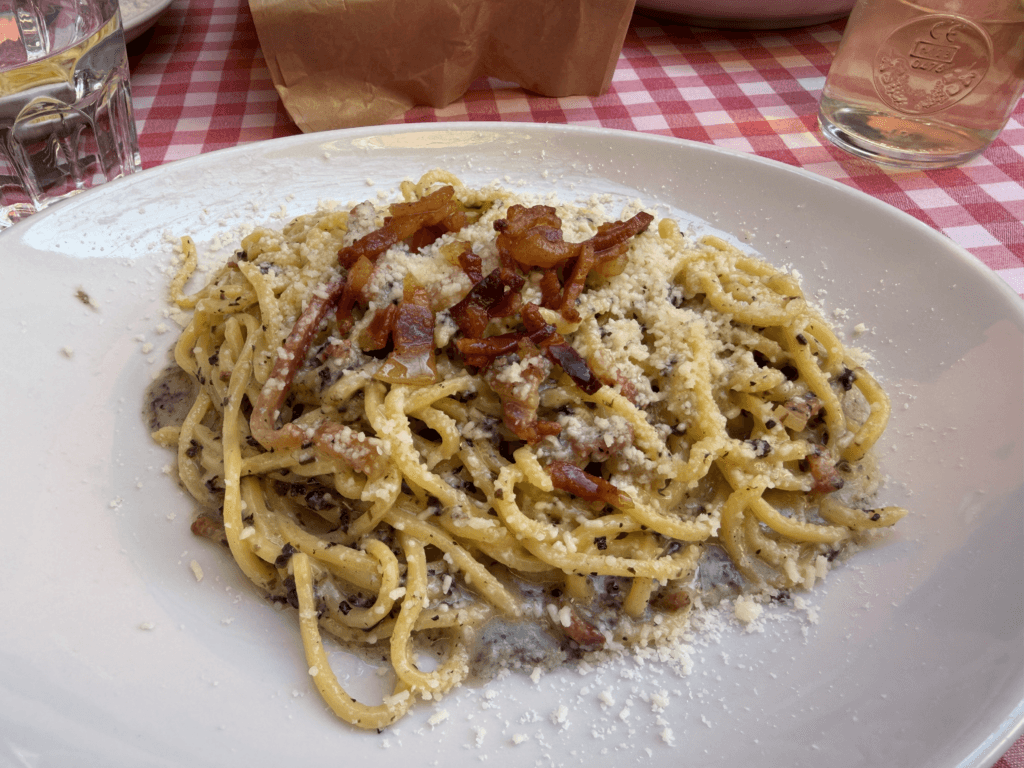
Arianna al Borghetto

La Pietra Scheggiata – Osteria/Pizzeria

Pasticceria Barberini


