
Museo e Cripta dei Cappuccini
Via Vittorio Veneto, 27, 00187 Roma RM, ItalyOverview
Walk up Via Vittorio Veneto toward the Cappuccini church and you enter a place most Romans know exists but few have actually seen. The chapel sits quiet on the second floor, its walls and ceiling lined entirely with bones. Not displayed behind glass or arranged in neat museum rows, but woven into the architecture itself. Thigh bones form crosses. Skulls nest in eye sockets. Spinal columns curve into arches. Around 4,000 Capuchin friars rest here, their remains arranged between 1650 and the 1850s as a meditation on mortality and the Franciscan ideal of renunciation.
The Museo e Cripta dei Cappuccini is unlike any religious space or museum you'll find elsewhere in Rome. It occupies a small church that most tourists walk past without noticing, hidden among the grand hotels and embassies of one of the city's most polished neighborhoods. The actual experience takes 30 to 45 minutes. What makes it worth your time isn't spectacle or size, but the unsettling clarity of its message: we all end up here, one way or another.
Why this place matters
The crypt represents a specific moment in European thought. During the 16th and 17th centuries, Capuchin friars across Italy and beyond began arranging the bones of their deceased brothers into elaborate designs. It wasn't morbid for morbidity's sake. The practice emerged from genuine spiritual conviction. Franciscans took vows of poverty, and they extended that principle even to death. Rather than occupy expensive grave space, they were reused. Their remains became part of the church architecture itself, a permanent reminder that wealth and status meant nothing in the end.
Rome's version became the most elaborate and famous of these ossuaries. The arrangement was neither random nor crude. Friars with artistic skill spent years composing the designs. The result feels closer to sacred art than to a crypt in the medical sense. It influenced European Romanticism and still appears in art history courses studying memento mori iconography.
For modern visitors, it functions as both museum and meditation. You're not observing someone else's history behind a barrier. You're walking through a space that friars intentionally created to challenge your assumptions about death, decay, and what matters.
Quick facts
- Location: Via Vittorio Veneto, 27, near Piazza Barberini in central Rome
- The bones date from the 17th to 19th centuries, with most arrangement occurring between 1650 and 1850
- Approximately 4,000 Capuchin friars are interred in the crypt
- Six small chapels make up the ossuary, each decorated with bones in different patterns
- Visit duration: 30 to 45 minutes for most people
- Strict dress code enforced: knees and shoulders must be covered
- Photography is prohibited inside the crypt
Getting there
The church sits on Via Vittorio Veneto, the long avenue that runs from Piazza Barberini uphill toward Porta Pinciana. If you're coming from the Metro, Line A stops at Barberini. From there, walk north up Via Vittorio Veneto for about five minutes. The entrance is easy to miss. Look for a small wooden door on the left side of the street, marked with a simple sign. There's no grand facade or obvious signage announcing a major attraction.
By bus, several routes run along Via Vittorio Veneto. If you're staying near Termini Station, you can walk south and west in roughly 15 minutes, or take a short taxi ride.
Parking on Via Vittorio Veneto itself is limited and expensive. The neighborhood has paid parking throughout, or you can use one of the larger garages near Piazza Barberini.
The layout and experience
You enter through a small ground floor room where you pay admission and receive a brief explanation of what you're about to see. A narrow staircase leads to the second floor. The crypt consists of six small chapels branching off from a central corridor. Each chapel is no larger than a modest bedroom. The walls, ceiling, and sometimes floor of each room are completely covered in bone.
The first chapel you encounter is dedicated to the Archangel Michael. The remaining five are named after different saints and arranged thematically. One features an elaborate crown made entirely of bone. Another displays a chandelier constructed from vertebrae and ribs. A third contains what appears to be a skeleton posed in a Franciscan habit, holding a scythe and an hourglass. The friars who arranged these pieces understood symbolism and composition.
The lighting is intentionally dim. It comes from small windows and soft electric bulbs that don't flatten the three-dimensional quality of the arrangements. Moving from one chapel to the next, you're aware of the weight of the space, though not in an oppressive way. The friars clearly intended this as a place of prayer and reflection, not horror.
Most visitors walk through in silence. There's little impulse to chatter or take casual photos. The space commands a different kind of attention than a typical museum.
Main highlights
The ceiling vault of the first chapel, constructed entirely from hundreds of vertebrae arranged in concentric circles, is often cited as the most striking single element. The geometric precision required to fit all those bones together without mortar speaks to the skill of whoever designed it.
The chapel dedicated to the Archangel Michael features a skeleton in armor, a direct reference to the saint's role as defender against evil. The positioning of the bones creates the illusion of movement and purpose, transforming a skeleton into a figure of agency rather than mere remains.
The final chapel contains an inscription in Latin that translates roughly to "We once were what you are, and what we are you will become." This small statement encapsulates the entire theological point of the crypt. It's the lesson the friars wanted you to leave with.
History and background
The Capuchins arrived in Rome during the 16th century as part of the broader Franciscan renewal. They took vows of extreme poverty and simplicity, rejecting the institutional wealth that other religious orders had accumulated. By the 1650s, they needed a burial space for their dead. Rather than purchase expensive ground in the city's cemeteries, they used the crypt beneath their church on Via Vittorio Veneto.
The earliest bones were simply stacked. Over time, as more friars died and the space filled, later generations began to arrange the remains more deliberately. By the late 18th century, the crypt had become a complete work of bone art, with elaborate designs covering nearly every surface.
The practice fell out of favor during the 19th century, as European attitudes toward death and display shifted. The last major rearrangement of bones occurred in the 1850s. Since then, the crypt has remained largely untouched, preserved as a historical artifact and a spiritual space for the Capuchin community that still uses the church above.
In the 20th century, the crypt transitioned from a purely monastic space to a site open to visitors. Today, it functions as both a museum and an active chapel. Masses still occur in the church above, though the crypt itself is no longer used for burials.
Tickets and entry
Admission is charged at the ground floor reception. Expect a mid-range ticket price. The admission includes access to all six chapels and the central corridor. There are no separate timed-entry slots or guided tour options. You move through at your own pace.
A small donation box sits near the entrance, supporting the Capuchin community. This is separate from the admission fee.
Children are permitted, though the nature of the site means parents should use their judgment about age appropriateness. There's no official age restriction, but the crypt isn't designed as a children's attraction.
Best time to visit
The crypt has no seasonal variation in terms of what you'll see. Bone arrangements don't change with weather. However, the experience differs based on foot traffic and light.
Early morning, roughly between 9 and 10 a.m., tends to be quieter. You'll have more space to stand and absorb each chapel without someone else moving through. By late afternoon, school groups and casual tourists accumulate, making the narrow chapels feel crowded.
Sunlight entering the side windows varies with season and time of day. In late afternoon during summer, direct sun can wash out the bone details. Morning light, especially in autumn and winter, tends to be more flattering to the three-dimensional arrangement.
The site operates year-round. There are no seasonal closures, though opening hours can shift slightly. Check ahead if you're planning a visit during a major Italian holiday.
Photography tips
Photography is prohibited inside the crypt itself. This rule is enforced. You cannot take pictures of the bone arrangements, the chapels, or any part of the interior decoration. Violation can result in being asked to leave.
The reasoning is partly practical (bright flashes damage pigment and bone) and partly philosophical (the friars wanted the crypt to be experienced as a contemplative space, not a backdrop for documentation). You're welcome to photograph the exterior of the church and the entrance area on Via Vittorio Veneto.
Facilities and preparation
The ground floor reception area has a small counter but no cafe, gift shop, or extended facilities. There are no bathrooms on the ground floor that are available to visitors. If you need facilities, use them before arriving.
The staircase to the crypt is narrow and steep. If you have mobility issues or difficulty with stairs, the crypt will not be accessible to you. There is no elevator.
Dress code is strictly enforced. Knees and shoulders must be covered. This means no sleeveless shirts, no tank tops, no shorts. Women should wear long pants or a skirt that reaches the knee. Men should wear long pants and a sleeved shirt. Hats should be removed. Violation of the dress code can result in denial of entry.
The interior is cool and slightly damp. A light jacket isn't a bad idea, especially in winter.
Combining with nearby attractions
Via Vittorio Veneto itself is lined with hotels and restaurants, but few major attractions. The neighborhood is upscale and quiet compared to the center.
Piazza Barberini sits directly south, where you'll find the Fountain of the Triton and the Barberini Palace. That palace houses an important art collection and is worth a separate visit if you have time. The walk between the crypt and Piazza Barberini takes five minutes downhill.
Further south, near Trevi Fountain, you're about 15 minutes away on foot. Many visitors combine a trip to the crypt with a walk toward the center of Rome, stopping at Trevi on the way back.
The Spanish Steps are roughly 10 minutes south of Piazza Barberini. If you're planning an afternoon of walking through central Rome, the crypt can be a starting point on Via Vittorio Veneto before heading downhill toward more crowded attractions.
Sample visit plan
Arrive around 9:15 a.m. on a weekday if you want to avoid crowds. Enter, pay admission, and take the stairs up. Spend 10 to 15 minutes in the first chapel, reading the arrangements carefully and letting your eyes adjust to the dim light. Move through the remaining five chapels at your own pace, spending roughly 5 to 10 minutes in each. Leave time to read any inscriptions or plaques. By 10 a.m., you'll be done and back outside on Via Vittorio Veneto.
From there, walk south down Via Vittorio Veneto toward Piazza Barberini. Stop at the fountain and grab a coffee at one of the cafes on the piazza. If the Barberini Palace is open and interests you, visit it next. Otherwise, continue downhill toward the center, eventually reaching Trevi Fountain or the Spanish Steps.
Practical tips
- Arrive early in the day to avoid crowds and experience the chapels in relative quiet
- Wear clothes that cover knees and shoulders, or bring a light scarf to wrap around your shoulders if needed
- Allow your eyes several minutes to adjust to the dim lighting before trying to see details
- Read any plaques or inscriptions in the chapels; they add context to the bone arrangements
- The crypt is emotionally intense for some people; there's no shame in spending less time than expected
- Check opening hours before visiting, as they can shift seasonally
- Bring small change or bills for admission if you plan to pay in cash
- Use the bathroom before arriving; facilities are limited nearby
FAQ
Is this really a place tourists should visit, or is it disrespectful? The Capuchin community welcomes visitors. They deliberately opened the crypt to the public and continue to maintain it as a museum. The friars created it as a spiritual teaching tool, not a secret. Visiting respectfully, following the dress code and rules, is not disrespectful to the friars or the deceased.
How long does a visit take? Most people spend 30 to 45 minutes. Some move through in 20 minutes. Others spend an hour. There's no right duration. Go at whatever pace feels right to you.
Are the bones real human remains? Yes. The bones in the chapels are genuine remains of Capuchin friars who died between the 17th and 19th centuries. They have never been moved or replaced since the crypt was sealed in the mid-1800s.
Can children visit? Yes, but use your judgment. There's no official age restriction, but the subject matter isn't for every child. Older children and teenagers often find it fascinating and thought-provoking rather than frightening.
Why is photography prohibited? The rule protects the bones from light damage and preserves the contemplative atmosphere the friars intended. The crypt is designed as a space for reflection, not documentation.
Opening hours
Reviews
Sign in and mark this place visited to leave a review.
No reviews yet.
Free Trip Planner
Plan your Rome trip with our free planner
Build a day-by-day itinerary with AI suggestions, hand-picked places, and friends. Free forever — no credit card.
Things to see near Museo e Cripta dei Cappuccini



Places to eat or drink near Museo e Cripta dei Cappuccini
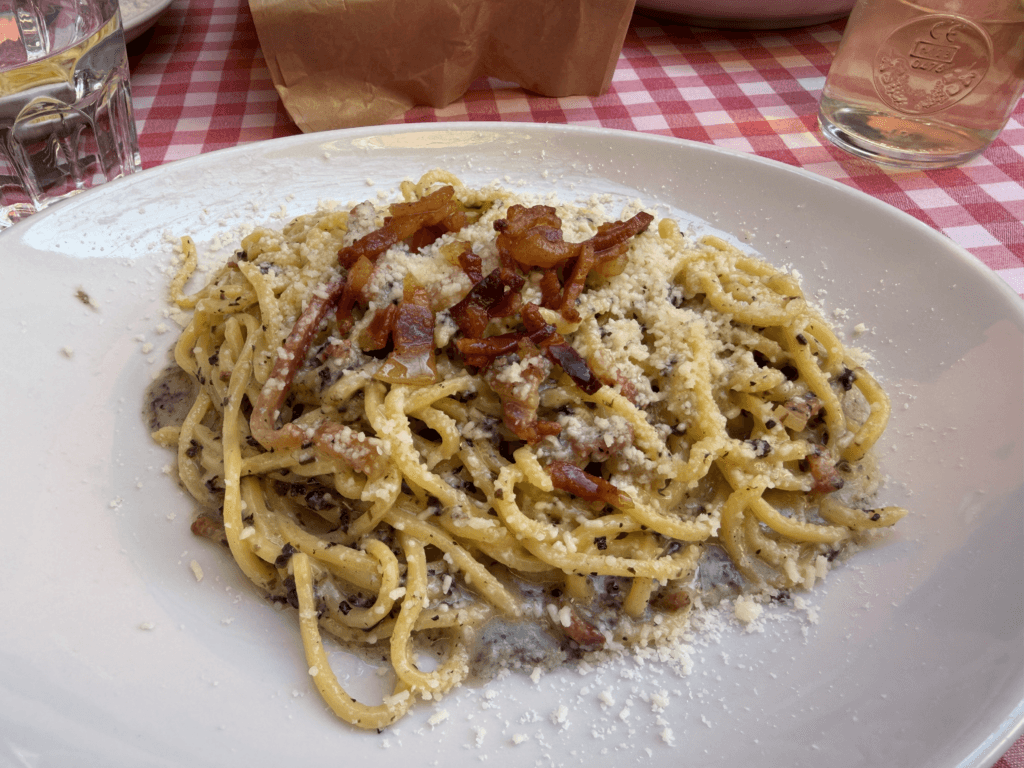
Arianna al Borghetto

La Pietra Scheggiata – Osteria/Pizzeria

Pasticceria Barberini


