
Porta Magica
P.zza Vittòrio Emanuele II, 00185 Roma RM, ItalyPorta Magica: Rome's Enigmatic Alchemical Monument
Walk into Piazza Vittorio Emanuele II on a quiet morning and the Porta Magica hits you immediately. It's a stone gateway about four meters tall, ornately carved with symbols and Latin inscriptions that seem to writhe across its surface. Most visitors miss it entirely, hurrying past toward the market stalls that now dominate the square. But if you stop in front of it, reading the strange concatenation of symbols, astrological signs, and cryptic text, you sense you've stumbled onto something deliberately obscure. This is Rome's most mysterious monument, a physical record of 17th-century alchemical obsession that still defies complete interpretation more than three centuries later.
Why This Place Matters
The Porta Magica stands as one of Europe's most documented connections between high alchemy and urban landscape. It was commissioned by the Marquis Massimiliano Palombara, a nobleman and alchemist who believed the gateway would unlock the secret to transmuting base metal into gold. The inscriptions and symbols covering its surface represent a deliberate coded message, a kind of stone-carved puzzle that alchemists studied for centuries afterward. Unlike most alchemy relics, which survive only as manuscripts and marginalia in old books, this is a monumental public statement carved in travertine and left for anyone curious enough to look closely.
For art historians and esotericists, Porta Magica remains a primary source document of Renaissance and Baroque occult thought. The symbols reference Hermetic philosophy, classical astrology, and the spiritual alchemy that blended mysticism with proto-chemistry. Scholars still debate the precise meaning of certain inscriptions and whether Palombara believed he had actually succeeded in his alchemical work.
Quick Facts
- Built in 1680 by Marquis Massimiliano Palombara
- Located in Piazza Vittorio Emanuele II, Esquiline Hill neighborhood
- Approximately 4 meters tall, carved from travertine
- Originally stood at the entrance to Palombara's palazzo, relocated to the piazza in the 1800s
- Free to visit and view at any time
- No formal opening hours; the piazza is accessible day and night
Getting There
Piazza Vittorio Emanuele II sits on the Esquiline Hill, one of Rome's seven hills, in the Rione Monti district. The nearest Metro station is Vittorio Emanuele, on Line A, which deposits you directly at the square's edge. If you're coming from the Colosseum or Roman Forum, it's about a 10-minute walk north through residential streets. From Termini Station, the walk is roughly 15 minutes heading southeast.
The piazza itself is a sprawling rectangular space that functions as a neighborhood market most mornings. The Porta Magica sits at the center-eastern side of the square, near the fountain, making it easy to spot once you know where to look. Street parking around the piazza is limited and competitive, so arriving by Metro or taxi is more practical.
The Layout and Experience
The Porta Magica is not a passageway you walk through. It's a monumental archway that once led into the garden of Palombara's palazzo, but the building was demolished long ago. Today the gateway stands isolated in the piazza, surrounded by market vendors and modern Rome, a fragment of 17th-century esoteric ambition marooned in everyday contemporary life. This collision between the mundane and the mysterious is part of what makes it compelling.
The arch itself consists of a rectangular opening topped by a smaller lunette. Every available surface is covered in carved symbols. The left and right pillars bear dense inscriptions running vertically. The archway's interior contains more text and geometric designs. Above the main opening, additional symbols and a cartouche with Latin phrases occupy the lunette. The level of detail is extraordinary; you could spend 20 minutes examining the carvings and still find new details.
Most of the inscriptions are in Latin, though some Greek letters appear alongside numerical and astrological symbols. The text includes fragments of alchemical theory, references to classical philosophers, and what scholars believe are coded instructions for alchemical procedures. Certain phrases appear multiple times, suggesting they held particular significance for Palombara.
Main Highlights
The primary highlight is the inscriptions themselves. The phrase "Benedictus qui venit in nomine Domini" (Blessed is he who comes in the name of the Lord) appears prominently, blending Christian theology with occult symbolism in ways typical of late Renaissance thought. Other inscriptions reference the four elements, the planets, and various classical authorities on natural philosophy.
The astrological symbols are particularly dense. Saturn, Jupiter, Mars, Venus, Mercury, the Sun, and the Moon all appear in various arrangements, often paired with numbers or geometric designs. These likely correspond to alchemical processes or stages of the Great Work, the ultimate goal of transmuting lead into gold.
The geometric patterns carved between the text blocks include pentagrams, hexagrams, and other esoteric shapes. Whether these are purely decorative or encode additional meaning remains debated among scholars. The overall effect is visually striking, layered with meaning in ways that resist easy interpretation.
History and Background
Massimiliano Palombara was a minor Roman nobleman and a serious student of alchemy during the reign of Pope Innocent XI. He commissioned the Porta Magica around 1680, positioning it as the entrance to his palazzo's garden. The gateway was meant to embody his alchemical philosophy and, in some accounts, to commemorate a supposed alchemical success he believed he had achieved.
The legend surrounding Palombara claims that a mysterious alchemist visited his palazzo and demonstrated the transmutation of mercury into gold, leaving behind detailed instructions carved into this very gateway. Whether this event actually occurred or was a romanticized story Palombara encouraged, it became the defining narrative of the monument. What's clear is that Palombara invested significant resources in creating a public statement of his alchemical interests and knowledge.
After Palombara's death, the palazzo fell into disrepair. In the 1800s, during urban renovations of the Esquiline district, the Porta Magica was relocated from its original position to Piazza Vittorio Emanuele II, where it has stood ever since. The piazza itself was designed as a modern square during this same period, making the ancient gateway an unexpected survivor in a reimagined neighborhood.
For centuries after its creation, the Porta Magica attracted scholars, occultists, and curious visitors attempting to decode its inscriptions. In the 19th and early 20th centuries, the monument became a focal point for esoteric societies and individuals interested in Hermetic philosophy and alchemy. This reputation persists today, though most modern visitors approach it as an art historical curiosity rather than an active alchemical text.
Photography Tips
Morning light tends to illuminate the carved details most clearly, especially if you position yourself to the east of the monument so the sun rakes across the stone surface. The shadows cast by the relief carving become more pronounced in strong sunlight, revealing details that are harder to see in flat midday light.
The piazza fills with market activity and foot traffic as the morning progresses. If you want clean shots without crowds, arrive by 8 AM on weekdays. Weekends draw more people, especially tourists. The surrounding market stalls, vendors, and modern Roman street furniture will inevitably appear in wide shots, which either adds authentic context or detracts from the monument depending on your aesthetic preference.
Close-up photography of the inscriptions and symbols requires getting very near the stone. A macro lens or phone close-up mode will capture the intricacy of the carving. Individual inscriptions and symbol groups can be photographed in isolation to document specific sections. This is useful if you're trying to research or record particular phrases.
Tickets and Entry
There is no admission fee. The Porta Magica is a public monument in an open piazza, accessible 24 hours a day. You do not need a ticket or reservation to view it. The piazza itself is free to walk through, though it functions as a neighborhood market with vendor stalls that come and go throughout the day.
Best Time to Visit
Visit early morning on a weekday if you want relative quiet and clear light on the carvings. The piazza becomes notably busier by midday and on weekends. There are no seasonal closures, though the piazza is less pleasant during heavy rain or extreme heat in summer.
If you're interested in the esoteric and historical dimensions of the monument, consider visiting in the late afternoon around 4 or 5 PM, when the market activity winds down and the light softens. The atmosphere becomes more contemplative at this hour, less like a bustling public square and more like a place where you can actually study the stonework without distraction.
Facilities and Preparation
Piazza Vittorio Emanuele II has no dedicated visitor facilities. There are no bathrooms, water fountains, or information plaques directly at the monument. The surrounding neighborhood has cafes, bars, and restaurants, but nothing immediately adjacent to the Porta Magica itself.
If you're planning to spend significant time studying the inscriptions and symbols, bring comfortable walking shoes and consider sitting on one of the piazza's benches while you examine the stone. Bring a camera or phone for documentation. A notebook is useful if you want to sketch or record specific inscriptions. No special preparation is required beyond basic comfort items for being outdoors.
Combining with Nearby Attractions
The Esquiline Hill neighborhood has several significant attractions within walking distance. The Basilica di Santa Maria Maggiore is about 10 minutes south, one of Rome's four papal basilicas and a masterwork of Renaissance and Baroque architecture. The church contains works by major artists and maintains a treasury with reliquaries and precious objects.
The Baths of Diocletian, among the largest public baths built in ancient Rome, lie about 15 minutes southeast near Termini Station. Portions of the original structure are preserved and incorporated into the church of Santa Maria degli Angeli. The archaeological remains give a visceral sense of Roman engineering and daily life under the Caesars.
The area around Piazza Vittorio Emanuele II itself is worth exploring. The neighborhood has a distinctly local character, with family-run restaurants, vintage shops, and residential buildings that feel less manicured than Rome's more tourist-saturated zones. Several small churches and palazzo courtyards dot the surrounding streets.
Sample Visit Plan
Arrive at Piazza Vittorio Emanuele II by 8 AM. Spend 30 to 45 minutes at the Porta Magica, examining the inscriptions and photographing details that interest you. If you have a reference book on alchemy or Renaissance symbolism, this time will be more productive.
Walk south to the Basilica di Santa Maria Maggiore (about 10 minutes). Spend an hour inside viewing the mosaics, marble floors, and Renaissance chapels. The church is less crowded in the early morning.
Grab coffee or a light breakfast at one of the neighborhood cafes near the basilica or back toward the piazza.
If you have more time, walk to the Baths of Diocletian and the adjacent church of Santa Maria degli Angeli. This adds another 45 minutes to an hour to your visit.
Practical Tips
- The piazza has limited seating. If you want to sit while studying the monument, arrive early when benches are available.
- Bring water. The neighborhood has few water fountains and the piazza has none.
- The monument is outdoors and exposed. In summer heat, visit in early morning or late afternoon.
- Pickpockets work the piazza, especially near the market. Keep valuables secured and bags closed.
- If you're interested in the alchemical symbolism, consider downloading or printing a reference guide beforehand. There are no interpretive plaques at the site.
- The piazza's market vendors are generally friendly and accustomed to tourists. They won't hassle you for viewing the monument.
- Bring comfortable shoes. The piazza's surface is uneven in places, and the surrounding neighborhood requires walking.
FAQ
Can you actually walk through the Porta Magica? Technically yes, there's nothing stopping you from stepping through the archway, but it's not a functioning passage to anywhere. It stands isolated in the piazza as a standalone monument. Walking through it won't confer any magical properties or alchemical wisdom, despite what some esoteric guides claim.
What do the inscriptions actually say? They're primarily in Latin and reference alchemical philosophy, classical authorities, and Christian theology. Full scholarly translations exist in academic papers on Renaissance alchemy, but no single definitive interpretation of the entire monument has universal acceptance. Different scholars emphasize different inscriptions and symbols as primary.
Is the Porta Magica a real alchemical gateway or just a decorative monument? It's both and neither, depending on your definition. Palombara certainly intended it as an expression of his alchemical beliefs and knowledge. Whether it was meant as a functional magical object, a philosophical statement, or simply a showcase of learning is debated. As a physical artifact, it's real and impressive. As an active magical or transmutational device, that remains a matter of personal belief.
How much time should I spend here? 20 to 30 minutes is sufficient for most visitors. If you're genuinely interested in decoding the inscriptions and symbols, bring an hour and a reference text. You could also return multiple times and spend 10 to 15 minutes on each visit, focusing on different sections of the monument.
Is there a guide or information at the site? No. There are no official plaques, QR codes, or guided tours specific to the Porta Magica. The monument stands without interpretation. This adds to its mysterious appeal but means you'll need to research independently if you want detailed context.
Opening hours
Reviews
Sign in and mark this place visited to leave a review.
No reviews yet.
Free Trip Planner
Plan your Rome trip with our free planner
Build a day-by-day itinerary with AI suggestions, hand-picked places, and friends. Free forever — no credit card.
Things to see near Porta Magica



Places to eat or drink near Porta Magica
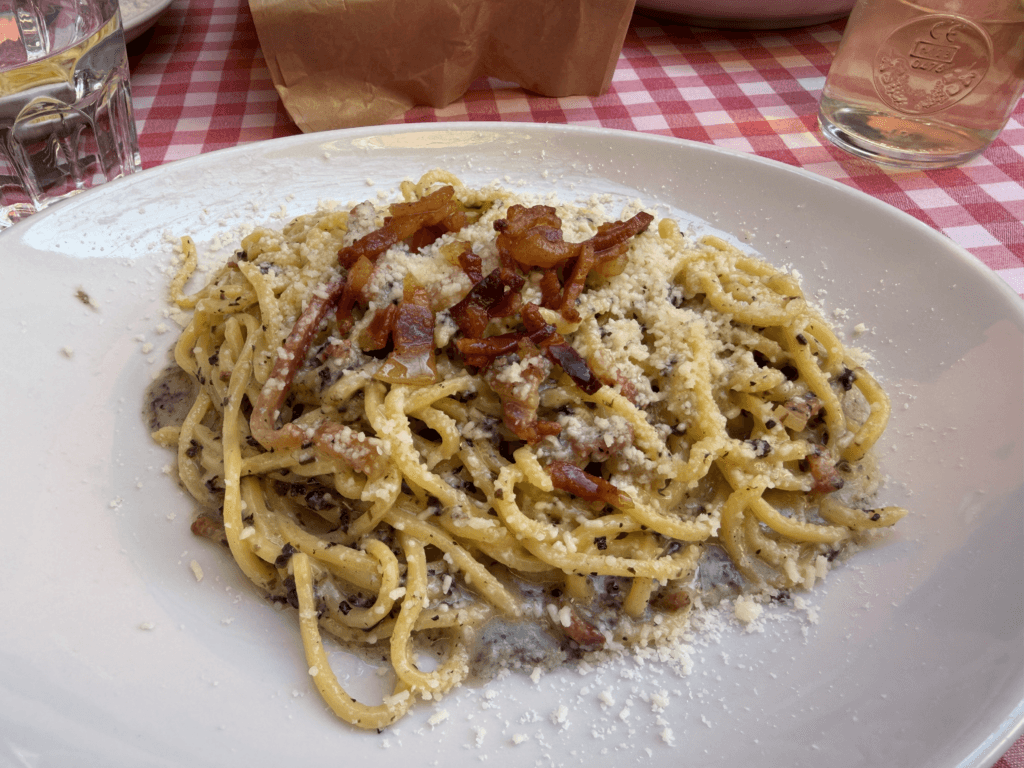
Arianna al Borghetto

La Pietra Scheggiata – Osteria/Pizzeria

Pasticceria Barberini


