
Jensen Huang's Taipei Night Market Food Map (2026)
By
Explore on the map
48 places from the destinations in this story. Tap a pin to open the listing.
There is a particular kind of fame that only Taiwan can confer, and Jensen Huang has it. The Nvidia chief executive cannot walk through a Taipei night market without the photographs being online before he has finished eating. In May 2026 he wandered into Raohe Street with his wife and daughter, took a bite from a stranger's corn on the cob, and turned a charcoal grill into a pilgrimage site within about forty-eight hours.
Since then, a small industry of "Jensen Huang food maps" has appeared. Most of them share a problem: they list thirty stalls and imply he ate at all of them. He did not. This guide separates the two things — the places where his visits are actually documented, and the places worth your evening regardless.
What he actually ate, and where
Three locations have real reporting behind them.
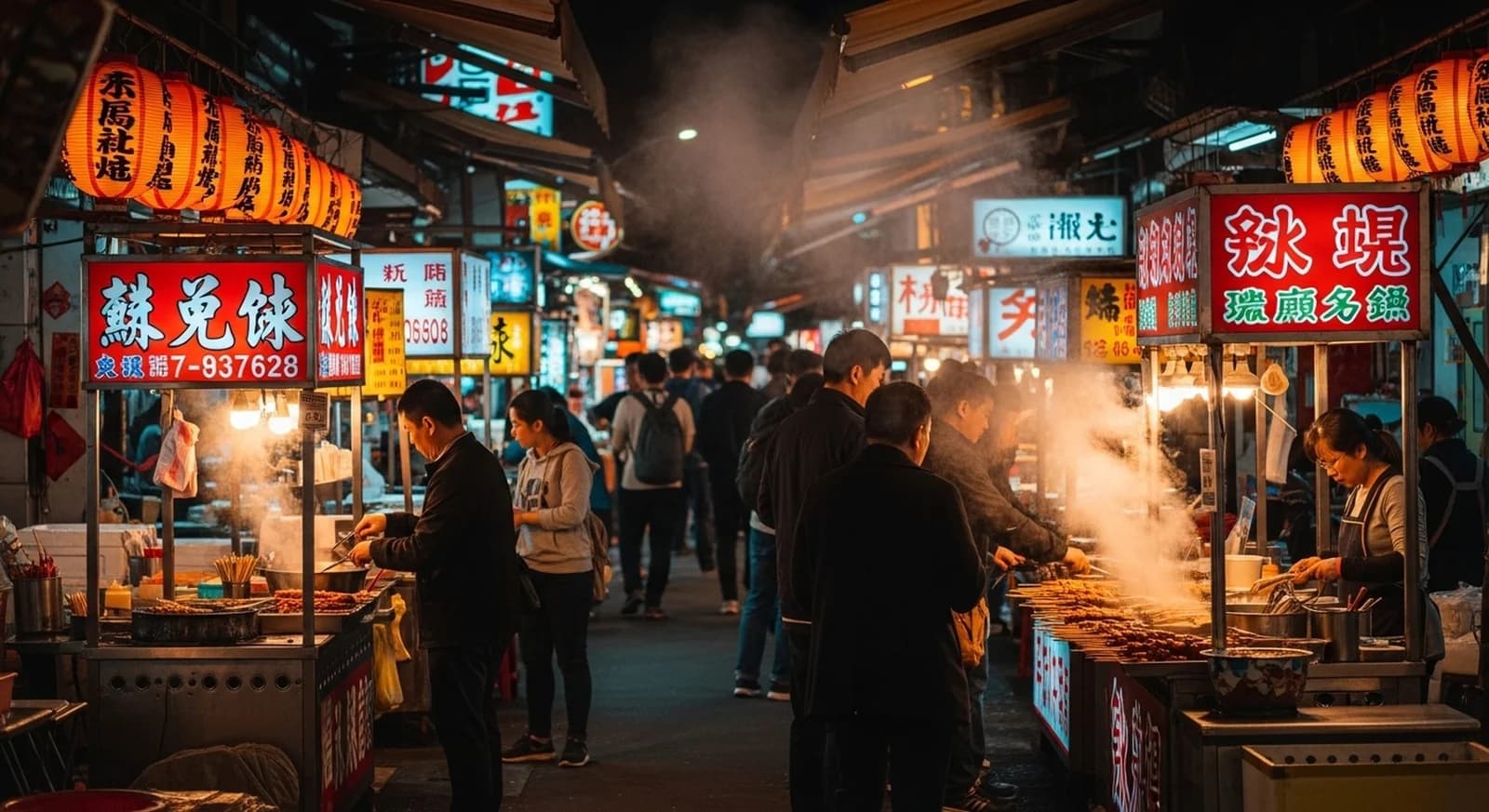
Raohe Street Night Market, 24 May 2026. An unannounced stop after dinner with TSMC founder Morris Chang, with his wife Lori and daughter Madison. The family worked through pepper buns, grilled sausage, grilled squid and shaved ice. The corn moment — leaning in to bite a cob a fan was already holding — is the image that travelled. By most accounts he then handed the vendor NT$1,000 so the queue behind him ate for free, and the vendor matched it for another fifteen groups. He also left a "Jensen was here" note on a bathroom wall, which tells you something about the mood of the evening.
Ningxia Night Market, October 2023 and January 2024. Analysis of Taiwanese social media puts Ningxia at the top of his most-discussed food stops, on the strength of two publicised visits. He was also spotted at Raohe buying fried dough twists back in May 2023, before any of this became a genre.
Linjiang Street Night Market. The quietest of the three and, by the sound of it, the most habitual. He buys fruit here — green mangoes, watermelon — from a vendor he has used for years and reportedly speaks to in Taiwanese rather than Mandarin.
Everything below is on this map because it is good, not because there is a photograph of him holding it.
Raohe Street Night Market, Songshan
Raohe is a single straight run of about six hundred metres, bookended by the Ciyou Temple at the western entrance. That shape makes it the easiest Taipei market to do properly: start at one end, walk to the other, eat as you go, and you will not miss anything.
The queue you see from the temple gate is Fuzhou Shizu Pepper Bun. Peppery minced pork and a great deal of spring onion are sealed in dough, slapped against the inside wall of a clay barrel oven and baked until the base crisps. Wait for it to cool more than feels necessary — the first bite releases scalding juice, every time, to everyone.
Further along, Liu's Grilled Corn is the stall from the famous photograph. Corn is basted in a soy-based glaze and turned over charcoal until the kernels blister, in original, spicy and black-pepper versions. It is slow — genuinely slow, cooked to order — so order it early in your walk and collect it on the way back if the queue allows.
For something not cooked over fire, Sin Sin Hong Kong Rice Rolls steams Cantonese cheung fun to order: rice batter steamed into soft sheets, rolled, cut and dressed with sweet soy. It is the lightest thing on the street and a useful reset partway down.
The rest of Raohe's reputation rests on stalls without fixed addresses, which move and change hands: black pork sausage grilled over coals, boneless chicken thigh steak fried to order, fried dough twists sold by weight, cut fruit, and an elderly vendor selling preserved plums and dried Alishan sweet plums. None of these are on the map below, because pinning them would mean dropping six markers on the same point. Look for them on the walk instead.
Ningxia Night Market, Datong
Ningxia is smaller than Raohe and more concentrated. There is no clothing, no phone cases, no carnival games — it is a short lane of food and almost nothing else, which is precisely why Taipei residents name it first. By eight in the evening, moving through it is a shuffle.
Yuanhuan Oyster Omelette sits beside the site of the old Jianguo traffic circle and cooks the dish that defines Taiwanese night markets: eggs, small oysters and leafy greens bound with sweet potato starch into something closer to a savoury pancake than an omelette, finished with a sweet-salty red sauce. Pork rib soup, oyster soup and clam soup round it out.
Finish at Douhua Zhuang at the top of the road — silky tofu pudding served warm in winter and iced in summer, with grass jelly, red bean soup and peanut soup alongside. Toppings are chosen separately, so point.
For fruit, Zhan Ji cuts plates to order — wax apples, mangosteen, guava, whatever is in season. Ask about the ginger-and-tomato plate: sliced tomato with a ginger-soy-liquorice dip, a Taiwanese pairing that sounds wrong and converts people. Elsewhere in the lane, look for peanut ice cream rolled in a crepe with coriander, and crispy stuffed squid.
Linjiang Street, Da'an
Most Taipei residents call it Tonghua. It runs through a residential stretch of Da'an and has kept an ordinary, unpolished quality that Raohe traded away years ago — this is a market people shop at rather than visit.
At the mouth of the street, Zailai Vegetable Egg Pancake makes danbing well into the night: thin egg pancake rolled around scallions and vegetables, folded, cut and bagged in under two minutes. It is Taiwan's default breakfast, eaten here at the wrong end of the day.
Beyond it: pickled green mango and guava from the fruit stands, tanghulu near the entrance, cold rice-dumpling dessert, sugarcane juice pressed in front of you, and indigenous-style wild boar sausage.
Beyond the night markets
Taipei's street food does not stop when the markets close, and several of these are better than anything you will queue for at eleven at night.
In Zhongshan, Fu Ba Wang braises pork knuckle down an unremarkable lane off Nanjing East Road until the skin goes glossy and the meat gives way without a knife; lunch sells out routinely. Two minutes away on the Siping pedestrian street, Siping Sunshine Douhua does tofu pudding and shaved ice with taro balls and barley for the office crowd, and Yu Zhan sells dried mango, preserved plums and candied ginger loose by weight. Taste before you buy — Taiwanese preserved plums run far saltier and sourer than most visitors expect.
In Songshan, Wang Ji Fu Cheng makes southern-style zongzi — boiled rather than steamed, so the rice stays soft and takes on the stock — served with a sweet peanut sauce. Li Yuan is the answer when someone wants soup dumplings and you would rather not spend an hour in a queue across town: plainer room, less photogenic pleating, skins that hold their soup.
Out in Neihu, past the tech campuses where a good deal of Taiwan's hardware industry actually works, Niu Er builds a clear, long-simmered beef broth rather than the darker braised style. And over the river in Sanchong, Wu Deng Jiang has built a following on braised pork rice and a pork knuckle people cross the bridge for.
For dessert in the Da'an shopping lanes, Dong Qu Fen Yuan has been selling hand-made tapioca pearls since long before bubble tea went global — chewier and far less sweet than the chain version.
The wider list that travels with his name
Alongside the news coverage, a fan-made MRT-style graphic has circulated widely since 2025 under the heading "Taipei food even Jensen Huang loves" — a long list of restaurants arranged by metro station. It is a good list of Taipei restaurants. It is not evidence that he has eaten at any of them, and it does not claim a source. Treat it as what it is: a local food recommendation with a famous name attached.
Worth knowing about, in that spirit. Chi Chia Chuang in Zhongshan serves chicken three ways on one platter — poached, smoked and drunken — with home-style dishes that have largely vanished from newer kitchens; it is the right answer when a night market is the wrong one. Ji Yuan in Da'an is a Sichuan restaurant whose signature is not a spicy dish but a chicken soup simmered until it turns opaque, usually ordered when you book rather than at the table.
Liaoning Street Night Market is the small Zhongshan market to visit when Raohe and Shilin feel like theme parks — ten minutes end to end and almost no English spoken. San Liu Shi Fu, down a lane off Shida Road, cooks the Fuzhou repertoire that shaped much of Taiwanese food long before anyone called it Taiwanese. Tainan Seafood in Shilin works in the southern register — lighter, sweeter, seafood left to taste of itself — and Hua Niang Xiao Guan is a small kitchen near the Taipei Arena worth knowing if you are in Songshan for an event.
Doing it in one evening
You cannot cover all three markets in a night and enjoy any of them. Pick one.
- If you want the Jensen Huang route: Raohe, starting at the Ciyou Temple end around 18:30, before the queues build. Pepper bun, corn, rice rolls, sausage, shaved ice to finish.
- If you want the best food: Ningxia, early, and eat in small portions across six or seven stalls rather than filling up on two.
- If you want to see how Taipei actually eats: Linjiang, any weeknight, with no plan at all.
Practical notes
Every market here is a short walk from the MRT, which is the only sensible way to move between them: Raohe from Songshan station, Ningxia from Zhongshan or Shuanglian, Linjiang from Xinyi Anhe, and Liaoning from Nanjing Fuxing. An EasyCard covers the metro and most convenience stores.
Bring cash in small notes — many stalls still take nothing else, and a NT$1,000 note at a NT$50 stall will not make you popular. Most markets run roughly 17:00 to midnight, with individual stalls keeping their own hours and closing one unpredictable day a week. Portions are small by design: the point is to eat six things, not one. And treat every stall list, including this one, as a starting point rather than a guarantee — vendors retire, move three doors down, and hand businesses to their children.