
Colorado Hot Springs: All 37, Mapped by Region
By
Explore on the map
37 places from the destinations in this story. Tap a pin to open the listing.
Colorado has more soakable hot springs than any other state in the Rockies, and they are spread across 300 miles of mountain country. Some are polished resorts with twenty terraced pools; some are rocks in a river that somebody piled up last week. The useful question is never which is "best" — it is which ones are near each other, and which ones suit the trip you are actually taking.
So this guide is mapped and organised by valley. Below are 37 Colorado hot springs, from the big Glenwood pools to a wilderness soak at 11,200 feet that takes an 8.5-mile hike to reach.
How to use this map
The state's springs fall into three rough groups, and mixing them up is the most common way to be disappointed:
Resorts — lodging, changing rooms, restaurants, tickets. You book these.
Municipal pools — fed by mineral water but run as town swimming pools. Cheap, practical, unglamorous.
Wild springs — free, unsupervised, variable, and sometimes washed out entirely by spring runoff.
Colorado's tourism board links many of the developed ones as the Historic Hot Springs Loop, an 800-mile driving route through Glenwood Springs, Steamboat, Chaffee County, Ouray and Pagosa Springs. It is a good spine for a first trip, but it leaves out most of the wild springs and the whole San Luis Valley cluster, which are on the map here too.
Glenwood Springs and the Crystal River valley

The busiest hot springs town in the state, and the easiest to reach — straight off I-70.
Glenwood Hot Springs Pool is the one everyone has seen a photograph of: a mineral pool over two blocks long, in operation since 1888, with a waterslide complex attached. It is a swimming pool rather than a soak, and it is reliably full of families.
Iron Mountain Hot Springs, just upstream, is the opposite: sixteen small terraced pools stepped down to the Colorado River, each held at a different temperature, with a separate family pool. If you want to actually soak in Glenwood, go here.
Yampah Spa and Vapor Caves is the strangest and oldest option — underground chambers where 125°F mineral water fills the rock with natural steam, used by the Ute long before the town existed. You sit in the dark and sweat. Most people manage fifteen minutes.
South up the Crystal River, Avalanche Ranch has three stone pools stepped down a hillside facing Mount Sopris, and Penny Hot Springs is free, roadside and entirely undeveloped — soakers wall off the river with rocks to mix hot spring water with cold snowmelt. West of town, South Canyon is a rougher, locals' version of the same idea.
Steamboat Springs

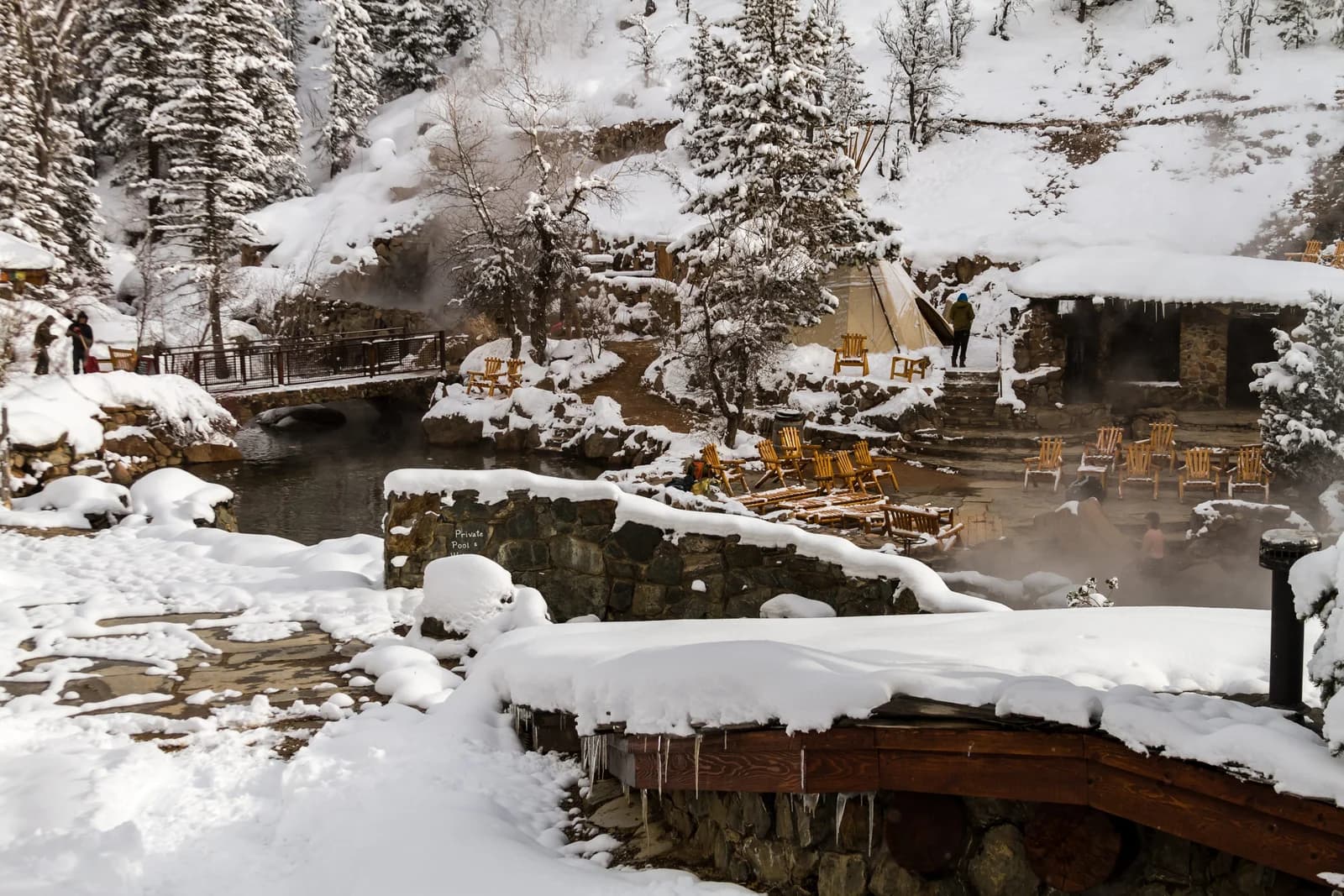
Strawberry Park Natural Hot Springs is the one worth planning around: stone-walled pools in a creek canyon seven miles up a dirt road from town, clothing-optional after dark, with cabins if you want to stay. Winter access usually requires four-wheel drive or a shuttle, and that difficulty is most of why it stays good.
In town, Old Town Hot Springs is a community facility with eight pools, a lap pool, waterslides and a gym — the practical after-ski option rather than a wellness experience.
Chaffee County: Buena Vista, Nathrop and Salida
The densest cluster in the state, under the Collegiate Peaks.
Mount Princeton is the headline: a full resort beneath a fourteener, where the real attraction is Chalk Creek. Hot water seeps up through the streambed and soakers build their own rock pools, mixing it with the creek to taste. Creek access depends on water levels and is best from late summer.
Cottonwood Hot Springs runs five untreated stone pools at descending temperatures with no chlorine, quiet and adult-leaning. Next door, Merrifield Homestead gives each cabin its own private tub on the same source — rare in a state where almost every soak is communal. Charlotte Hot Springs adds botanical gardens to the mix.
South in Salida, the Salida Hot Springs Aquatic Center is the largest indoor hot springs pool in Colorado, fed by water piped eight miles from Poncha Springs. It is a municipal pool, priced like one, and genuinely useful in January.
Ouray and Ridgway

Ouray calls itself the Switzerland of America and has four separate soaking options inside a few hundred metres.
Ouray Hot Springs is the town pool — large, sulphur-free, with lap lanes and slides, ringed by peaks on every side. Box Canyon Lodge has four redwood tubs on hillside terraces reached by a wooden stairway, and the best view of the lot. The Wiesbaden has a natural vapour cave underneath the building. Twin Peaks rounds out the set.
Ten minutes north, Orvis Hot Springs is clothing-optional, with several outdoor ponds facing the Sneffels Range — arguably the best mountain view from any soak in Colorado. The nudity is matter-of-fact rather than a scene; if it is not for you, Ouray is twenty minutes away.
Pagosa Springs
The Springs Resort has more than twenty pools terraced down to the San Juan River, drawing on an aquifer so deep nobody has measured the bottom — the basis of the town's claim to the world's deepest geothermal spring.
Across the road, Overlook Hot Springs Spa offers rooftop and private tubs in a historic downtown building, and Healing Waters is the plain, cheaper, long-established option locals tend to name. For something free, Nathan's Hippy Dip sits on the riverbank, and Piedra River Hot Springs is a mile and a half's walk north-west, with a river crossing that is impassable in runoff.
The San Luis Valley
A flat, high, very dark valley with four springs and almost nothing else — which is the attraction.
Joyful Journey has three pools and a sauna on the open valley floor with the Sangre de Cristos filling the eastern horizon; night soaking here is primarily an astronomy experience. Valley View, run by a non-profit land trust, has natural pools up a hillside, is clothing-optional throughout, and caps numbers by reservation — plan well ahead rather than turning up.
Sand Dunes Hot Springs at Hooper pairs naturally with Great Sand Dunes National Park half an hour east: hike the dunes, soak afterwards. Splashland near Alamosa is a seasonal community swimming pool on geothermal water.
The southwest corner

Durango Hot Springs — formerly Trimble — was rebuilt recently and now runs a large complex of pools north of town. Further west, Dunton Hot Springs is an 1880s mining ghost town restored into a small, very expensive resort where springs surface around the property, including inside the old saloon. Near Creede, 4UR Ranch is a historic private guest ranch with its own springs, taken by the week.
Front Range and Grand County
Indian Hot Springs at Idaho Springs is the closest to Denver, about forty minutes up I-70, with geothermal cave baths cut into the rock and a glass-domed pool. It is faded rather than polished, which is much of its character.
Hot Sulphur Springs has more than twenty small pools on a hillside above the Colorado River, and is the nearest full resort to Rocky Mountain National Park. Waunita Hot Springs Ranch near Gunnison operates as a weekly guest ranch rather than a day soak.
Out on the plains, Dakota Hot Springs and Desert Reef near Cañon City are low-key, warm-water and clothing-optional at posted times — the pairing for the Royal Gorge rather than for any mountain town.
The wild ones

Free, unsupervised, and worth being realistic about.
Conundrum Hot Springs is the hardest-won soak in Colorado: pools at about 11,200 feet in the Maroon Bells–Snowmass Wilderness, 8.5 miles in with 2,500 feet of climb, and an overnight permit that must be secured well in advance. The season is short because the trail holds snow late.
Radium near Kremmling is a short steep walk above the Colorado River, popular with rafters. Penny, South Canyon and Piedra River round out the free list.
Wild springs wash out in spring runoff, hold no facilities, and depend entirely on whoever was there before you. Pack everything out — Conundrum in particular has been badly damaged by overuse.
A week-long route
Days 1–2. Denver to Idaho Springs, then Glenwood Springs via Hot Sulphur. Three very different soaks in Glenwood alone.
Day 3. South through Redstone — stop at Penny — to Chaffee County. Mount Princeton's creek in the afternoon.
Day 4. Over to the San Luis Valley. Great Sand Dunes in the morning, Joyful Journey or Valley View at night for the stars.
Days 5–6. West to Pagosa and Durango, then north over the Million Dollar Highway to Ouray and Ridgway.
Day 7. North to Steamboat for Strawberry Park, and back to Denver.
Practical notes
Altitude. Most of these sit between 6,000 and 9,000 feet, and hot water plus altitude plus alcohol dehydrates people fast. Drink more water than feels necessary and get out sooner than you want to.
Clothing-optional. Orvis, Valley View, Dakota and Desert Reef are wholly or partly clothing-optional, as are Strawberry Park and Penny after dark. It is signposted and entirely matter-of-fact. Photography is not acceptable at any of them.
Season. Winter is the best time to soak and the worst time to drive. Several access roads — Strawberry Park especially — need four-wheel drive or a shuttle once the snow arrives.
Booking. The resorts sell out on winter weekends and holidays, and Valley View and Conundrum operate hard caps. Reserve rather than arrive hopeful.
Etiquette at wild springs. Leave the rock walls as you found them or better, take every piece of rubbish out, keep noise down, and accept that the temperature is whatever the river says it is.